Think small, go far: Save gas with this one fun trick!
As gas prices climb, Kalamazoo residents are exploring e-bikes and other micromobility options to save money, improve transportation efficiency, and rethink how they get around safely.
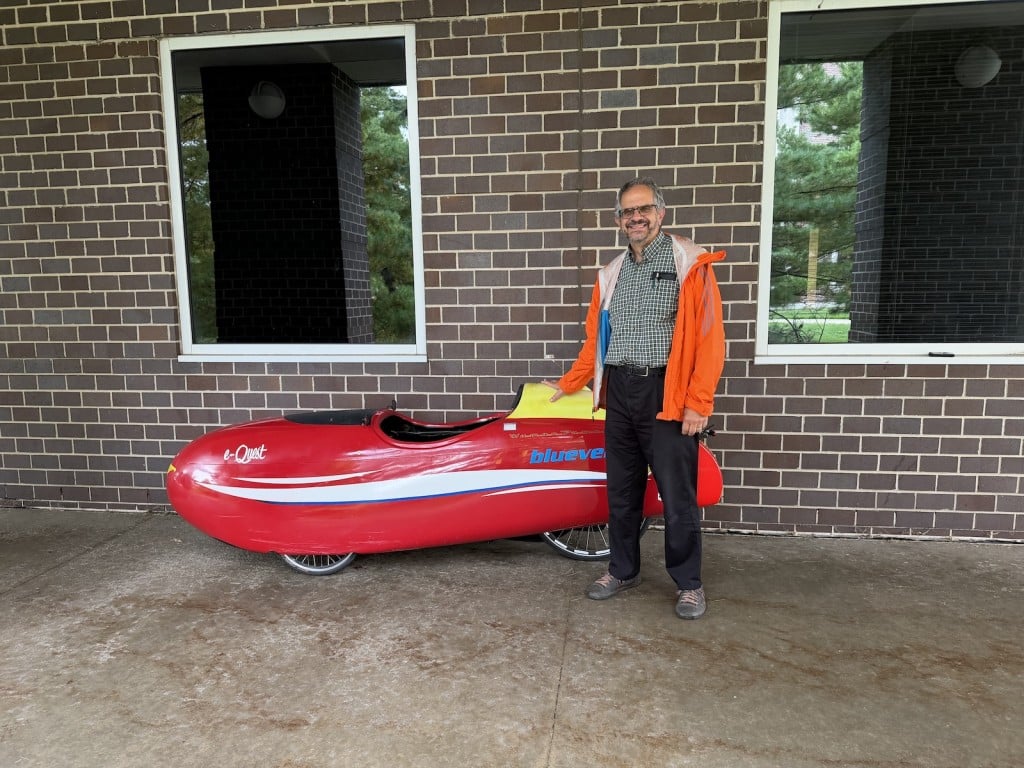
It’s all about efficiency for Dr. Paul Pancella.
A Professor of Physics at Western Michigan University, with his Ph.D. in nuclear physics, Pancella explains that some transportation options are more efficient than others.
If one uses a large motor vehicle for a trip of a few miles, that’s much more wasteful than if one walked, biked, e-biked, scootered or used anything that weighs much less than 5,000 pounds (the base weight of a Ford F-150).
Why?
“Well, because of F=ma. It takes more effort to move more mass,” he says.
It seems like Issac Newton’s second law of motion isn’t something one can get around when getting around. If you want A (acceleration) but you’ve got a lot of M (mass), you’ll need a lot of F (force).
“I mean, it’s thermodynamics too,” he adds. “If you’re going to convert your energy into motion, and you’re going to burn something, you’re going to throw 70% of the energy away as heat, and you can’t get around it. That’s ridiculous.”
When expensive gasoline is what people have to burn, there are probably laws of economics that mean consumers will wonder if there are other transportation options.
Gas prices have gone up, and it doesn’t look like they’re going down any time soon. Oil hit $100 a barrel again as we work on this story. On Oct. 20, the average gas price in Michigan is $4.46 a gallon, up from $2.79 a year ago.
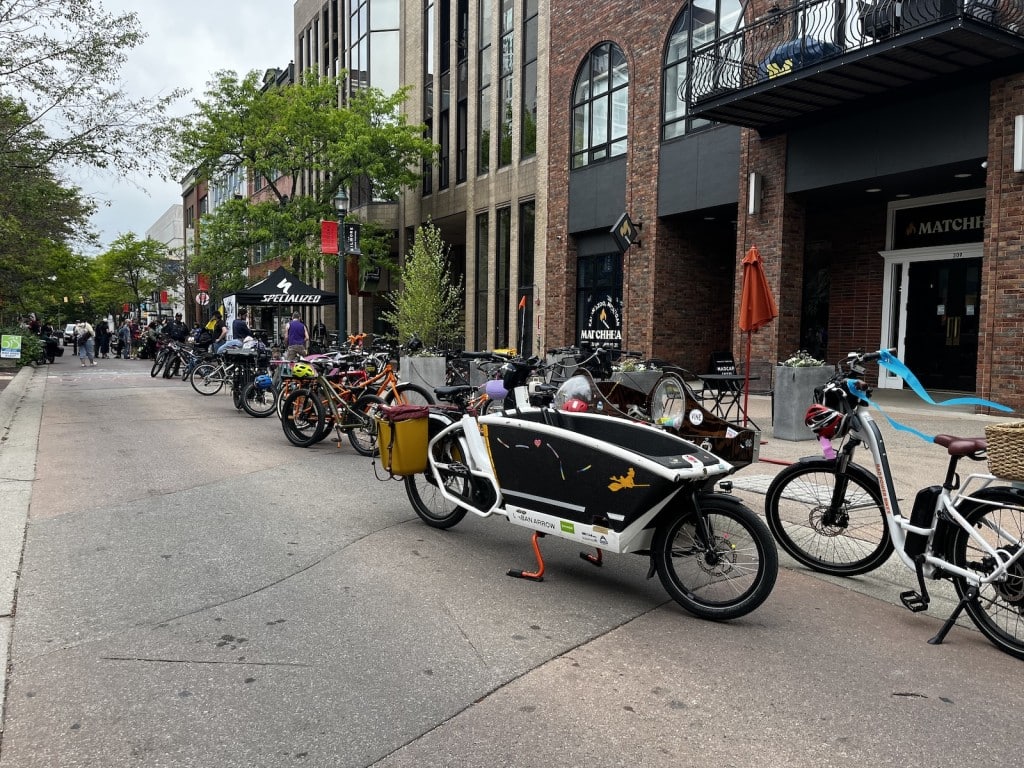
To save money, one can think small, think electric. There’s a fairly new term floating about — micromobility. It’s about traveling those short daily distances without burning gas, while using a smaller vehicle.
Micromobility options include bikes and other unpowered wheels, but a growing segment includes e-bikes, e-scooters, Onewheels and even golf carts — small vehicles with electric motors providing a boost.
“I love micromobility. It means right-sized,” Pancella says. It’s about using a vehicle that’s “not overly crazy for the job at hand. Not ridiculously extravagant.”
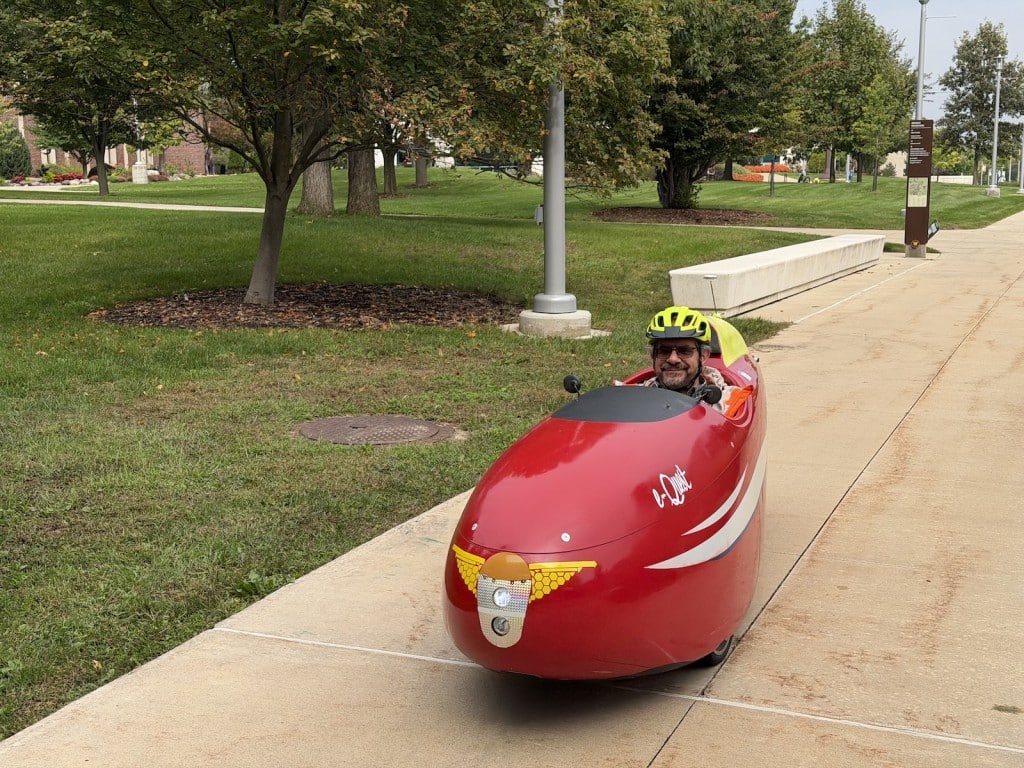
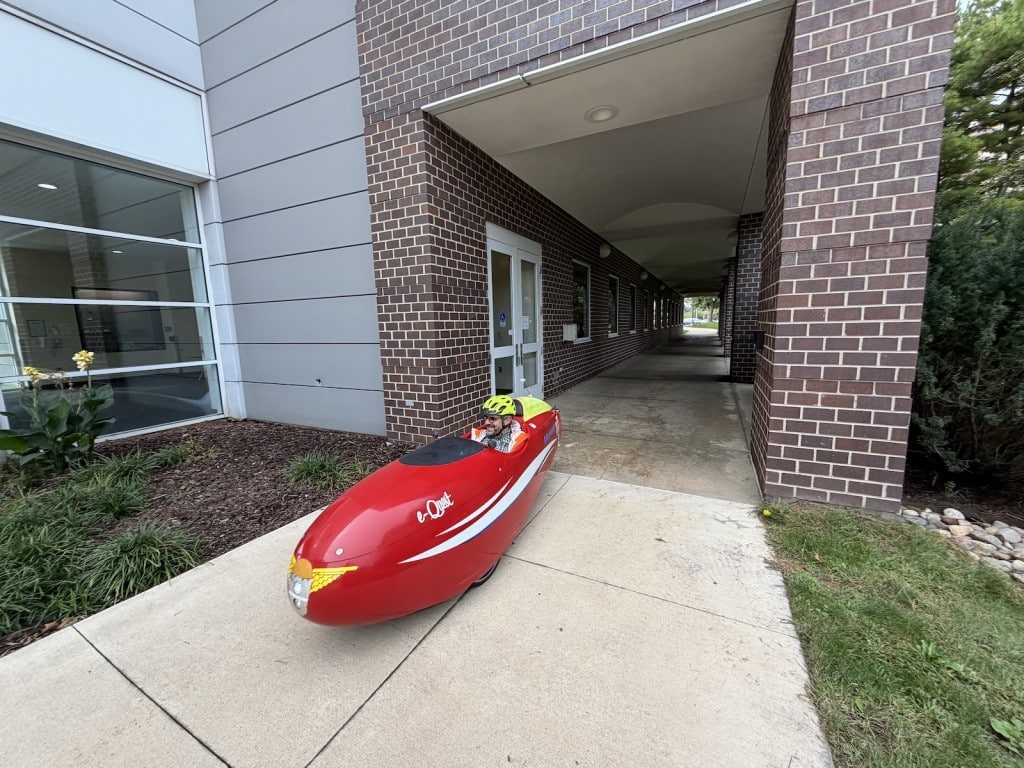
Pancella pieced together his own transportation option, a Velomobile with electric assist. More about that later, but basically it’s an aerodynamic shell around a recumbent trike with an electric wheel.
What kind of extremes should we go to to save a buck on gas? What does the future hold? Could we just use the car for the long drives, and get on a few low-powered wheels to get into town?
Micromobility in Kalamazoo is mainly e-bikes
Pancella has noticed that there’ve been a growing variety of small-wheeled ways students have been getting around campus. But the bike is still common.
Studies have long shown that a human on a bicycle is the most efficient mode of moving when comparing it to the animal kingdom and human-made vehicles. From a fruit fly to a jet airliner, a person on a bike has the lowest energy expenditure for its weight when in motion, according to Scientific American.
So, add a small electric motor to that efficient machine, and pedaling around becomes magic…
“It’s not magic, it’s physics!” Pancella scolds, laughing.
It feels like magic. Hills are suddenly easy to climb. Headwinds are no problem. Speeds of 20 MPH do not cause you to be sweat-soaked, with legs working beyond their limit.
I’m biased. Full disclosure: I sold my car and got an e-bike in early 2023. We’ve been a one-car household since, saving money on insurance, gas, and maintenance. The e-bike is my “car” and is incredibly handy for trips of a few miles to Downtown and back, up to 20 or 30-mile round trips to Portage or elsewhere. Cruising at around 25 MPH is easy. Also, it’s just fun.
The price of mine, including accessories to help carry cargo, was around $3,000. That’s money I would’ve spent over the past three years if I still had the old Subaru.
I got it in my head to get one because, since 2020, I’ve seen more and more e-bikes on pathways and streets in and around Kalamazoo.
I zipped on my e-bike to Pedal Downtown to ask owner Tim Krone what he’s seeing in the world of e-mobility.
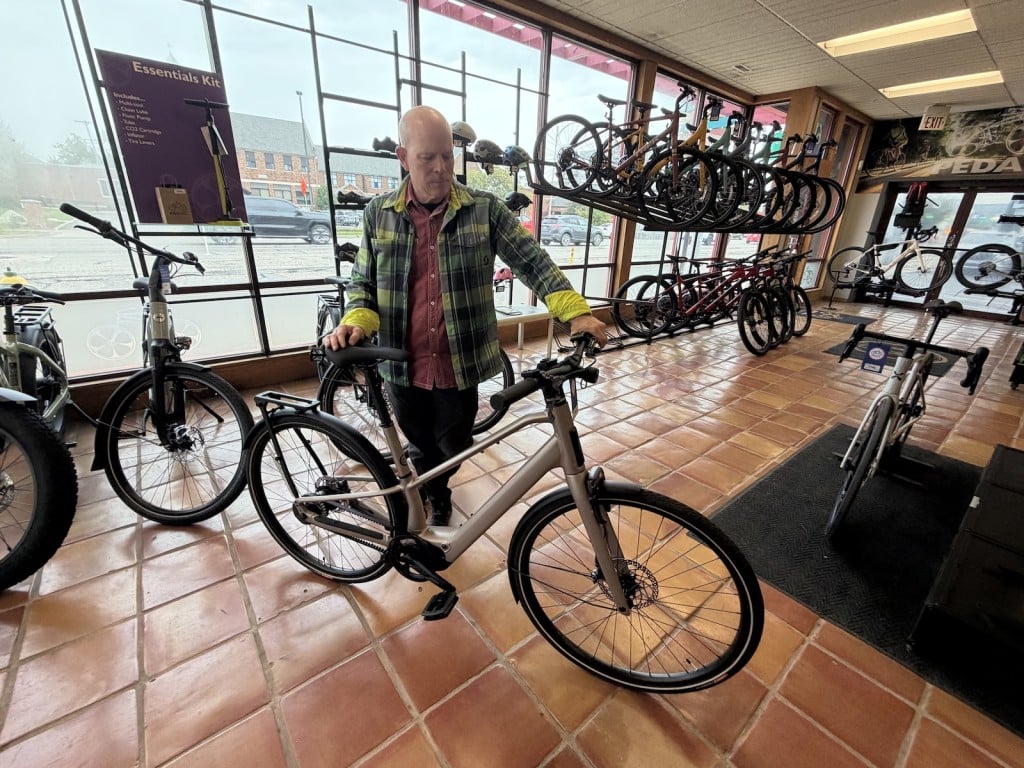
He tempted me with his favorite model, an Orbea city/commuter bike with belt drive, internal hub gears, and a lighter weight than most. “This is what I would want to get around with in the city,” Krone says.
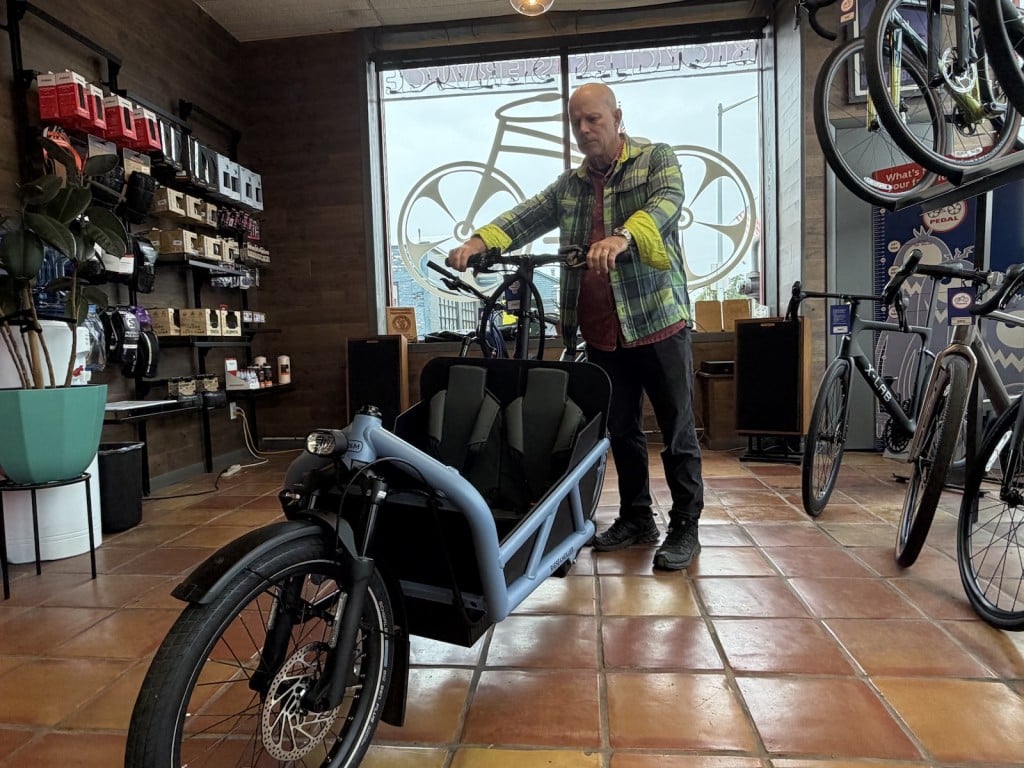
Or how about a Riese & Müller family bike with a front bucket for a couple kids or groceries for the whole family? You may have seen Kalamazoo families out on similar bikes.
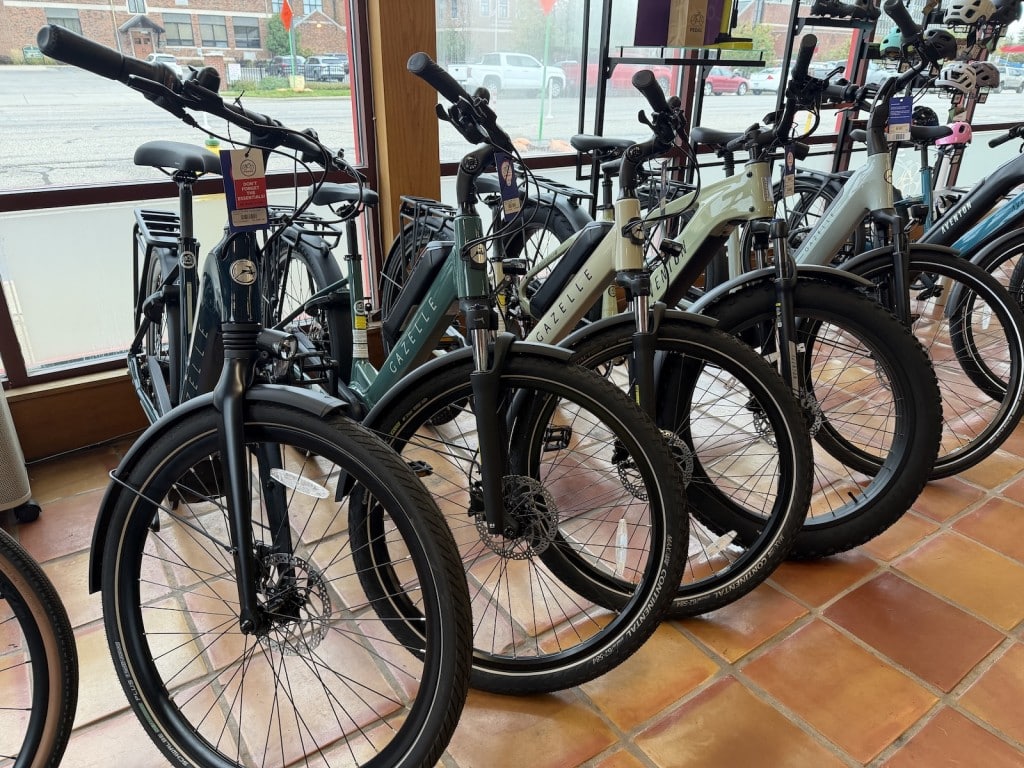
These were in the thousands of dollars — justifiable for some since an e-bike is more of a car replacement, an eventual money saver. Pedal also carries brands like Aventon that are under $2,000.
Krone says there are a variety of riders shopping for e-bikes. “We see a traditional bicycle client who wants an e-bike, either to expand the envelope of how far or fast they can go, for whatever reason that might be,” he says.
“We see a client who sees a way to do more with a bike, as far as commuting and cargo-type stuff, you know — like, lugging your kids around without electric assist is a lot of work.
“And then we have people who, who in no way, shape, or form would call themselves cyclists or identify as a cyclist, but who want to have a good time,” he says. You can ride along with your fitter, faster friends. “An e-bike kind of levels the playing field as far as who you’re riding with.”
E-bikes, e-motos, e-confusion
An attractive feature of e-bikes is that they seem unregulated. As with a traditional bike, one doesn’t need a license or insurance to ride one. They’re legal on the streets, and can — for the most part — be used on bike lanes, pathways, trails, even sidewalks. You can park them anywhere you can chain-up a bike.
For the most part, they seem unregulated — but it’s not a totally lawless world for e-bikes.
Krone outlines the class system of e-bikes:
“Class 1 is pedal assist up to 20 miles an hour.
“Class 2, pedal assist up to 20 MPH with a throttle (that can power the bike) up to 20 MPH.
“Class 3 has pedal assist up to 28 MPH — optionally, it might have a throttle that’ll get you to 20. All throttles cut off at 20, if they live within the classification system.”
E-bikes in the class system must have motors of no more than 750 watts.
Krone adds, “And bikes that don’t meet those criteria are what we would call unclassified. They fall outside the lines.”
Any electric bike that can go above 28 MPH is not an e-bike; it’s an e-moto, or electric motorcycle/moped. This is where things get complicated.
Harley-Davidson, for example, sells legit electric motorcycles that can reach highway speeds, and are designed like, and regulated like, gas-fueled motorcycles.
But there are online companies selling bikes that have pedals, and might be branded as an e-bike, but have a high-powered motor and no speed limiter.
According to the U.S. bike trade association PeopleForBikes, these have been confused with e-bikes. E-motos can go up to 30-65 MPH. Unlicensed riders, sometimes kids and teens, have been involved in collisions that’ve had tragic consequences for themselves and others, the association says.
This has led to controversy and confusion about the safety of actual e-bikes. “Based on the legal definitions of an electric bicycle and a motor-driven cycle, if it’s too fast or too powerful in any mode, then it’s not an electric bicycle, period,” PeopleForBikes states.
Some might think that an e-bike able to reach 20 or 28 MPH is too fast. So, should there be more laws regulating actual e-bikes?
Krone does worry that new e-bike riders, who haven’t been cyclists, haven’t learned the safety skills that regular bike riders have built through experience on trails and roads. “They don’t know the rules of the road. And that confuses the issue quite a bit.”
There are different regulations all over the world. He points out that “Class 2, for instance, does not exist in Europe.” Maximum power there is 250 watts, with a max speed of 25 kilometers an hour (15.5 MPH).
What about age? Should a kid under 16 be allowed to ride a bike that can go 20 or 28 MPH?
“Okay, so what’s that look like? Licensing?” Krone asks. “That’s not just the machine, right? Because there’s regulating the machines, and then there’s regulating the operator.”
Pedal staff members chime in to say they’ve seen a rise in the number of kids in Kalamazoo on e-motos and powered scooters.
Bike mechanic Tommy Nagle points out that fit adult cyclists can pedal up to and over 28 MPH with just their legs.
“That comes back to regulating the person,” Nagle says. “Maybe just the place to ride isn’t the bike path when you’re going 30 miles an hour, regardless of what you’re on. Remember, there could be a dog leash stretched out across the path,” he says with a laugh.
There is some demand for bikes with more power beyond Class 3. It’s a big issue, Nagle says, that “manufacturers purposefully obfuscate what they’re really selling by slapping cranks and pedals and a chain” on a high-powered e-moto. “And saying, ‘this is a bike.'” If they were honest about what they’re selling, the manufacturers would come under scrutiny and regulations from states’ DOTs, he says.
Is Kalamazoo ready for this mode of the multi-modal plan?
Overall, e-bikes, “are the change that’s happening, that’s what’s going on in the cycling world right now,” Krone says.
Nalgle says, “I think for transportation, it’s revolutionary to get people around effectively. I mean, probably the biggest drawback to normal bike commuting is there’s not a shower everywhere you go.”
Also, the local infrastructure has been changing, encouraging bike commuting. The City of Kalamazoo has been building a network of bike lanes as part of traffic calming efforts and the in-progress two-way conversion Downtown.
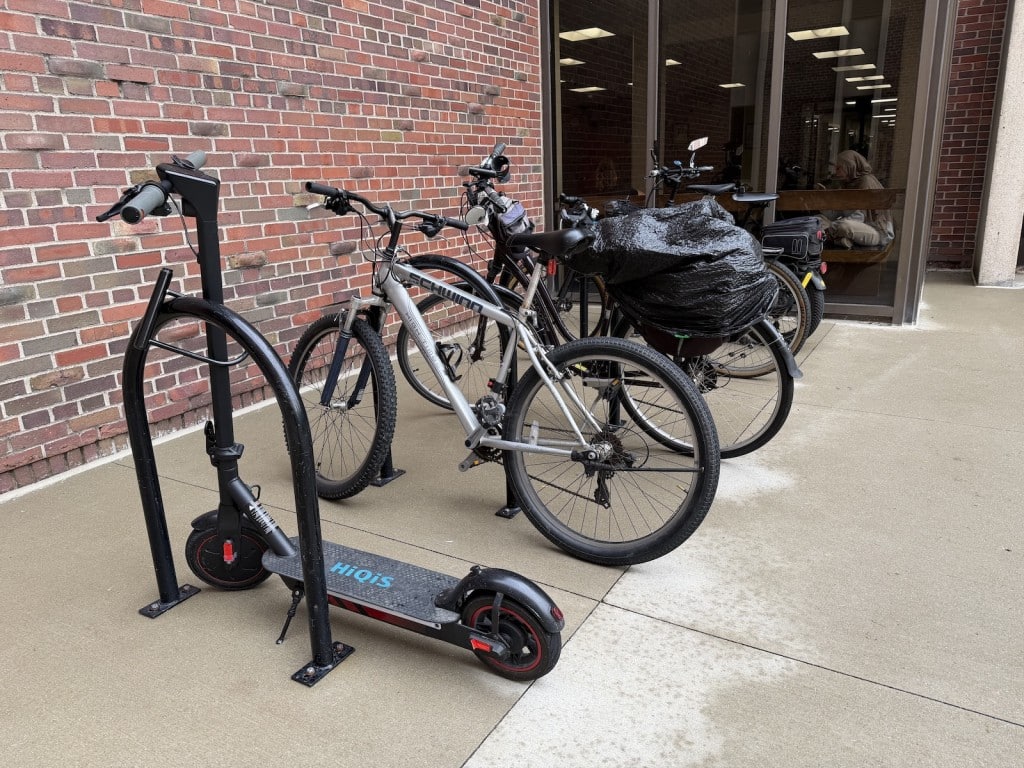
The multi-modal plans of “Streets for All” began to take shape long before e-bikes were common. Those multiple modes are walking, biking, driving, and taking the bus — all need to coexist safely. Where do e-bikes and the rest of micromobility fit?
Bike lanes are appropriate for the usual e-bike and other e-devices, Nolan Bergstrom, City of Kalamazoo Community Planner, says.
There is that “weird space,” however, of overpowered bikes outside of the class system, “a wheelie machine…. that can be very powerful and unwieldy for some,” Bergstrom says.
The State of Michigan has begun looking at legislation regulating e-bike usage, “especially with youth,” he says.
Such as Senate Bill 1156, introduced in Lansing in September. It would ban riders 14 and under from using any e-bike on public roads, sidewalks and trails. Riders between 14 and 17 would need written permission from a parent or legal guardian to use an e-bike.
Michigan law currently bans children under 14 from using class 3 e-bikes, and teen riders over 14 must wear a helmet.
The City follows Lansing’s lead when it comes to traffic regulations, Bergstrom says.
He hasn’t heard any concerns coming from Kalamazoo’s elected officials about e-bikes. In the planning and engineering departments, City staff are “taking time to research best practices, look at other communities and what they might be doing, and learn from what they’re doing, then taking our time to implement changes here,” Bergstrom says.
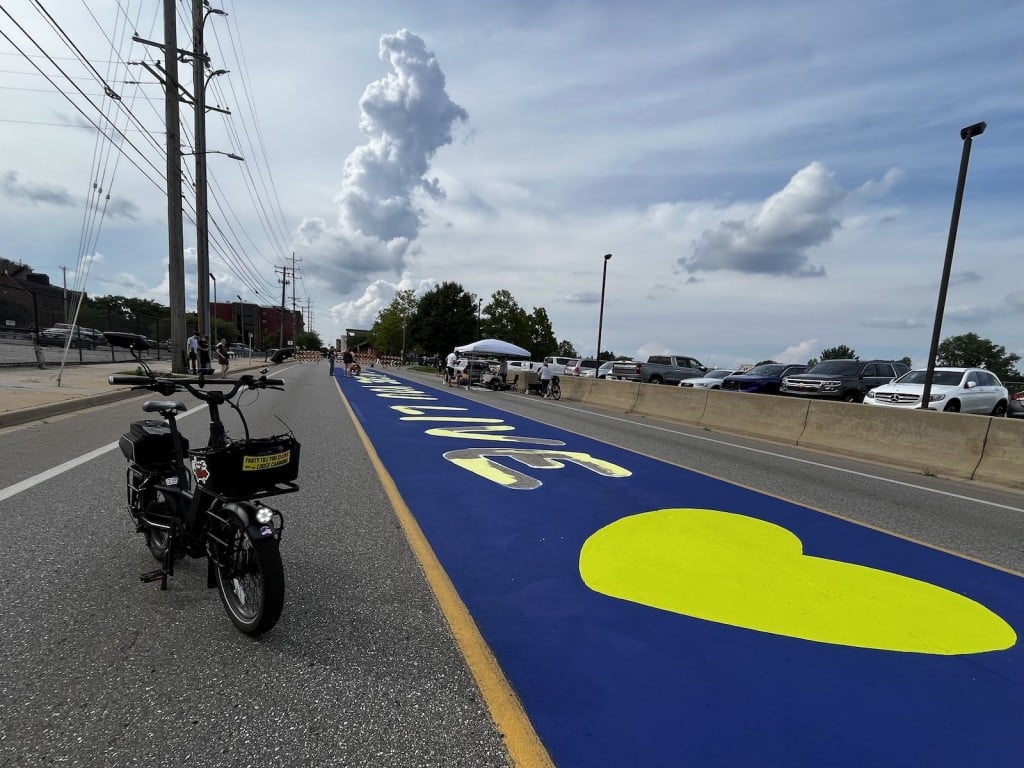
“Obviously (e-bikes) are not as dangerous in terms of the damage they can do, versus a motor vehicle,” he says.
He has noticed a growing amount of e-bikes in Kalamazoo. “It is kind of that great equalizer,” fitting a need for cheap, accessible, and relatively quick transportation over short distances.
The City will need to look at how they interact among pedestrians and traffic, Bergstrom says, “look at it from a safety lens.”
For example, bikes are allowed on most Downtown sidewalks — but should a bike capable of 28 MPH wizz past shop doorways, weave around walkers? Should they regulate the machine, or the user?
The City is planning on Downtown cycle tracks, separated travel lanes for bikes, for the coming years. They won’t get one everywhere — a rider will eventually have to take to the streets, even the sidewalks.
Most sidewalk riding for that last segment of a journey was assumed okay by the City when it comes to regular bikes. But have they considered e-bikes?
The non-motorized section in the City’s planning books “is dated,” and will need updating to “help speak to some of these emerging issues,” Bergstrom says. “Some of the regulation has to catch up — it’s like with any new-fangled thing.”
Dr. Quest’s ride
Will our elected officials be educated about e-bikes, and not be goaded by public hysteria when passing laws on micromobility?
Pancella looks pained as I ask that.
“If you’re relying on that, it’s pretty tough,” he says, laughing, “it’s pretty tough to be optimistic.”
Using a small, low-power means of transportation is outside of what we’re culturally used to, he agrees.
“You have to acknowledge the safety concerns that people have,” Pancella says. The streets have been the site of “an arms race. If there were more smaller vehicles, then it wouldn’t be as dangerous for everybody. But if you’re in the minority (in using a small vehicle), it’s going to be perceived as pretty dangerous. And that’s a tough trade-off -— saving a few cents on gasoline, or getting killed.”
Still, Pancella is determined to use what may be the most efficient commuter vehicle, if not in the world or country, the most efficient in Kalamazoo.
He was born in 1959, and remembers the many oil crises caused by Middle East conflicts in the 1970s. Pancella also remembers what he learned about energy in high school physics. “You can’t make it out of nothing, but you need to do it for everything.”
Pancella got into biking, switched to laid-back and aerodynamic recumbent bikes, then discovered the Velomobile. With a missile-shaped carbon fairing around a recumbent, it’s as aerodynamic as one can get.
Pancella suggests looking up distance and speed records by velos — such as Austrian Aidan Lampe’s ride of 940 miles in 24 hours this year.
However, velos are a bit heavier than regular bikes. Kalamazoo has hills to climb. So he got an electric wheel and began his project. One can hear Pancella’s lecture on his process and discoveries online: Part one, part two.
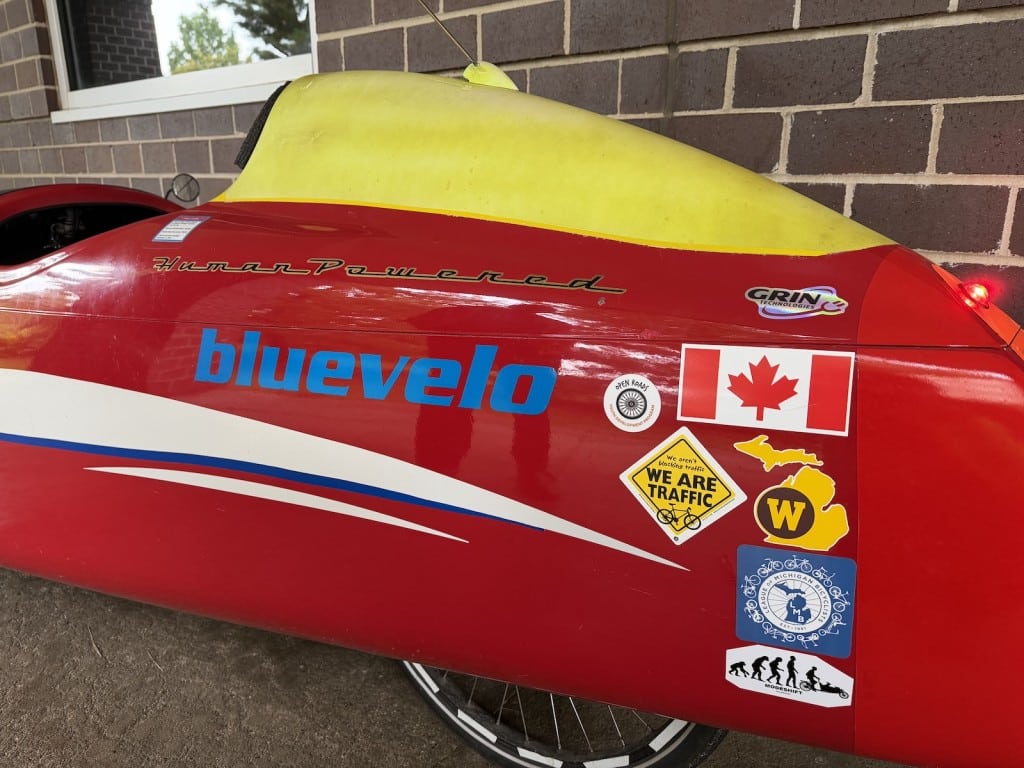
His E-Quest has a bit of a “Johnny Quest” theme — though Pancella is more like professor/inventor Dr. Benton Quest of the 1960s adventure cartoon.
Pancella’s design includes regenerative braking, so going down hills gets him a lot of the energy back that was spent going up. Therefore, the battery he uses can be smaller and lighter than the usual e-bike battery.
Outside are headlights, brake lights, turn signals, running lights, and a 360-degree flashing light sticking up from a rod for visibility. Inside is a computer system for collecting all the data.
Data show his legs do 80% of the work, with the motor assisting when needed.
For over a year, he’s used the E-Quest most days on his commute of a couple miles to work, for errands around town, and for adventures like a recent camping trip up and down the White Pine Trail between Rockford and Cadillac.
So, someday we’ll all be using these?
“I doubt it,” Pancella says. “It would take something really drastic.”
Like $6 a gallon gas?
“No, that wouldn’t do it,” he says.
Maybe $10 a gallon gas?
“Maybe $10.”
Author

Related Articles
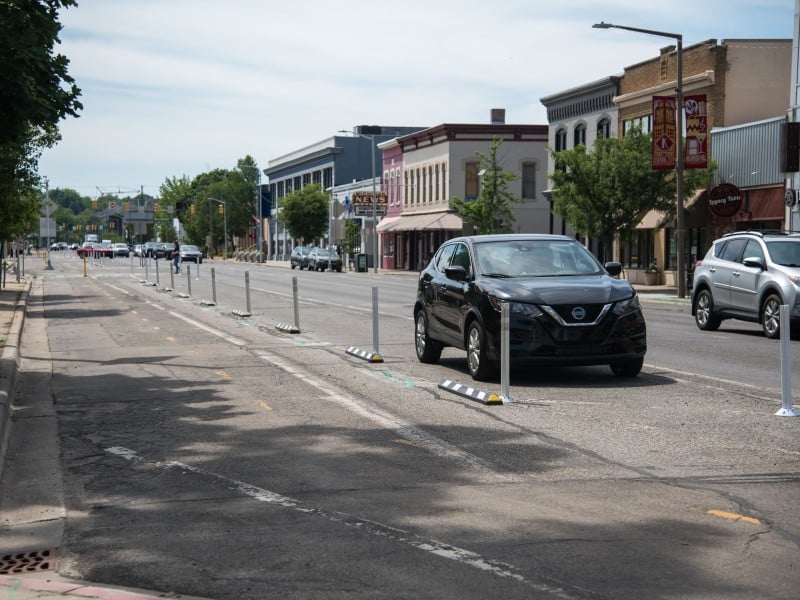
Feeling slowed down? That’s the point. Kalamazoo crashes drop 25%.
Kalamazoo’s traffic calming makes roads safer for everyday mistakes, while enforcement targets truly dangerous driving.
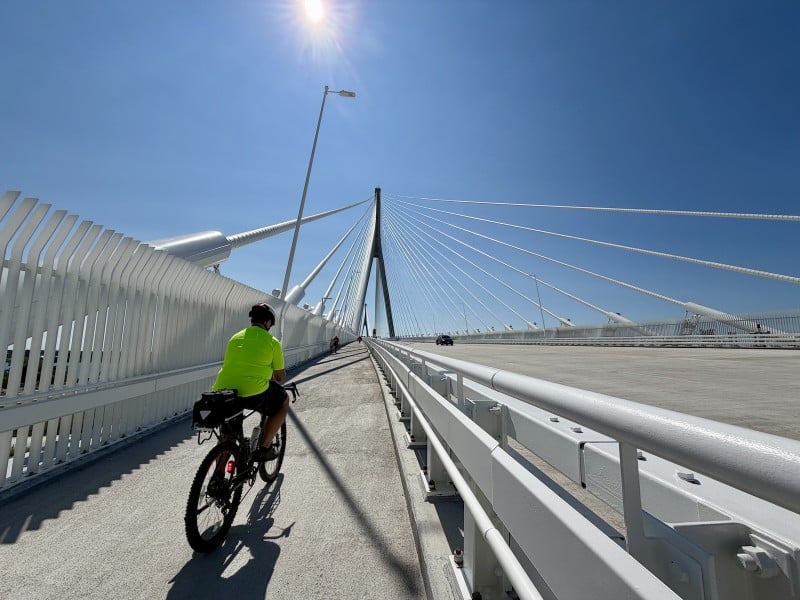
Elbows up, hearts open: One Kalamazooan’s ride across a bridge built to connect
Kalamazooan Mark Wedel bikes the new Gordie Howe International Bridge, discovering history and connection as he pedals across the border from Detroit to Canada.
Short-term pain, long-term gain: Kalamazoo begins biggest Downtown street transformation in 60 Years
Construction is underway on Kalamazoo’s long-planned Streets for All project, with city leaders and downtown businesses acknowledging years of disruption while promoting the $100 million overhaul will create a safer, more accessible, and more vibrant downtown.