
The road ahead: Everything you need to know about Downtown Kalamazoo’s two-way street conversion
Downtown Kalamazoo’s six-year, $50 million-plus two-way street conversion begins July 15, with phased construction leading to a calmer, more connected downtown by 2030.
Editor’s Note: This series explores the ongoing transformation of downtown Kalamazoo. From a new arena rising to fresh businesses opening and festivals drawing crowds, these changes are redefining how we experience the heart of downtown. This project is sponsored by the City of Kalamazoo.
KALAMAZOO, MI — A new future for Downtown Kalamazoo streets is coming. Traffic patterns will be very different from what we’ve had for six decades.
Getting there will involve a lot of construction, and likely some disruption. The two-way conversion project starts July 15, and will continue through 2030.
The City assures that disruption will be kept to a minimum; that construction will proceed in stages, block-by-block; that where construction is underway, one lane of traffic will be kept open much of the time; and that there will be clearly posted alternate routes.
The planners have been presenting the project through June to the City Commission, at public meetings, through videos on social media, and on their project site.
They’ve been letting the community know what’s happening with construction this year and what will come in the upcoming years. But they’ve also been selling the why of the project, and describing what the streets will be like once construction is done.
Residents, workers and businesses in the City have expressed mixed reactions to it all. Some are hopeful about future changes, many dread the construction period.
Picturing two-way
Christina Anderson, Deputy Director of Community Planning and Economic Development, and James Baker, Public Services Director, presented before-and-after maps of routes Downtown to the Kalamazoo City Commission June 15, as well as a public meeting June 23.
A portion of their presentation involved explaining the benefits of two-way travel.
It’s difficult to picture Kalamazoo’s main streets as two-way if you know Downtown’s traffic patterns.
The reality since 1965 is easy to envision for those of us familiar with driving Downtown. It’s imprinted on drivers’ minds.
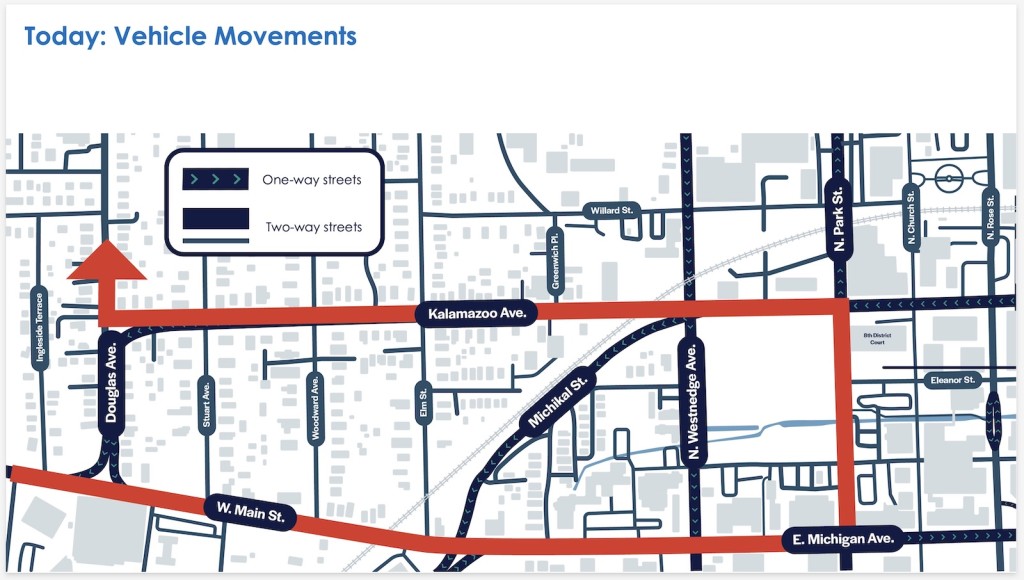
Say you’re on West Main, headed from the west into town, and you want to turn left on Douglas. Well — you can’t.
You’ll need to drive into Downtown on Michigan Avenue, get through two stop lights, turn left at the third light on Park, turn left again on Kalamazoo Avenue, drive through the historic Stuart Neighborhood, and then you get to go right on Douglas.
That’s a journey of nearly 1.5 miles, with five stoplights and two railroad crossings. You’re forced right into Downtown traffic. And you’ve added to congestion, becoming part of Downtown traffic.
But starting in 2028, you’ll be able to turn left at the intersection of Douglas and West Main. That’s it.
Or, you’re coming from Stadium or Oakland Drive through what’s been referred to lately as “The Spaghetti Bowl.” You get merged onto West Michigan, pushed east, but you need to head west on West Main. You get funneled to the right onto the one-way portion of Michigan through Downtown, and you have to do a similar circular dance that’s around 1.3 miles. Be careful crossing the lanes of fast traffic to get to the left-turn lane at Park, because others are likely crossing over to the right to turn at Westnedge.
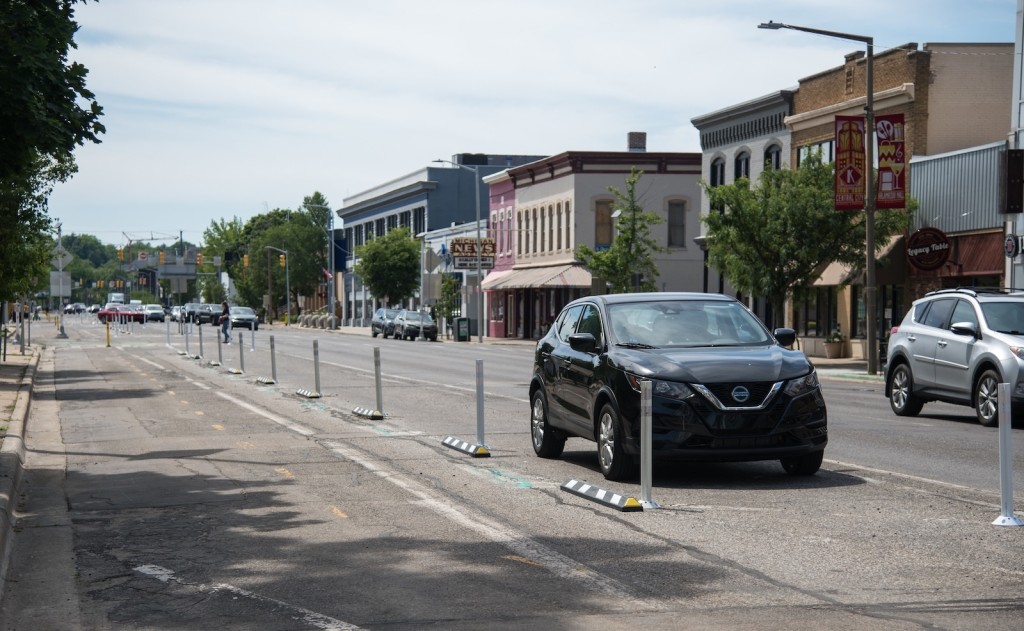
Starting in 2028, you will be able to simply turn left on West Main from West Michigan.
Since 1965, drivers have had to take a circuitous route, James Baker told the Kalamazoo City Commission June 15, to get to where they want to go. The route circles “all throughout downtown, winds through neighborhoods unnecessarily.” After the changes, drivers will be “able to cut that trip and reduce those movements.”
The old design, which emphasized traffic flow, has also led to speeding and hazardous lane-changing, the City says. The curves leading onto and off of Douglas, connecting with Kalamazoo and West Main, are comparable to “highway on-ramps,” Baker says. “If you’re not driving fast, you’re not keeping up with folks. It’s a move or get out of the way situation on that route.”
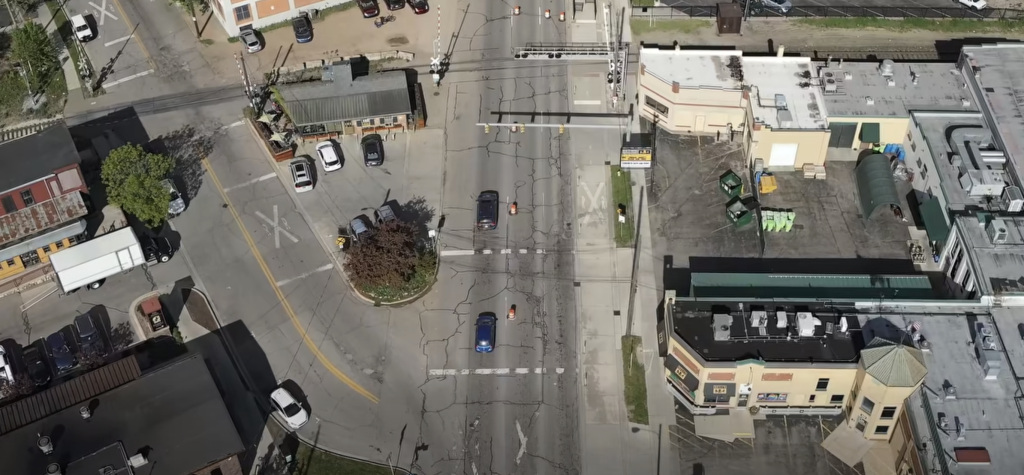
Traffic flow was the goal when the main streets were made one-way in 1965, after the City transferred control of the streets to MDOT. They were designed with a “highway mindset,” as the “Streets for All” video describes it, to move drivers through the city as quickly as possible.
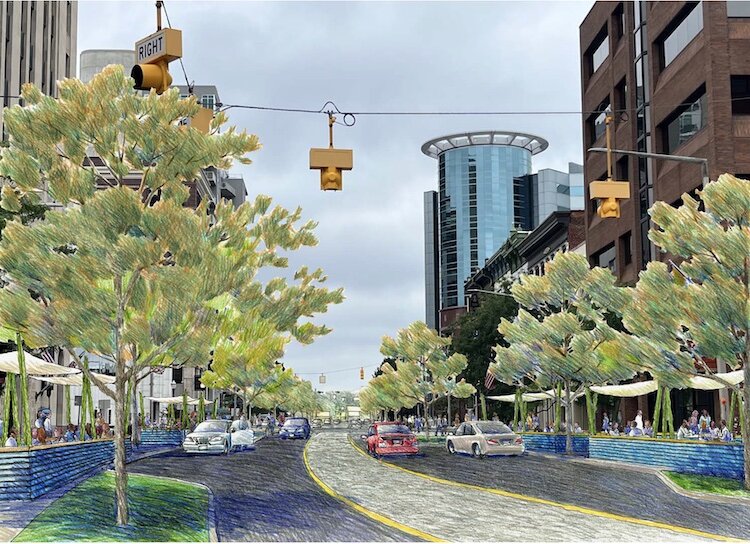
The goal is to complete the main project in 2030. After that, the City’s video states, “Instead of circulating as a one-way loop, downtown streets will become two-way, which not only makes it more convenient for people getting around, but it also helps to slow down speeds and make it feel more like traditional city streets rather than a highway.”
Getting there
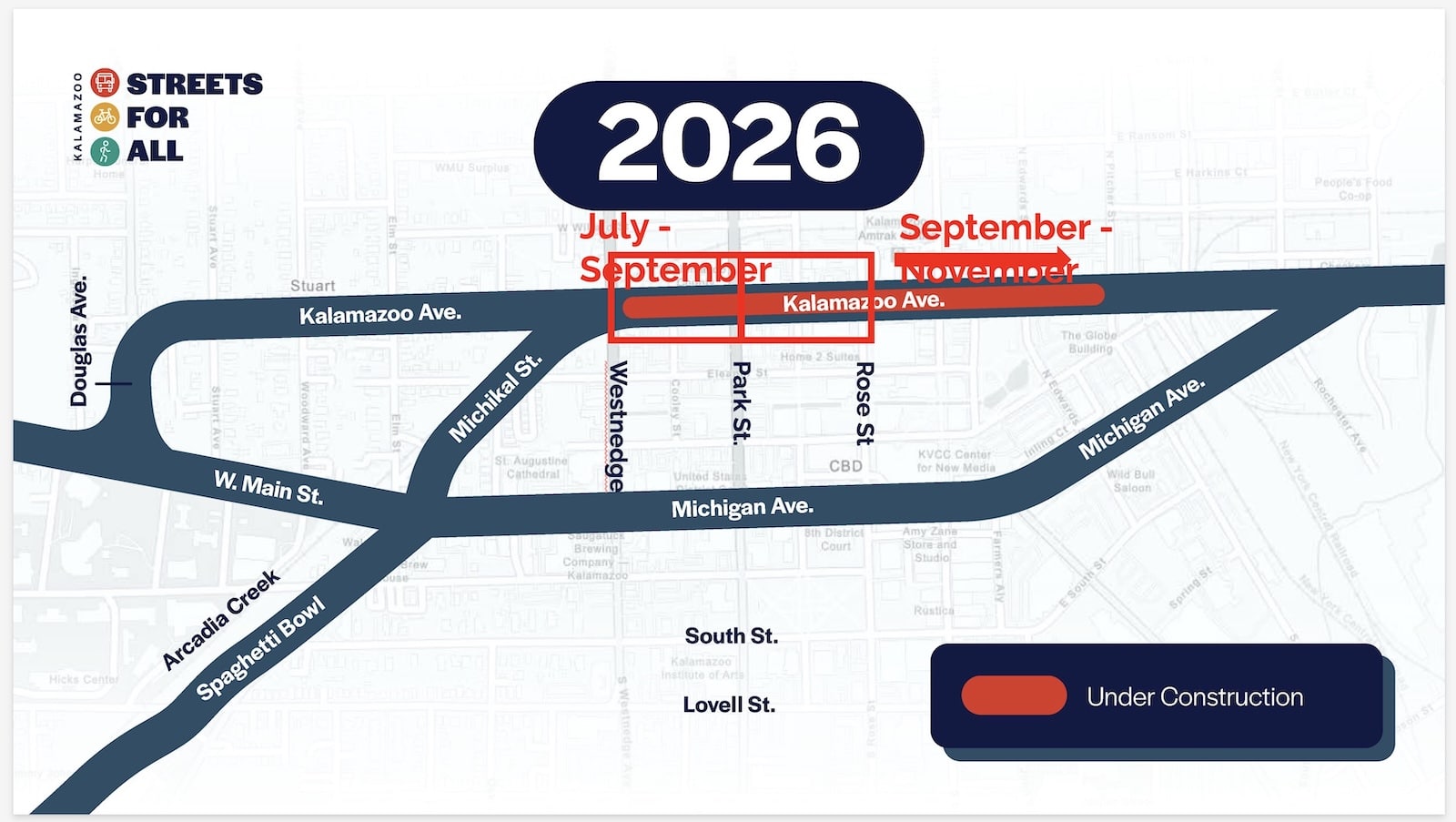
The journey starts July 15. Construction on Kalamazoo Ave. will first be between Westnedge and Park, then between Park and Rose, and will move east until it should reach “Edwards or Pitcher,” Anderson says. Construction will pause for winter, then “pick up where we left off,” and continue east to the point where Michigan and Kalamazoo meet in 2027.

The focus is on the remaking of the one-way streets to two-way. “However, there is a lot of other work being done and much of it is underground,” Anderson says. The project includes upgrading infrastructure and utilities, from pipes to traffic signals. Underground pipes dating back to the 1800s will be replaced, traffic signals will be converted to “smart signals,” and utility wires will be moved underground.
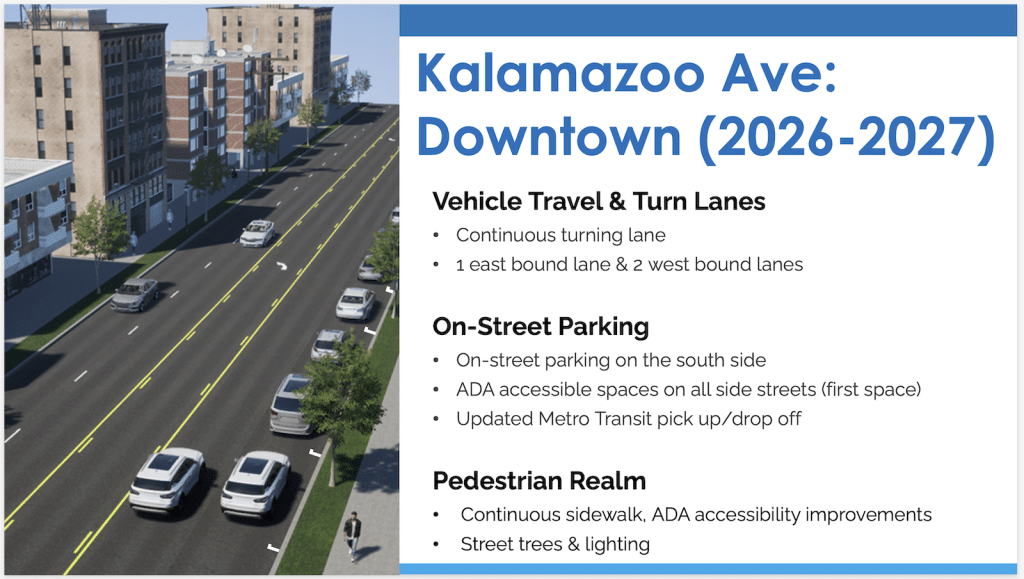
Also, 80 trees will be planted along the street, plus new sidewalks, traffic islands, and other street-calming infrastructure.
Baker outlines how construction will be one block at a time.
There will be alternate routes — for example, this year alternate routes will reroute Kalamazoo Avenue traffic to Ransom and North.
But most of the time during construction, roads will not close entirely; drivers can still drive past construction. Baker repeats that “there will be one lane open” during most of the Kalamazoo Ave. project, and in the following years’ work.
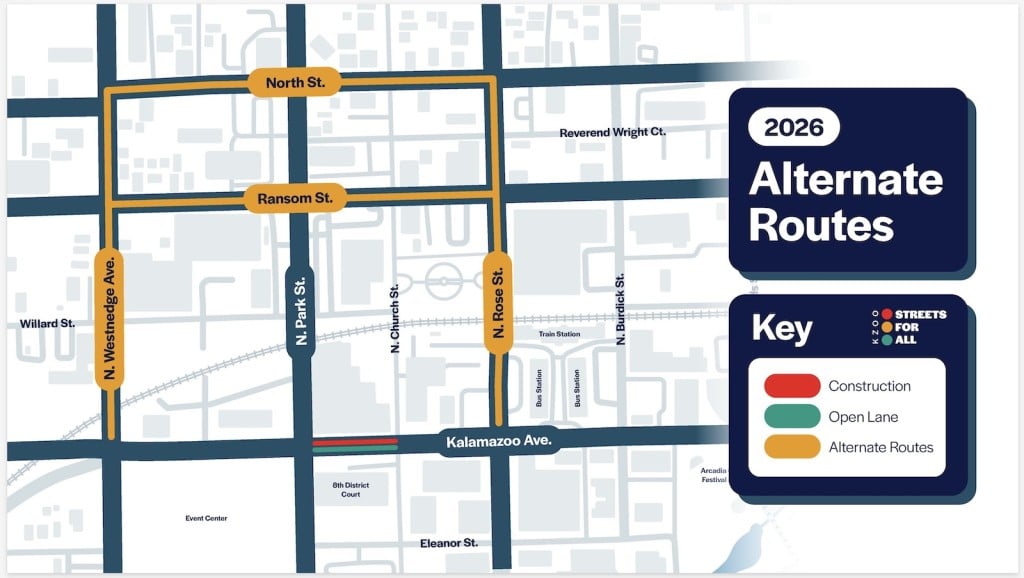
Alternate routes for this year: The City promises to keep one lane of construction open when possible, and to guide traffic to alternate routes, for the entire project.
But some residents and business owners at the June 23 meeting were concerned that there could be a time when major streets will be blocked off. The City map shown for 2027 has a lot of red filling Douglas, West Main, Michikal, and the intersection of Kalamazoo and Michigan. Some at the meeting noted that work in 2024 closed major streets and impacted businesses.
There will be some “short duration closures” for utility work on Kalamazoo Avenue this year, Baker says, during which a block would be closed. A closure of “a week and a half probably would be pretty typical… But our approach has been really different from what we had in 2024, to try to keep access to businesses flowing,” Baker adds.
2027-2028 and onward to 2030
The major work in 2027 will see the removal of highway-style turning curves at the intersections of Douglas and West Main, and Douglas and Kalamazoo Avenue.
Douglas and West Main will meet as a “T” intersection, with traffic signals. Douglas will be converted to two-way at completion; West Main from Douglas to West Michigan will also be two-way.
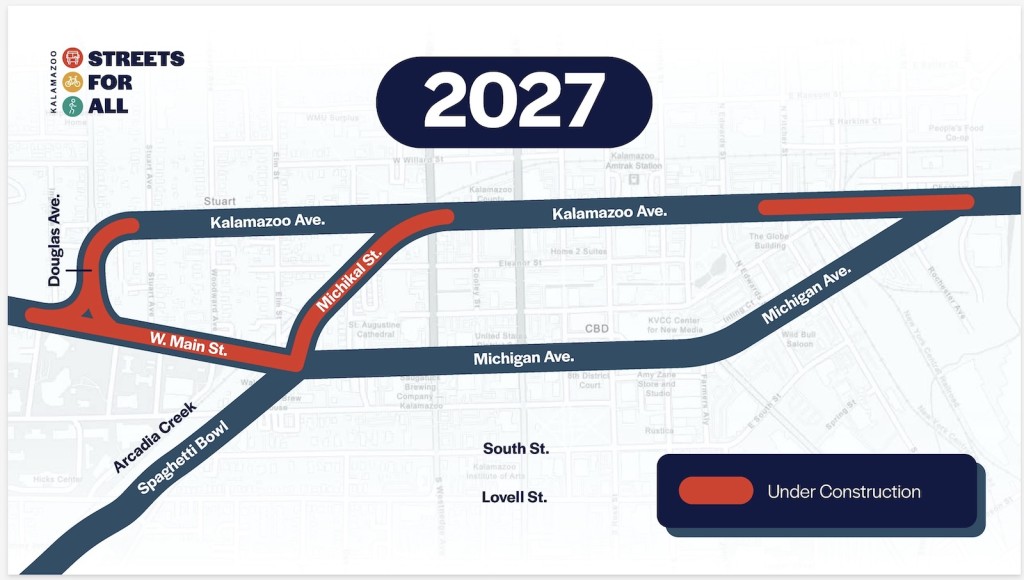
Kalamazoo Avenue will become a traditional “T” intersection, with stop signs.
Michikal will also see work, plus Kalamazoo to Michigan Avenue.
Once completed, instead of sending west-bound traffic through Stuart, Kalamazoo Avenue traffic will flow onto Michikal. Remember, that will be two-way, with Michikal also sending traffic to Kalamazoo Avenue.
Anderson clarifies via email that all this construction will not happen at the same time, and that most of the time there will be lanes open in construction areas.
She writes, “West Main will be done first, starting as early as possible in 2027. It must be completed to allow for traffic routing when Douglas Avenue is under construction. There will be a travel lane open on West Main during the construction. Douglas will go under construction after West Main ends. They will not be under construction at the same time, but will start one after the other in 2027.”
That year, along Michikal, phase one of the PROTECT grant work on reigning in Arcadia Creek’s floodplain will begin, Anderson writes. Work previously started on Michikal will also be completed.
“At the end of all this work (in 2027), Kalamazoo Avenue, Michikal, West Main, and Douglas will all be open to two-way traffic at the same time,” she writes.
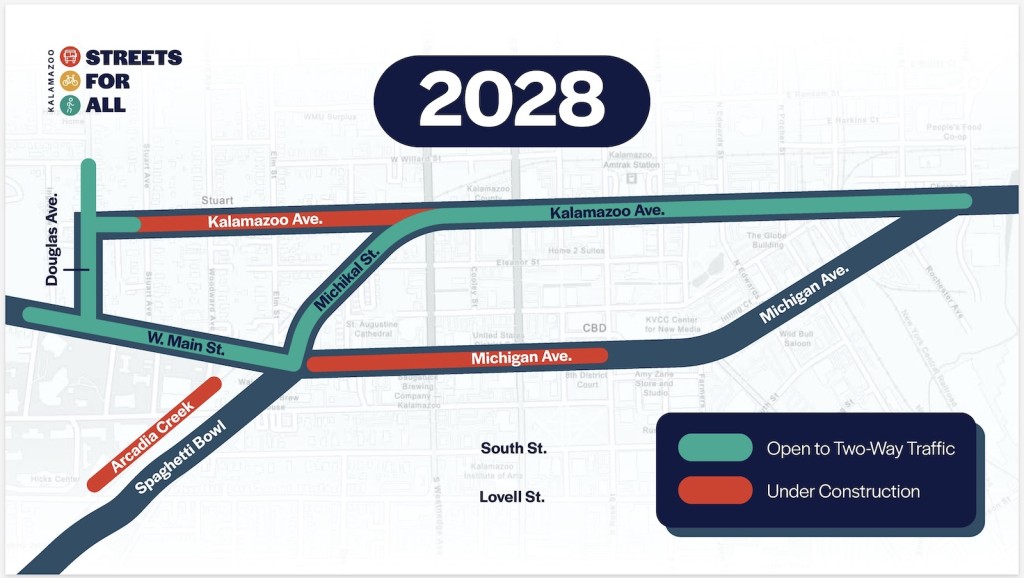
The map for 2028 shows completed streets will be two-way, allowing eastbound and westbound flow through Downtown.
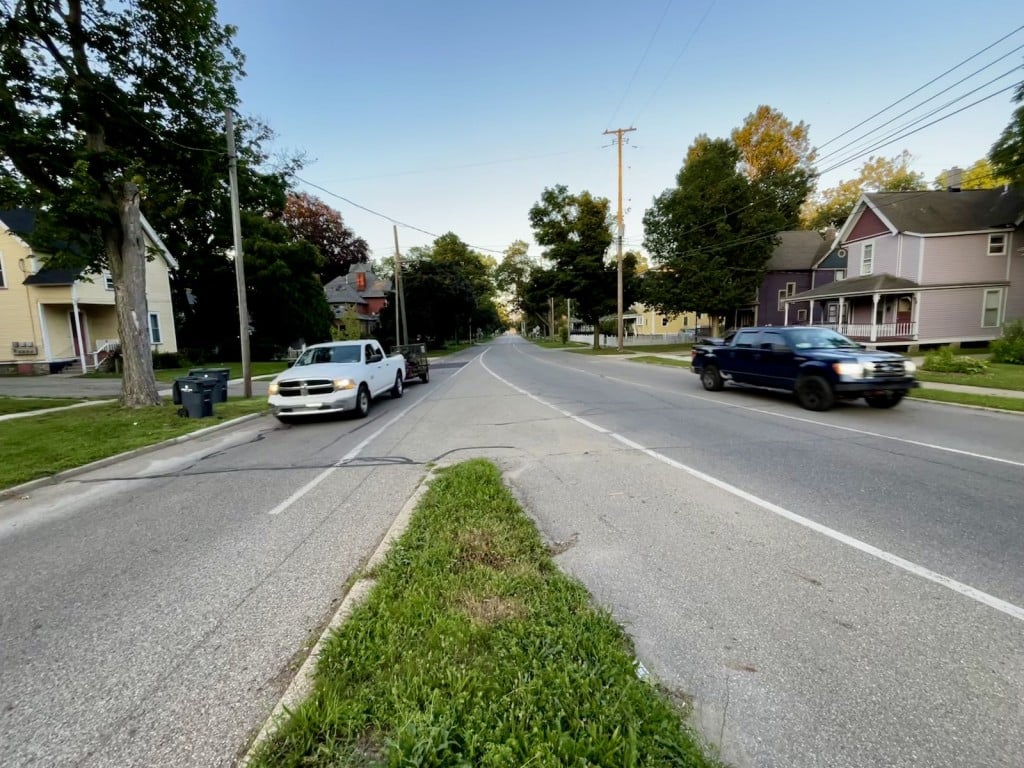
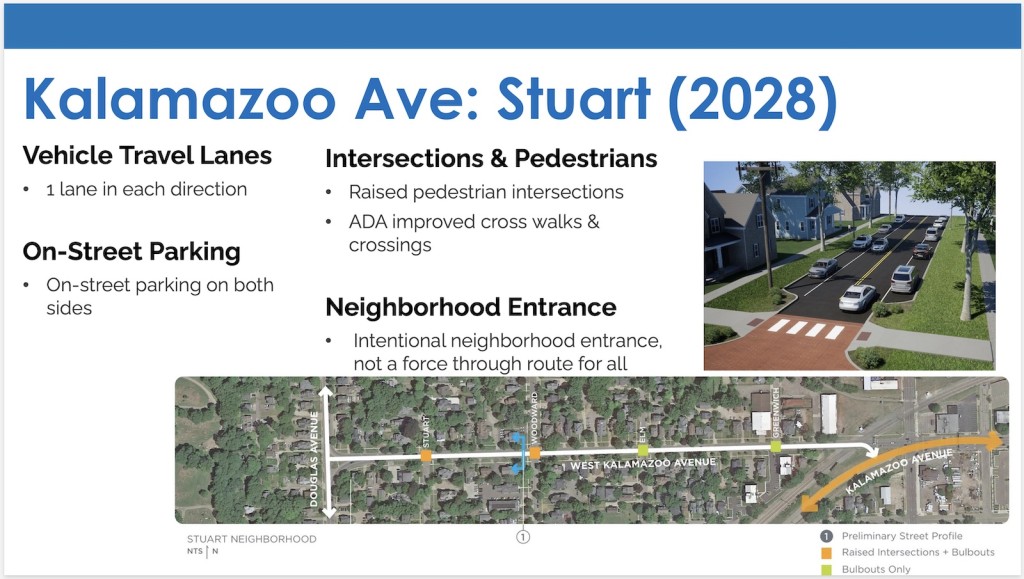
Construction-wise in 2028, West Kalamazoo Avenue through Stuart will be converted into a two-way regular neighborhood street. There will be two lanes, with on-street parking on both sides. There will be traffic calming with bump-outs protecting parked cars, and raised pedestrian crossings sending the message to drivers to respect whoever may be crossing.
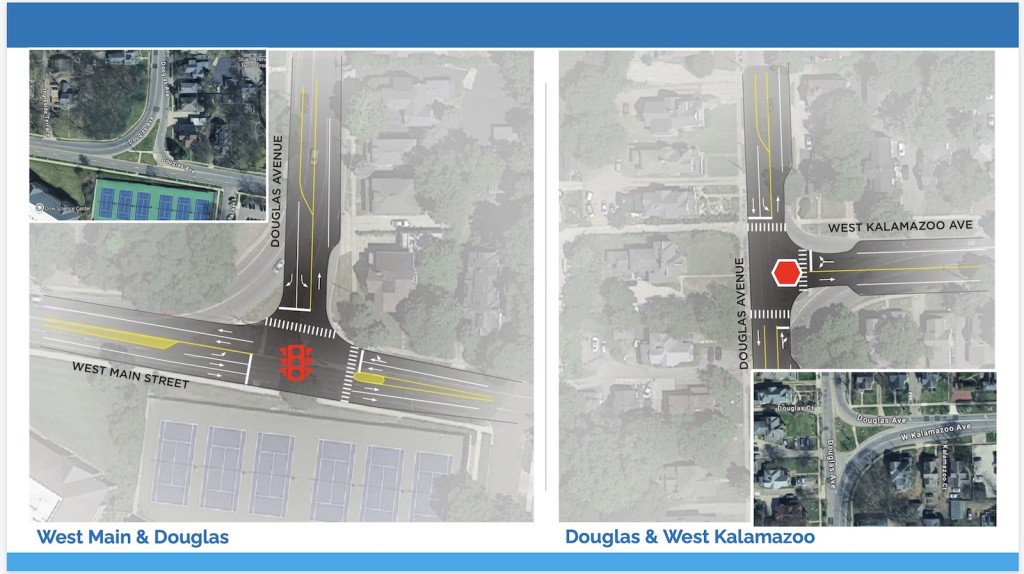
Through-traffic from the east will go along Michikal. Those wanting to enter Stuart will need to turn onto another “T” intersection, onto the new West Kalamazoo Avenue.
At this time, Michigan Avenue will undergo construction from Michikal to Rose. That will include street-calming, bike infrastructure, new signals, and more, in addition to two-way conversion.
If all goes as planned, the majority of work will be completed in or by 2030 with a new intersection at East Michigan and East Kalamazoo.
Stuart Neighborhood
The City’s presentation was careful to focus on impacts to the Stuart Neighborhood.
Stuart is an enclave of residents that had, after 1965, a chunk of homes cut off by Michikal — a one-way connection then meant to direct drivers south to Stadium — and by Kalamazoo Avenue, widened to send west-bound traffic past Stuart’s front lawns. They’ve also got the highway-like curves at Douglas/Kalamazoo and Douglas/West Main.
Some of the homes on Douglas have long been off-campus student housing. City Commissioner Jeanne Hess says after the June 15 presentation, “Students at Kalamazoo College for 25 to 30 years have been begging for this project. It’s like a game of ‘Frogger’ trying to get from their house on Douglas over to campus. And I’ve seen more than one upside-down vehicle on West Main that missed the curve.”
In other parts of Stuart, residents have long had drivers avoiding the circular route to Park, finding convenient shortcuts through their neighborhood.
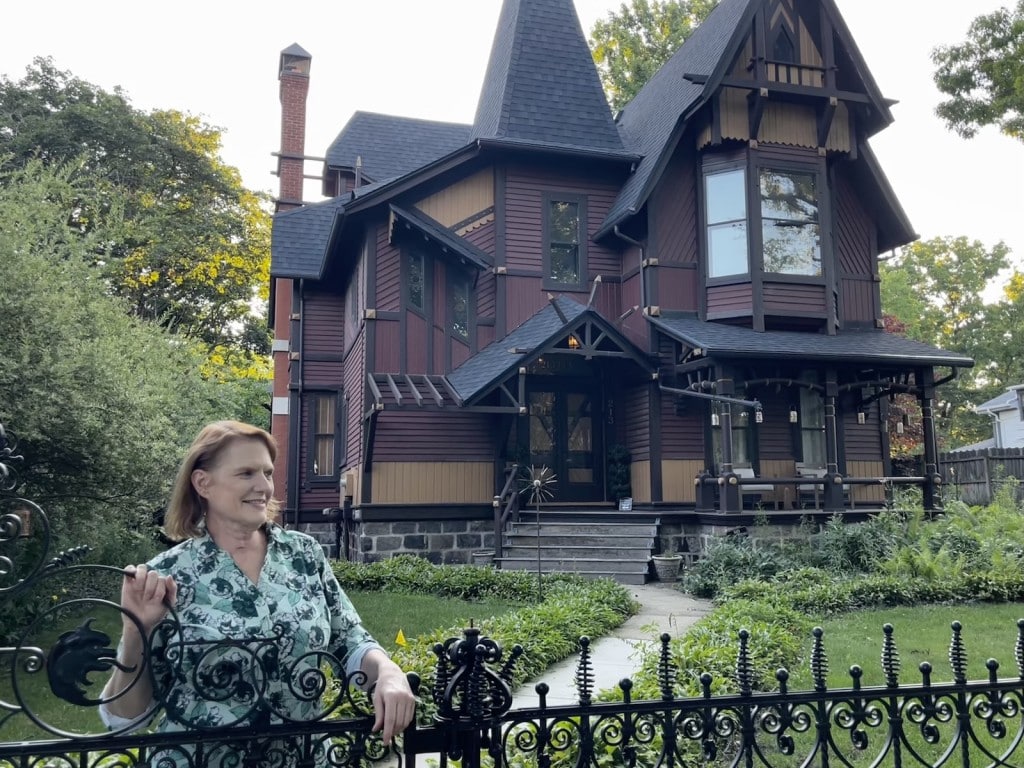
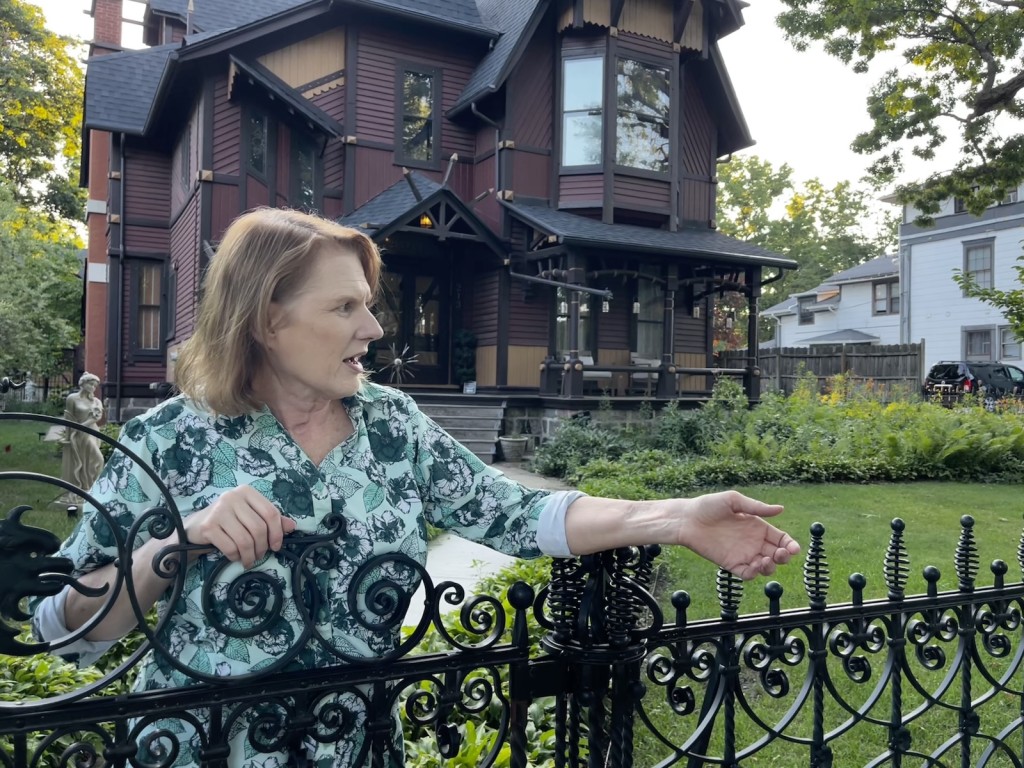
Dok Tael Stevens, A Western Michigan University student in the ’80-’90s who graduated and left Kalamazoo, returned two years ago to buy her “dream home,” an ornate Victorian structure on Elm Street.
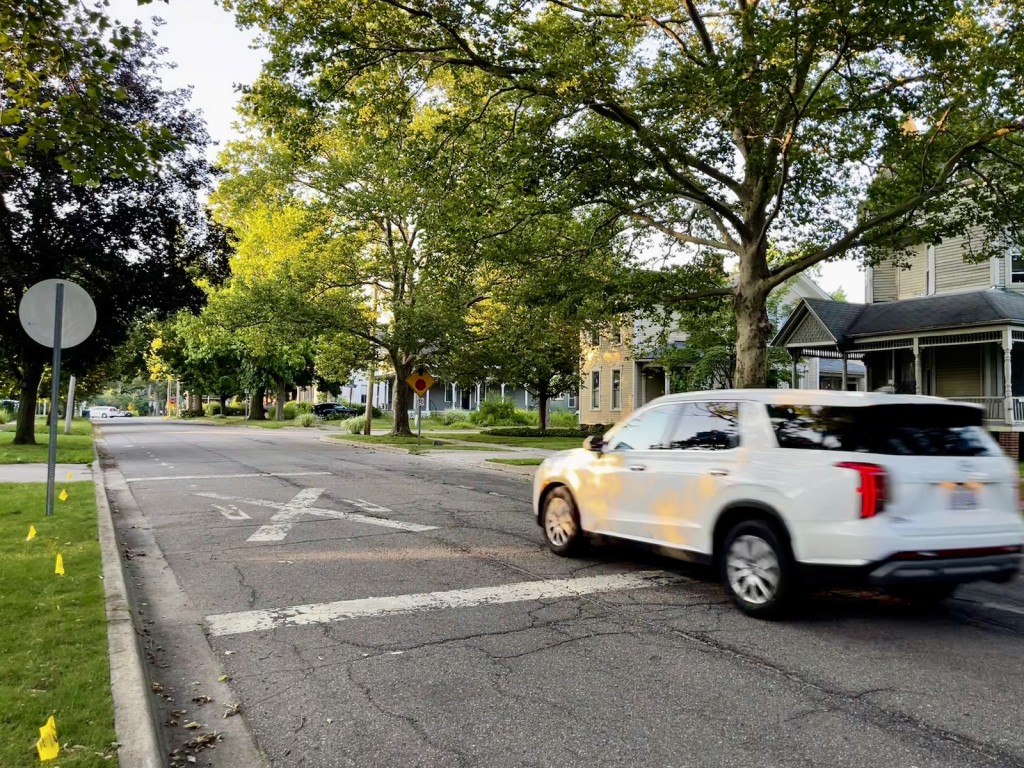
We spoke with her at her front gate, watching the cars go by. It was a quiet Monday evening Downtown, yet about a car every minute went by on Elm, all headed to Kalamazoo Avenue. Some were clearly exceeding the 25 mph speed limit.
She scowls at the street. “There goes one now, speeding!” The driver appeared to be going ten over the limit. She says she’s often seen drivers going over 40 mph. Neighbors have told her of the street’s history of children getting hit by cars. Stevens herself doesn’t feel safe crossing the street, even at crosswalks.
Stuart Avenue and Woodward Avenue could also work as cut-throughs, but they have speed humps. Elm does not, Stevens points out.
She has asked the City for speed humps, or for KPS to address the speeding. Stevens was told, by a KPS representative, “Well, you could call us every time that happens,” she says.
Stevens replied to them, “So, you want me to just call you every day? I’m just gonna quit my job and sit on the porch and call you all the time?”
Stevens has many concerns and hopes about the street conversion project.
She has heard that the south end of Elm at West Main would become a cul-de-sac. (There was no mention of that in the City’s presentations).
She’d be willing to give up that connection to West Main. As it is, Stevens feels surrounded and trapped by wide, fast, one-way roads.
“I love my neighborhood, but every trip I make starts and ends with Downtown,” Stevens says. “I often have to go waaaay out of my way to avoid construction or getting stuck by excessive traffic lights that don’t seem to be timed together.”
For two years, she’s been looking for the best ways to venture forth from Stuart and return home. Stevens describes swinging around Kalamazoo-Douglas-West Main to get to Stadium or Westnedge. Going home from the east, she often uses North Street instead of Kalamazoo to avoid backups.
Stevens used to live in Madison, Wisconsin, a famously bikeable town, where she’d often bike to work. “It would be great if I could do that here, but right now, the bicycle lanes aren’t connected enough to get me all the way there and back safely.”
“Sometimes I avoid driving my car altogether,” Stevens says.
Stevens is not looking forward to the construction. Seeing the 2027 map showing West Main, Douglas and Michikal all in red, she’d feared that Stuart would be isolated. (Again, the City promises that construction will be in phases, with most of the time one lane open where construction occurs.)
She looks forward to the two-way future, though. She thinks back to her time as a new WMU freshman, driving to the Downtown McDonald’s and finding herself going the wrong way down a one-way street headed back to the dorms. Stevens thinks about the people new to Kalamazoo who’ll be visiting the coming Events Center not far from her. “If it was two-way streets, it would make it easier for people to get to and from the arena,” she says.
Most of all, she’s hopeful for Stuart. “If they make (W. Kalamazoo Avenue) a normal neighborhood street, and they direct all the traffic away from the neighborhood — that would make a huge difference. Because that — ” Stevens points to Kalamazoo Avenue ” — divides us.”
Author

Related Articles
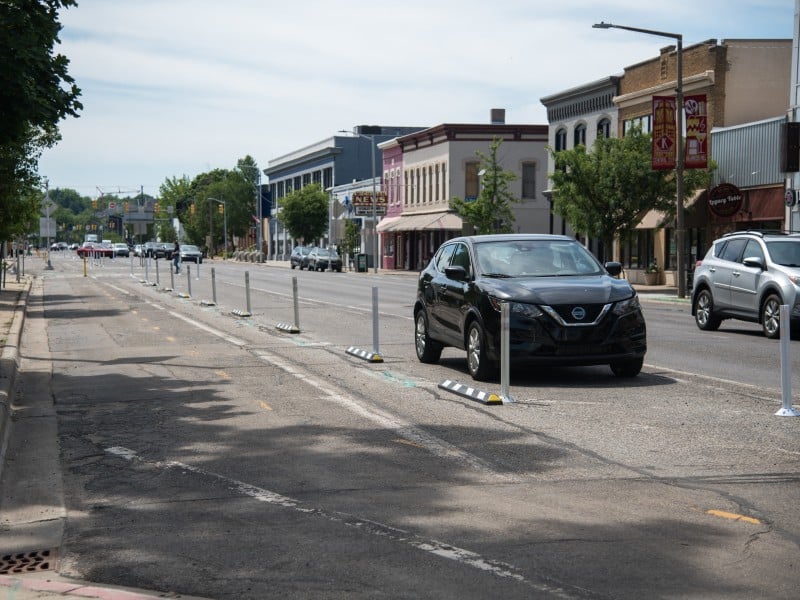
Feeling slowed down? That’s the point. Kalamazoo crashes drop 25%.
Kalamazoo’s traffic calming makes roads safer for everyday mistakes, while enforcement targets truly dangerous driving.
Elbows up, hearts open: One Kalamazooan’s ride across a bridge built to connect
Kalamazooan Mark Wedel bikes the new Gordie Howe International Bridge, discovering history and connection as he pedals across the border from Detroit to Canada.
Short-term pain, long-term gain: Kalamazoo begins biggest Downtown street transformation in 60 Years
Construction is underway on Kalamazoo’s long-planned Streets for All project, with city leaders and downtown businesses acknowledging years of disruption while promoting the $100 million overhaul will create a safer, more accessible, and more vibrant downtown.