Elbows up, hearts open: One Kalamazooan’s ride across a bridge built to connect
Kalamazooan Mark Wedel bikes the new Gordie Howe International Bridge, discovering history and connection as he pedals across the border from Detroit to Canada.
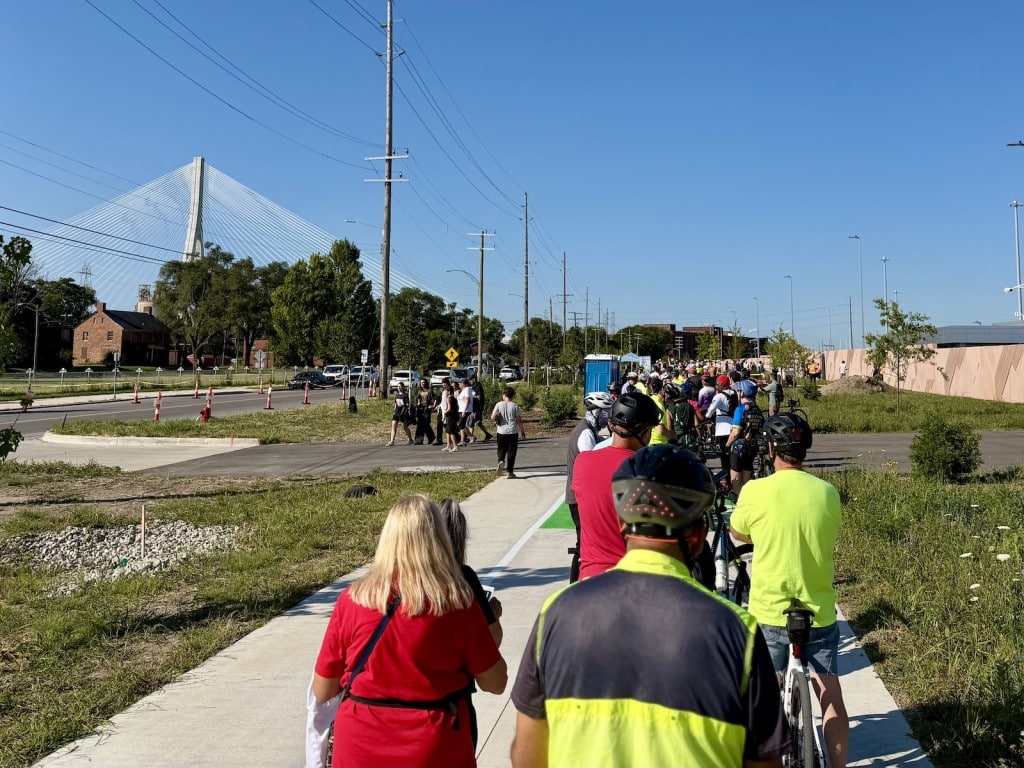
DETROIT, MI and WINDSOR, ON — In a divisive time, here’s a new bridge.
It’s a bridge joining people, joining sibling countries, joining friends and neighbors.
We are still friends, right?
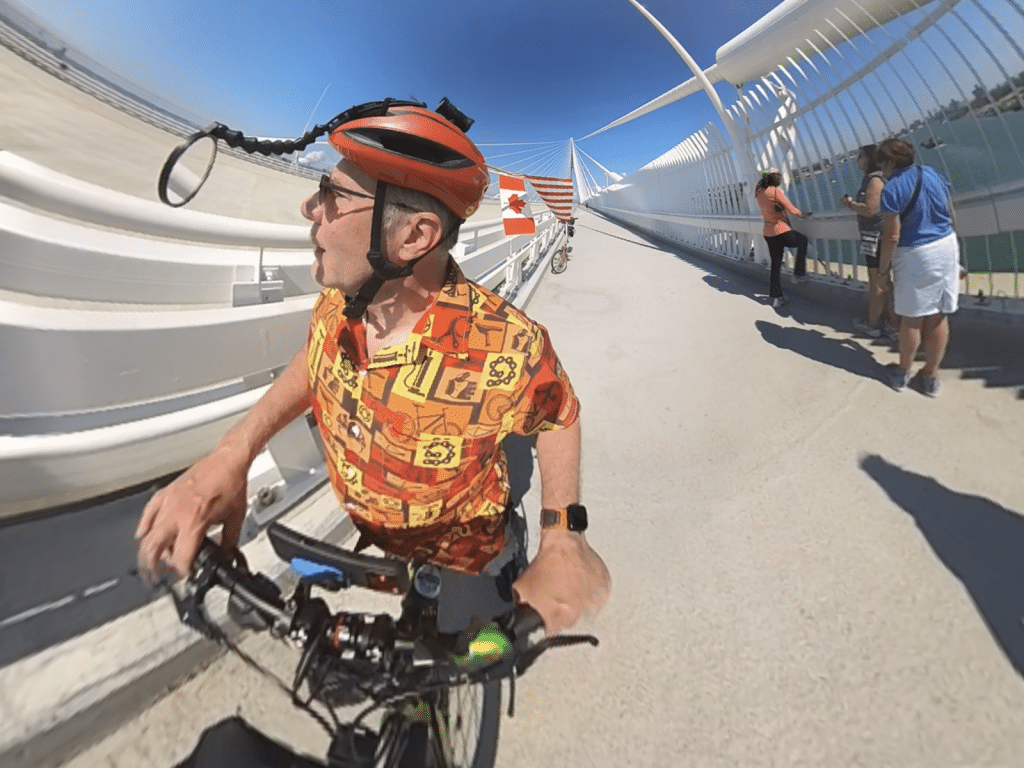
I pedaled my little folding bike up the slope of the new Gordie Howe International Bridge. It was the opening day of the bike/pedestrian path, Aug. 5.
Riding downhill towards the U.S. side was an older man with a walrus mustache and an “Elbows Up!” T-shirt. He had a determined smile.
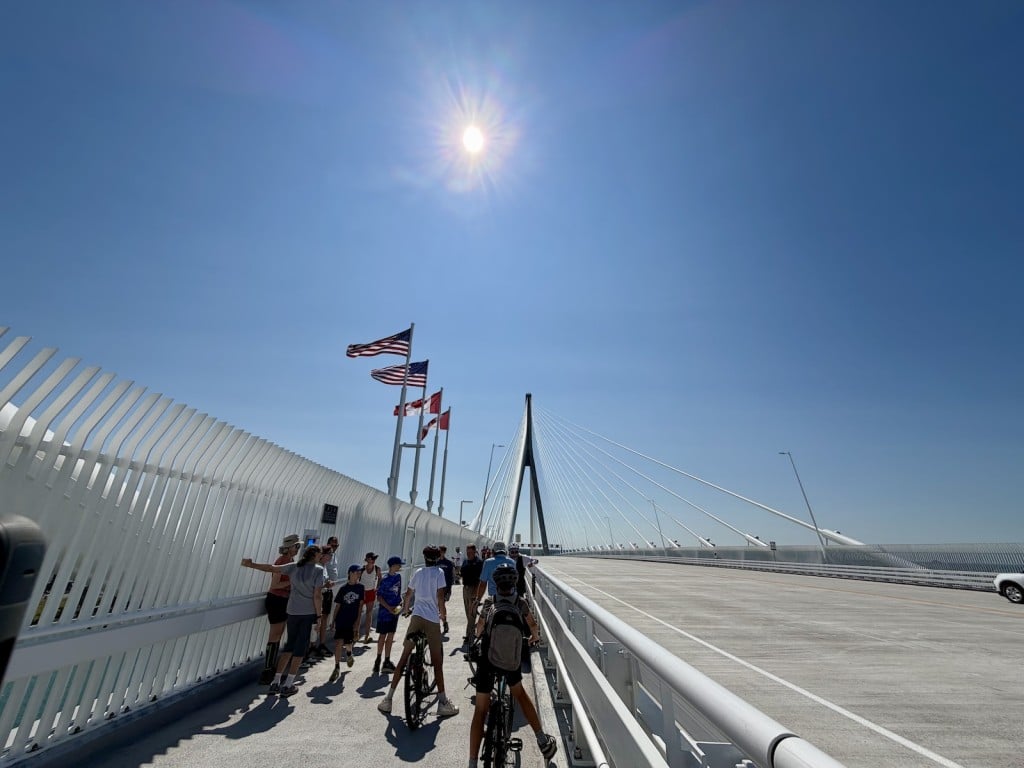
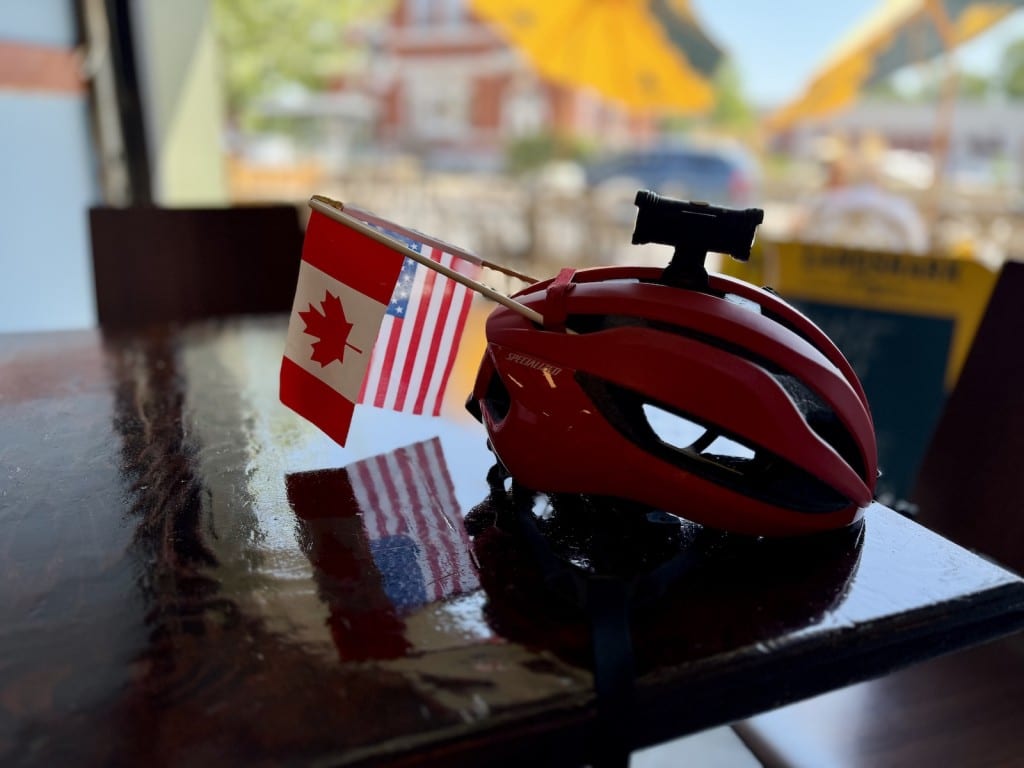
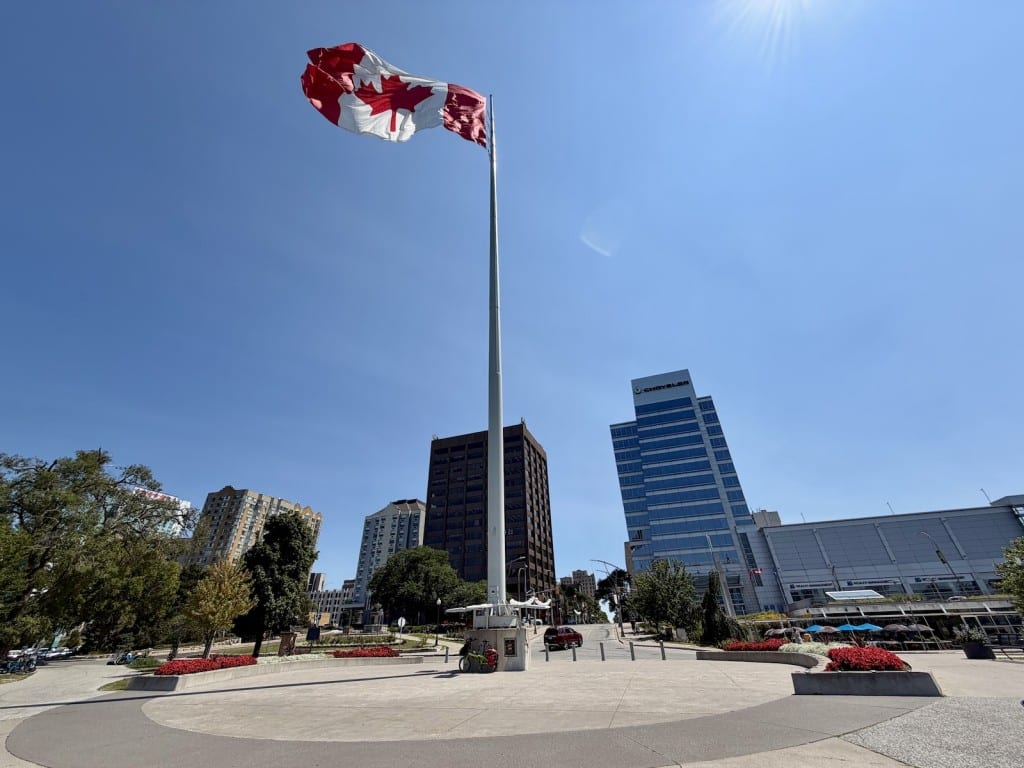
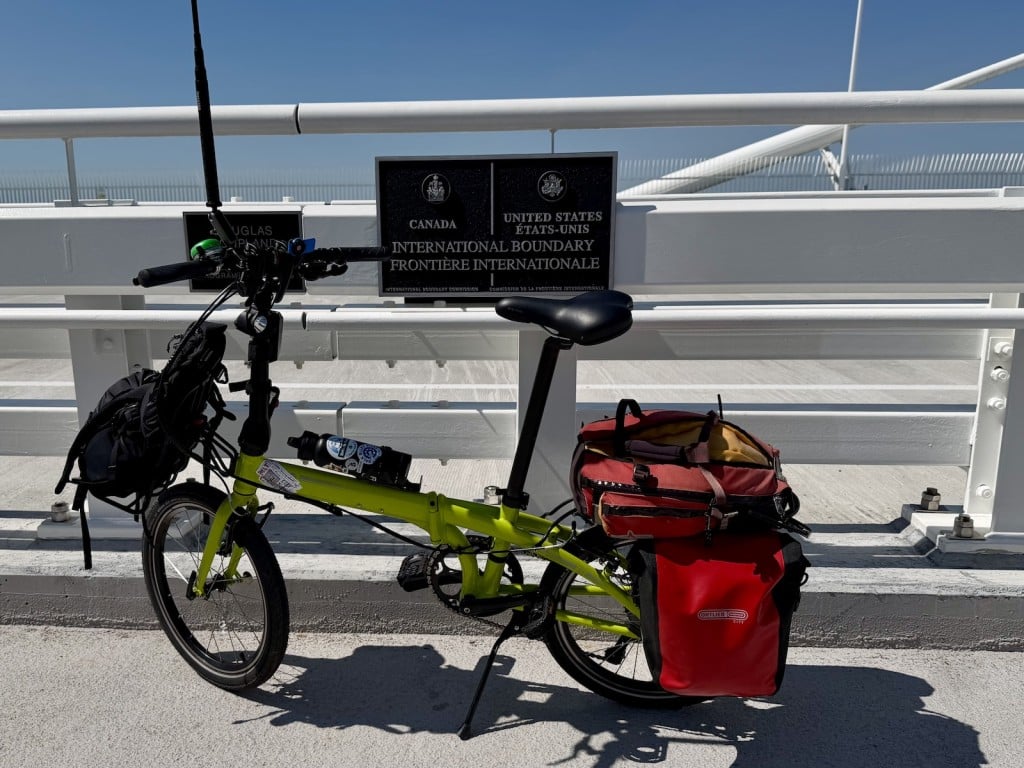
At the top of the hill, there’s a clot of people gathered around the border marker, under the U.S. and Canadian flags. Everyone is trying to get a photo, a selfie of themselves on the borderline. It’s a historic day.
A group of Canadian bicyclists was all wearing matching T-shirts of a beaver in a #9 Gordie Howe jersey, crossed hockey sticks over the number 51, and the Gordie Bridge in the background with the words, “WE PAID FOR IT.”
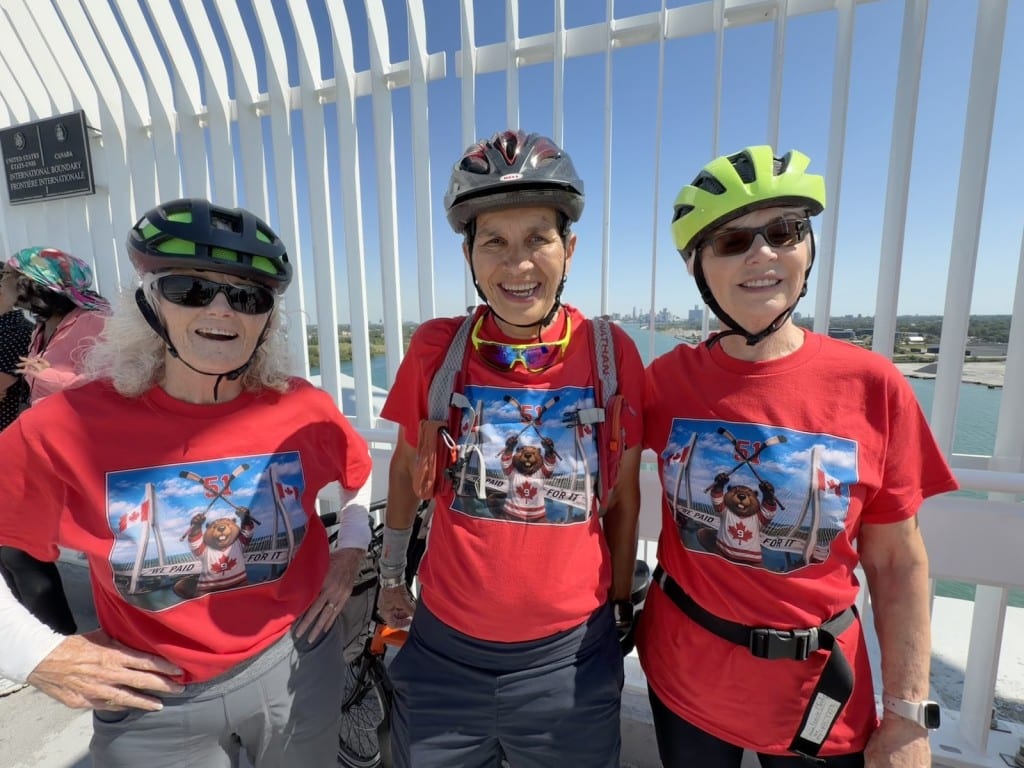
I was compelled to talk to them, to thank them for the bridge, and to apologize. Sorry about, you know, that one guy over there — I point toward the U.S.
“We still love you!” they say. “But we hate what’s happening.”
The Battle of Windsor
Before we get to the account of riding a bike over an international border, let’s look back a bit in Canadian history.
After I crossed over the Detroit River, I rode to Sandwich, Ontario, about one and a half miles from the end of the bridge. It was established in 1797, part of the then-new British Province of Upper Canada (1791-1841). It’s just southwest of Windsor.
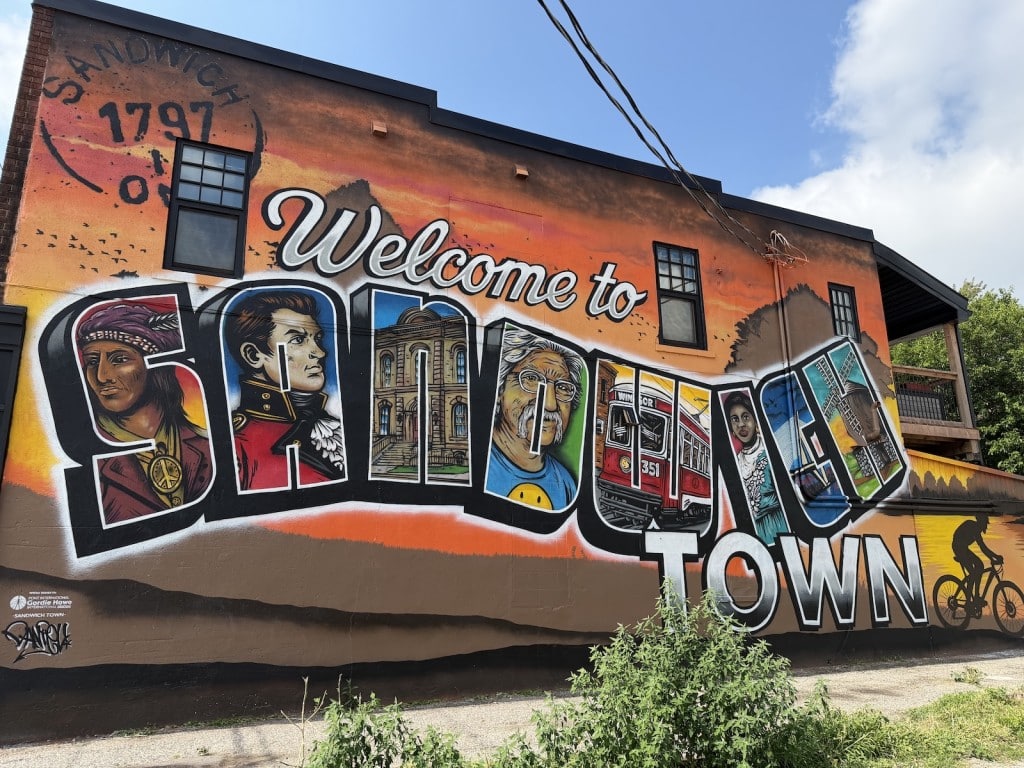
Sandwich has all the charm of a Midwest U.S. small town, with just enough difference that makes you realize you’re in another country.
Like “The Battle of Windsor,” a mural showing what they used to do to foreign troublemakers.
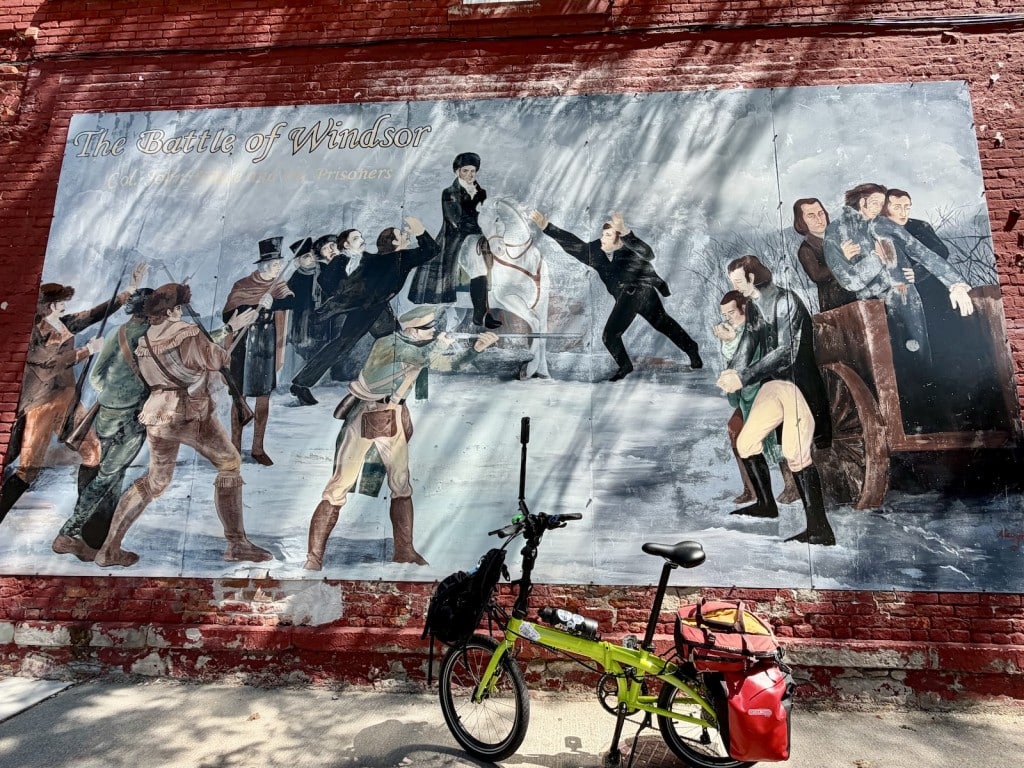
In 1838, Col. John Prince saw an attack on nearby Windsor committed by what he called “Brigands & Pirates,” according to the plaque by the mural. His militia drove them off, killing 27 and taking 20 prisoners.
Prince ordered all the prisoners shot, an on-the-spot “cold-blooded summary execution,” the plaque says. He had four of them shot before he succumbed to the argument of his men that killing prisoners is just not right and is a bit of a war crime. The mural shows sad prisoners, pleading men, and Prince on his white horse, looking smug and self-righteous.
The surviving prisoners were put on trial in London, Upper Canada. Six were executed, and the rest were sent to a penal colony in Tasmania or simply deported.
The mural doesn’t mention who these pirates and brigands were — a group of Americans and Canadians calling themselves the Patriots. They wanted to seize the Canadian land between Detroit and Niagara, north of Lake Erie, and turn it into something more American, perhaps into a new U.S. state.
The U.S. government also fought the Patriots, since they were causing trouble on this side of the border and endangering international relations with those cross-border incidents.
Our country had decided there were to be no more conflicts with our northern friends. We’d had our last troubles with British Canadians decades prior, in the War of 1812. That was when the White House was burned by troops from the north, causing the most damage that mansion would see until October 2025.
“Elbows Up!”
Then there was the last century. A great Canadian, a great Detroiter, #9 of the Red Wings, Gordie Howe. He became a symbol of the ties between the nations, between Hockey Town Detroit and hockey-loving Canada. Of course, the bridge had to be named after him.
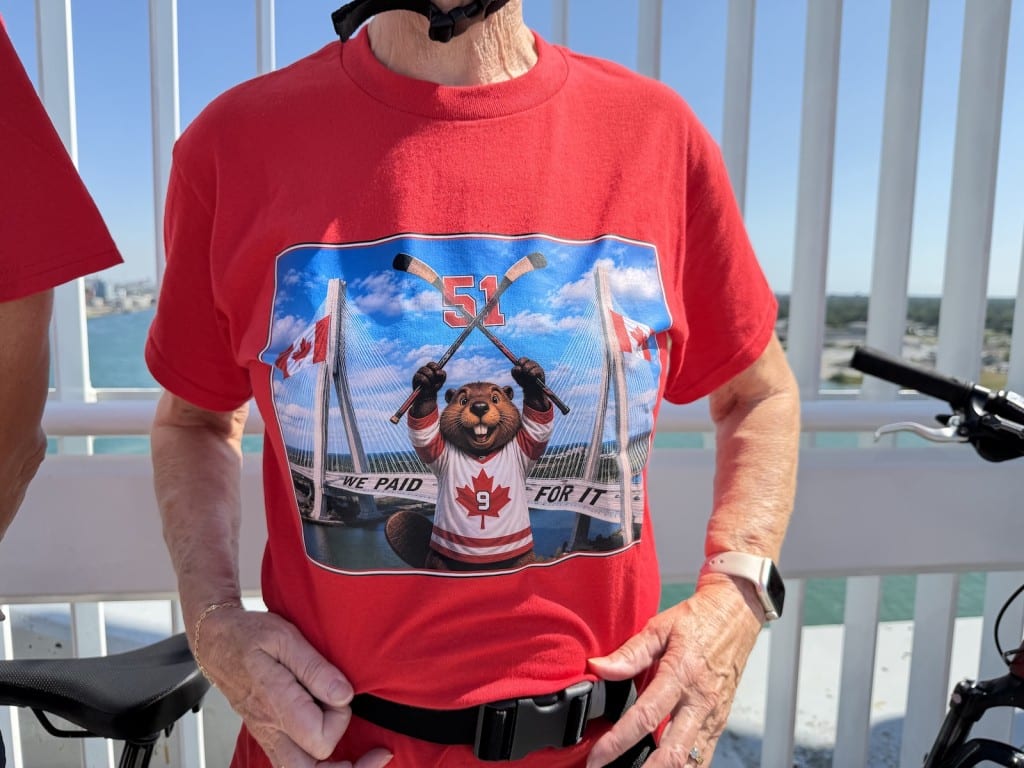
He had a defensive method on the ice known as “elbows up.” When an opposing player got a little too close and needed correcting, Howe would ram an elbow into the back of his head.
The stereotypical Canadian is polite. But the current U.S. administration’s talk of “51st state,” its imposition of tariffs, and demands that Canada give us a cut of the bridge they spent CA$3.8 billion to build, turned “Elbows Up!” into Canada’s recent national motto.
Riding the Gordie
I had big plans for the Gordie. As a bike traveler, a pedestrian/bike path into another country filled me with big ideas. The new path would connect not only the bikeable cities of Detroit and Windsor, it would also connect major regional trails and routes.
Last year I got a little folding bike that would be easier to haul onto a train. I was going to pedal it over the bridge to a train station in Windsor, then travel with it to Montreal.
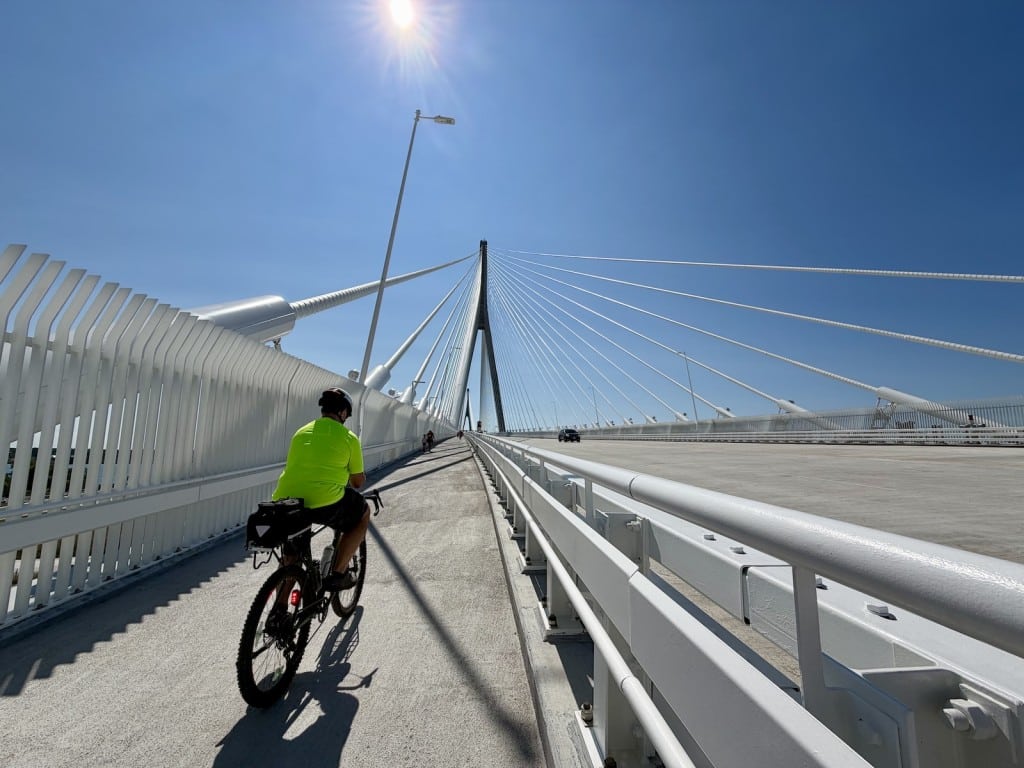
But, no. The Gordie was to open in the fall of 2025. Then it was moved to the spring of 2026. Then it was clear our President was getting personally involved in blocking the fully Canadian project. I couldn’t commit to any major trip.
After deals between governments were made, the Gordie opened to traffic July 27, and the non-motorized multi-use path opened Aug. 5.
I had no time for Montreal, but what if I took a couple days to ride over a bridge and back?
It’s really a simple thing: Load a bike with a few days’ clothes and essentials, ride to the Downtown Kalamazoo station, get on board the Wolverine. Get off at the Amtrak station on W. Baltimore Avenue, ride down the protected bike lanes of Detroit to the lodging of your choice. I’ve done it before.
When I heard that the long-promised pathway would be opened, I thought, I’m doin’ this. This is history. Trump’s not going to stop me. A recent back injury was not going to stop me.
None of the other Michigan/Canada crossings allow one to walk or bike over the border, except for a small ferry between Algonac and Walpole Island north of Lake St. Clair.
I’ve crossed over on that ferry, but it’s 65 miles from the Pontiac Amtrak station on a bike. The Gordie is a little over nine miles from the Detroit station.
Before the journey, I contacted Amanda Ray, founder of the Gordie Howe International Bike Club. She began the club three years ago, thinking it would be a small group ride, a wheeled mingling of Americans and Canadians.
Then the delays came, and the bridge became a big controversy. Time and attention brought in more riders.
“I thought it would be, you know, 30 of my friends and I, just kind of going over and hanging out,” she says. “Now it’s thousands of people.”
The Facebook group is up to 5.5K members. That Wednesday, 3,400 people on foot and wheels went over the bridge, according to the Windsor-Detroit Bridge Authority.
That morning I rolled up to the end of a long line. Historical moments can bring out a crowd.
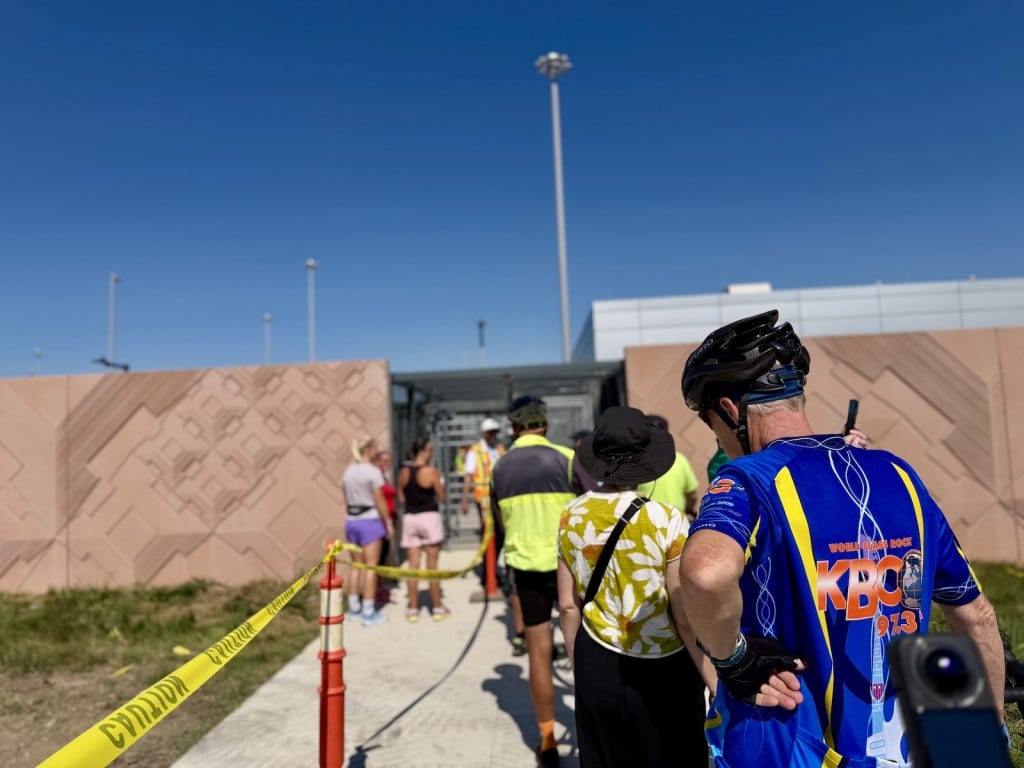
Guards at the gate were making sure only 250 people were on the path at a time. A few would come out of the border checkpoint, and a few would be allowed to trickle into the entrance. I stood there for a long time in the bright sunshine and the growing heat.
They finally opened the gate for me and my bike. Sunburned and a little delirious, I started pedaling through a caged pathway. It was enclosed, sides and top, a tunnel of fencing — security is tight at the entrance. There will be no unchecked people hopping onto this path.
Climbing uphill, towards the sun, I round a gradual curve. The towers appear, their sweeping cables holding the mass in the sky. This isn’t infrastructure; it’s art. A monument that one can picture a couple hundred years from now standing as a symbol of the 21st century’s hopes and dreams.
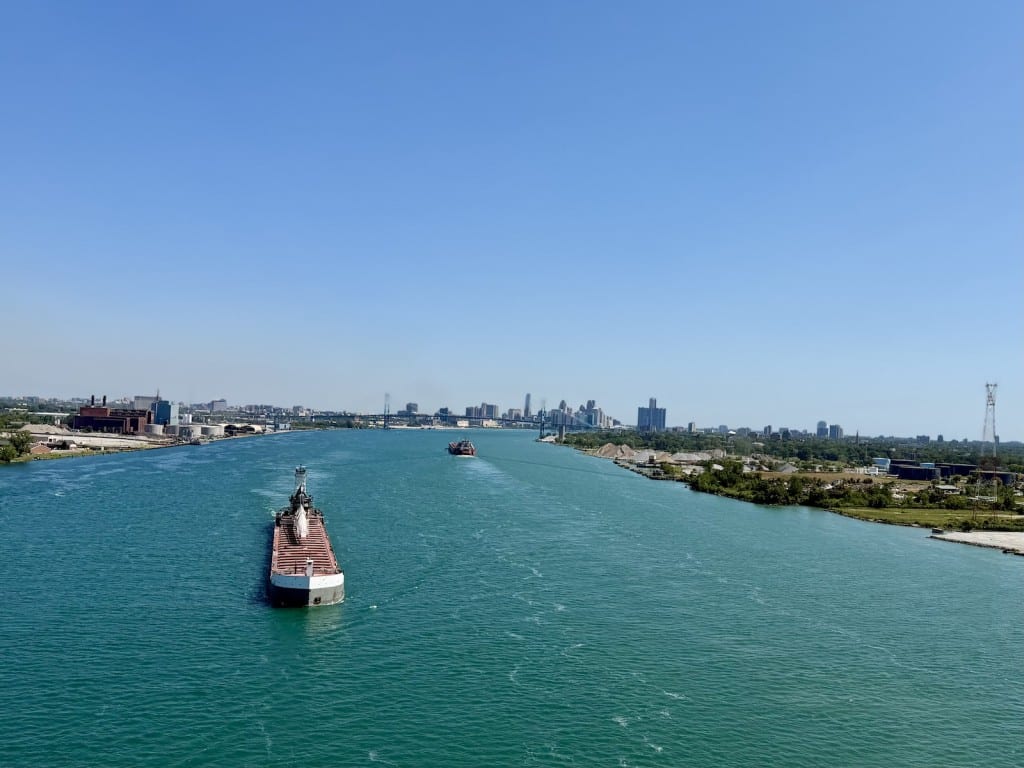
Even the safety fence is art. Angled white rails that reveal, if you look directly to your left (or right if headed the other way), the skyline of Detroit, the Detroit River, barges and boats.
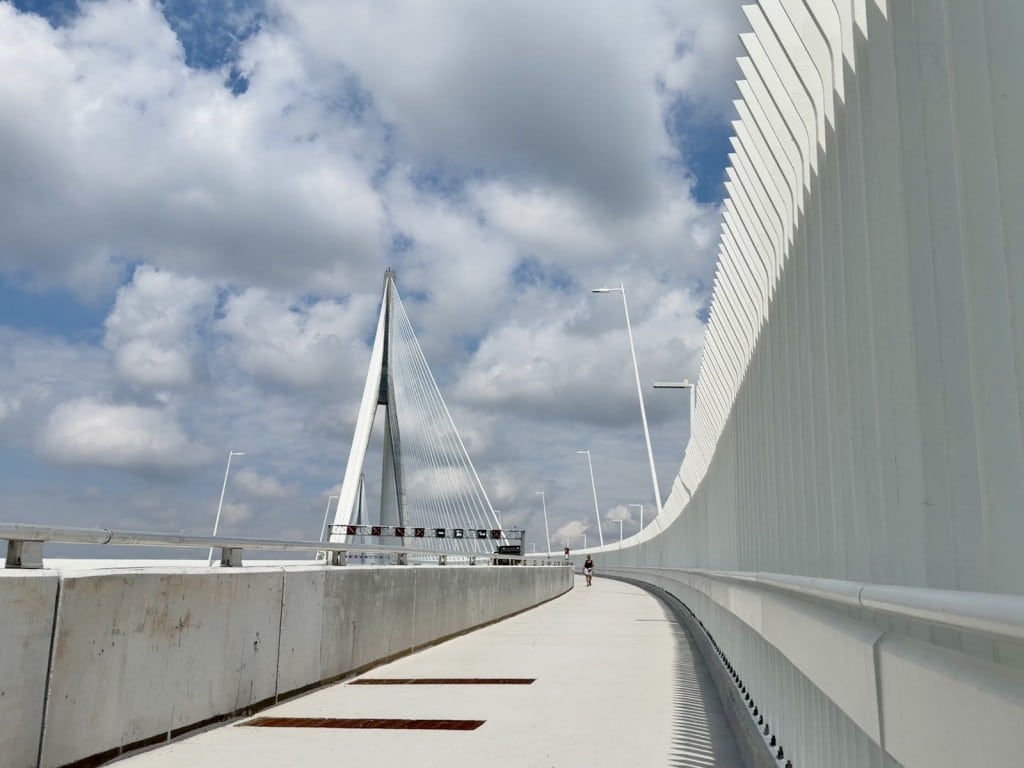
It’s a climb of 150 feet in elevation, at a grade between 3% and nearly 6%. That’s not too difficult, but you’re climbing for half the bridge’s length, nearly 5,000 feet. I was huffing and puffing, shifting down to the lowest gear, finding many excuses to stop and take photos.
Eventually the surface levels out, and you’ve reached the top of the hill, the borderline. Gathered at the border crossing were smiling Canadians and Americans, walkers and bikers, kids, families, elders. We mingled, enjoying a moment of history.
And it’s all downhill from there. I had to ride my brakes, careful to ring my bell before passing people on foot.
Getting closer to the end, I feel more and more…. Canadian? No, I’m still the American, the Yank, the foreigner. I simply feel more relaxed. There’s a weird tension in our country these days, you have to admit. It’s good to get outside of it.
Sandwich had a big welcome for the bikes, with information tables laid out along with bike racks that were all full by the time I got there. Lunch and a celebratory Canadian rye at Jake’s Olde Towne Tavern on Sandwich St., then off to wonder at the mural of Col. Prince and the prisoners.
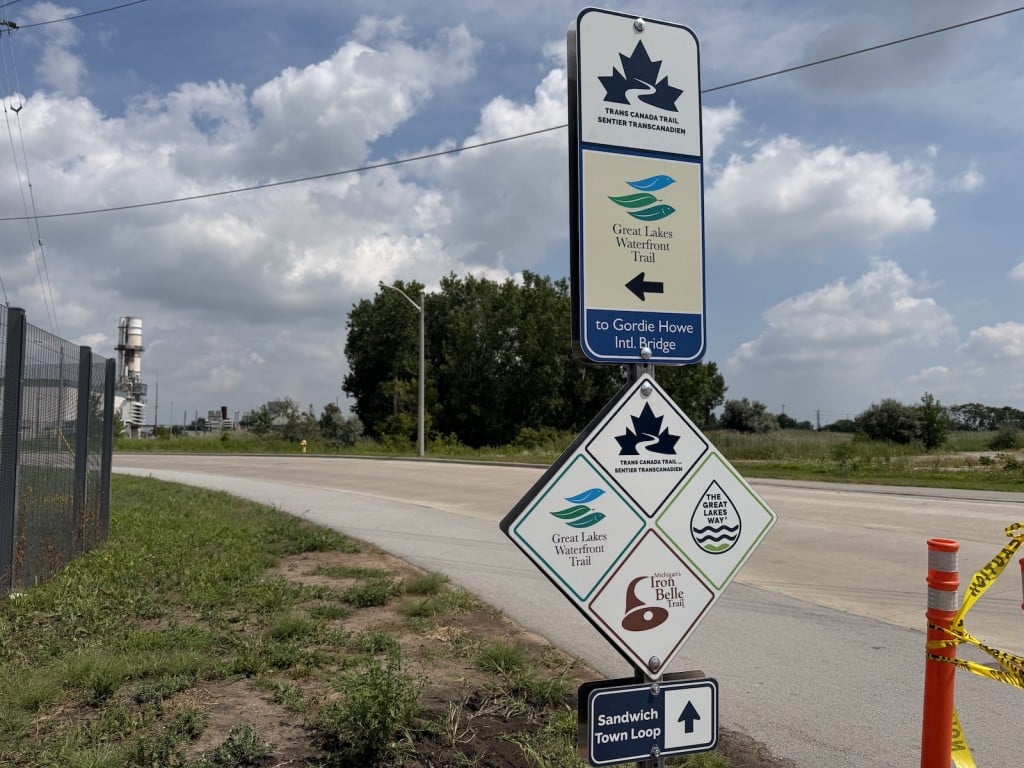
A night in Windsor, some meandering up and down the Canadian shore of the Detroit River, a visit to a black oak preserve, and back over the Gordie I go.
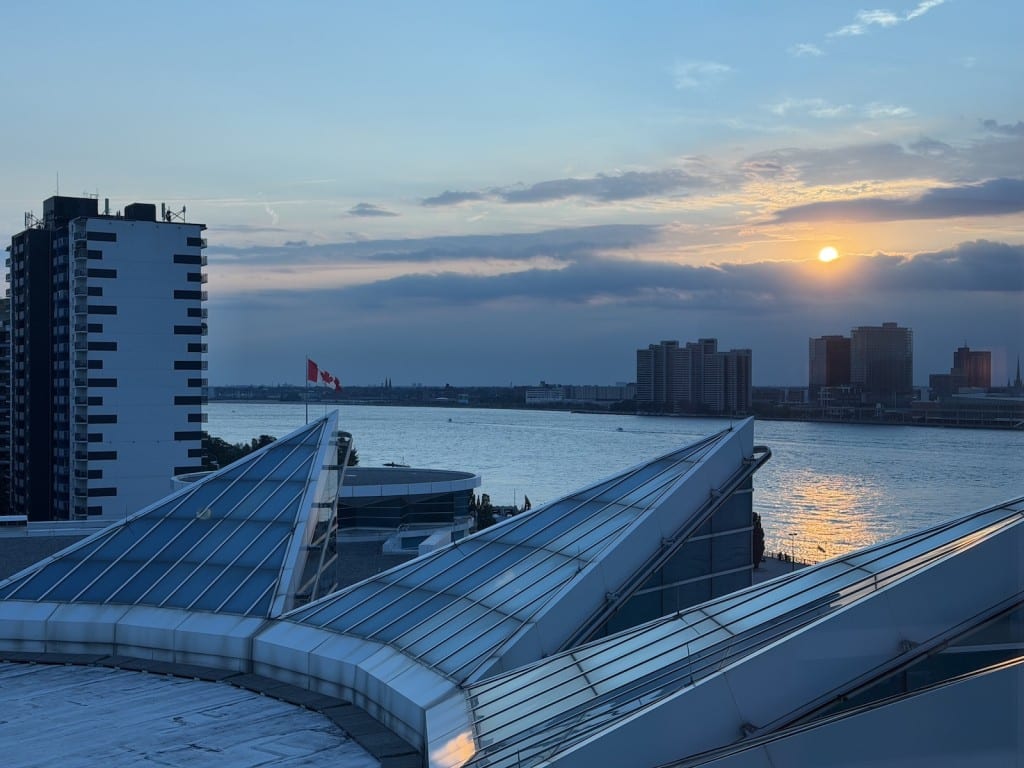
The second day was the first day of regular use, with families and seniors walking, a couple of joggers, and a few bikes from janky beaters to expensive road bikes. It felt like non-motorized travel over the border could be a normal thing — yet it’s still amazing.
“A human connection”
Somewhere on the bridge, in the opening day’s crowd, were other Kalamazooans: Channon Mondoux, Director of Canadiana Fest/Can-Am Peace Jam, and Kalamazoo City Commissioner Jeanne Hess. Canadiana volunteer Karen Burton also went along.
Mondoux, born in Canada, had invited Hess, whose family came from Canada, to walk across the Gordie on the first day. “How cool is that?” Hess says.
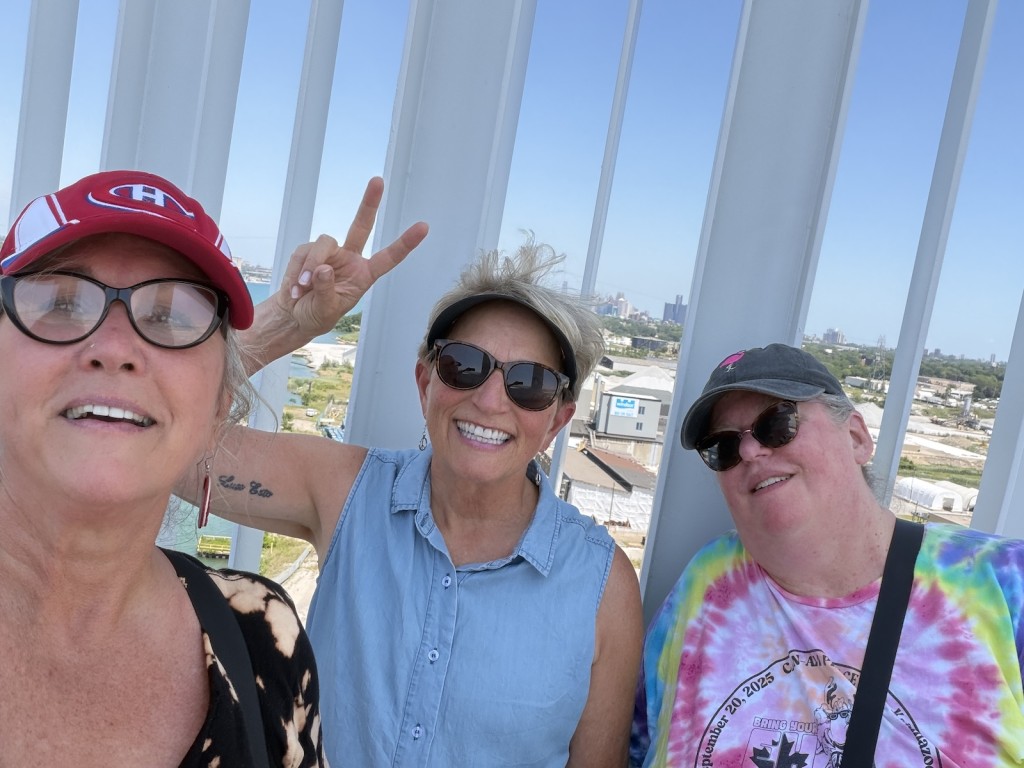
Hess points out the practical benefits of the new bridge for our area. Traffic, commercial and otherwise, will be headed to and from the crossing, passing Kalamazoo on I-94. “It’s an international connection from here, from Kalamazoo,” Hess says.
But experiencing the Gordie outside of a motor vehicle hits a very different way. “When you see the sign right there in the middle of the bridge — this is the U.S., and this is Canada. Something shifts, there’s a shift saying, this is not, you know, our country,” Hess says.
“I love, love, love the pedestrian/bicycle connection on this bridge. It made it more of a human connection,” Hess says.
Hess says they drove over to the Canadian side and walked over and back. “It showed me the power of the human connection and how that can totally enhance our lives and bring us to more joy. All I felt on Wednesday was joy…. And you didn’t have to say, ‘Are you Canadian? Are you American?’ It’s like, ‘Hello, fellow human. Let’s celebrate the joy of this beautiful bridge.'”
Mondoux says, simply, she “was in tears” crossing the bridge.
Mondoux is very Canadian, very Windsor. When she was a toddler, her father jokingly told her she was born “in that little Chinese house by the river” — an old restroom shelter with a pagoda roof that still stands on the Windsor Riverwalk by the Ambassador Bridge. Her parents had to be called to the school when she told her kindergarten teacher that.
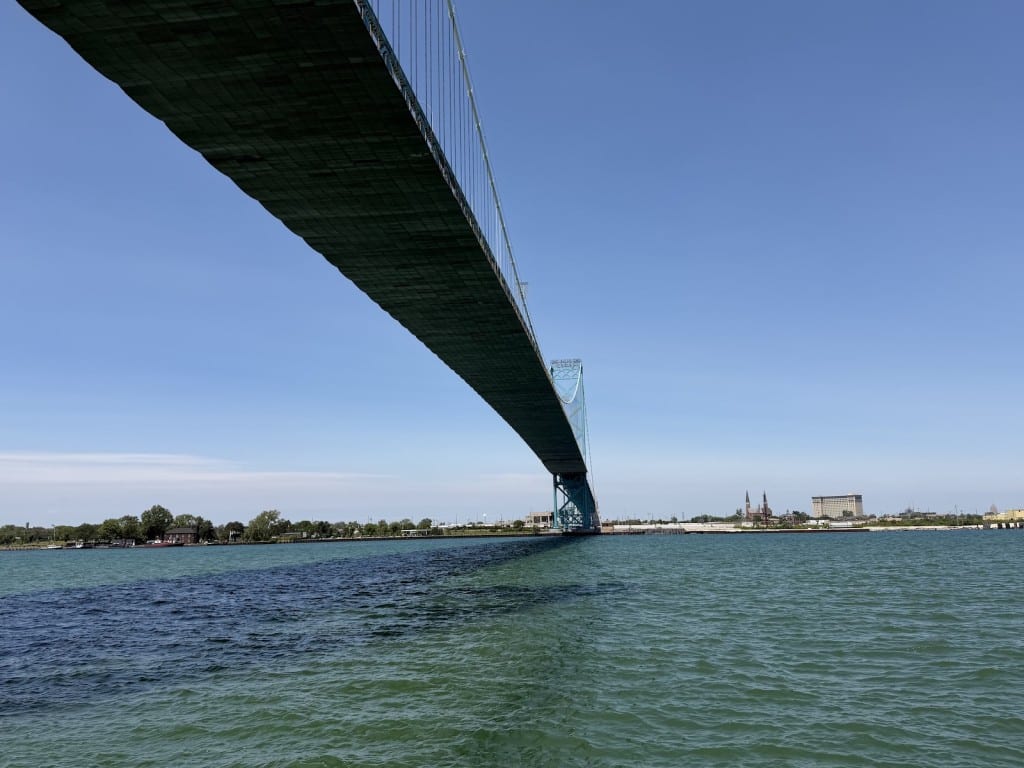
She lived in the shadow of the Moroun family’s bridge, among its traffic, “the constant stream of transport trucks.”
Mondoux remembers being nearly hit by a truck coming off the Ambassador Bridge when she was 11. The old bridge has caused congestion and pollution in downtown Windsor for decades, Mondoux says.
The effort to add another border crossing, one that was Canadian-owned and controlled, goes back to 1998, driven by former Windsor MP Brian Masse, she points out. One of the hopes was that it would bring relief to the city by easing traffic on the Ambassador.
The Moroun family wasn’t happy with that plan, with having a competing bridge a few miles away. Now the current U.S. administration has been demanding some control.
“Despite, you know, the overarching scope of political stuff, put that all aside,” Mondoux says. “This is an enormous win for not just Windsor, not just Detroit, but for all of North America. And it was championed by Canadians who would not give up, which tells you a lot about our character. So I’m very proud.”
Is it all about Howe’s “elbows up” spirit?
“Elbows up is a defensive stance, right? It’s not an offensive stance. It’s defensive. It’s to protect,” Mondoux says. “It’s a position of, ‘I’m standing my ground.’ And that’s why I love that phrase, ‘elbows up,’ because I’m not here to punch you in the face. I’m here to protect my own.”
The Gordie Howe Bridge multi-use path is free and open 8 am to 8 pm. A Michigan enhanced license or passport is needed to cross. As of now, e-bikes and scooters are not permitted, but may be after safety reviews.
Kalamazoo’s Can-Am Peace Jam (formerly Canadiana Fest) takes place Sept. 19 at Arcadia Creek Festival Place.
Author
Related Articles
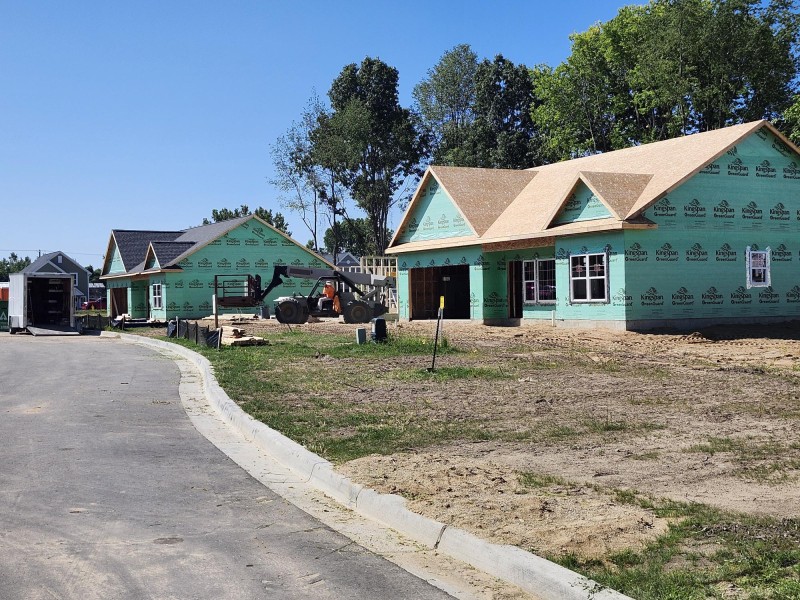
Community Land Trusts in Portage and elsewhere help residents become homeowners affordably
As the statewide housing crisis continues, communities of all sizes are looking at how to increase affordable housing options for current and future residents. In Kalamazoo County, the Portage Community Land Trust is helping residents become homeowners affordably with their new workforce housing development, Stanwood Crossings.
Packed Kalamazoo forum grapples with fear, rights, and how to protect neighbors
Kalamazoo residents packed a public forum to learn their rights, discuss safety, and organize community response amid growing fears of ICE activity.

OPINION: Here is one solution for the problem of social media and political violence
The intensity of America’s political culture that factored into the assassination of conservative influencer Charlie Kirk has intensified the scrutiny of the role of social media.