Viable housing is the baseline for thriving communities. It links many priorities, says national community development leader.
LISC leader is working to build relationships in visits across the country.
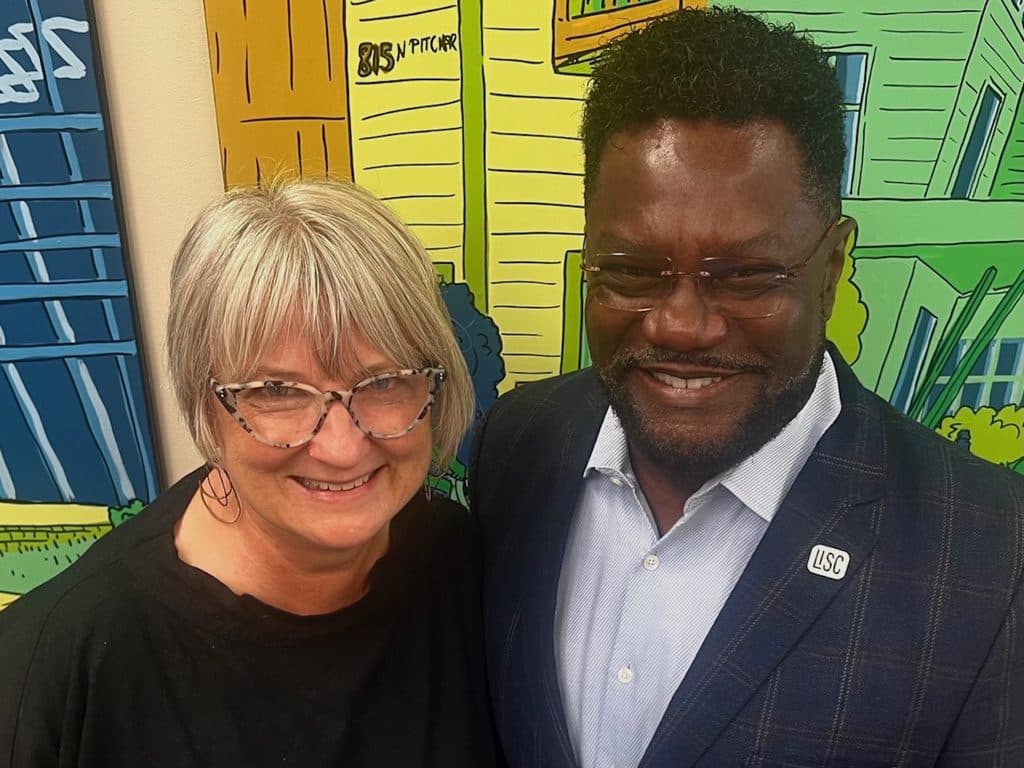
KALAMAZOO, MI – Housing is the starting point for every conversation in every community that LISC serves, says Michael T. Pugh.
The president and chief executive officer of the nation’s largest community development financial institution has been visiting LISC communities across the nation to help them create housing solutions tailored to the needs of each community.
“That’s how we spend our time,” Pugh says of Local Initiatives Support Corporation. “Housing is the starting point for every conversation in every community that we’re in. And then we work around that to look at the other needs of the ecosystem. So once you get housing – in terms of preservation or needing to be developed – how do you then start to think about other key needs like the support of small businesses? Child care? Health care?”
Pugh, who assumed the top leadership role of Local Initiatives Support Corporation in August of 2023, has been working to set a clear strategy and path for how the organization’s 38 metro-area program offices can effectively work with public and private organizations to deliver fair and equitable housing and revitalize communities.
Its Kalamazoo office invests in the creation of affordable housing, the development of commercial and retail space, and the creation of economic opportunity in Kalamazoo and Battle Creek. It has channeled some $43 million into those communities since 1988, and that has helped leverage a total of $297 million worth of investments here.
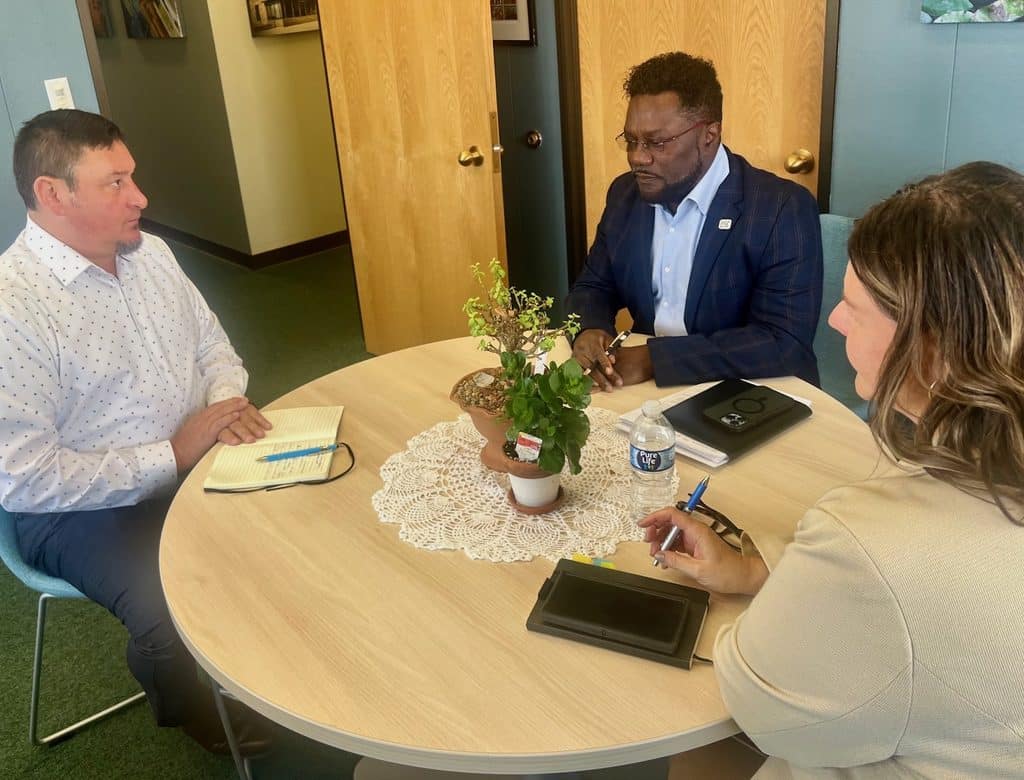
“While housing sits at the epicenter of everything we do, the approach and the delivery is very localized,” Pugh said during a visit here earlier this year. “And so the importance of coming to Kalamazoo and understanding what the issues and priorities are here – between private sector, public sector, partnerships, foundations being involved – those are all very important things because then, from my seat, I can be a much stronger advocate and also figure out how to support funding.”
LISC employs more than 500 employees nationwide and has invested more than $30 billion in deserving communities nationwide since it was founded in 1980 with $10 million in seed money from the Ford Foundation and six corporate partners.
Investments have come in the form of loans and grants to support affordable housing, small businesses, health, education, and other ventures, with LISC striving to bring together public, private, philanthropic, and government leaders to support and plan development and community improvement projects.
Jackie Koney, executive director of LISC Kalamazoo, says LISC program offices benefit from being part of a national organization that provides operating systems, capital, and ideas. It is now helping to bring city, county, financial services, and other officials together here to institute a program to help people of limited means to retain homes that are passed down to family members, often without a will.
“Let’s say grandma owned a house and she never went through probate and said who’s supposed to get the house,” Koney says. “Her family is still living there, and she passes on. The people living in the house may be paying taxes on the property, but they don’t get access to any kind of home-repair programs or tax-abatement programs because they can’t prove they own the home. These are called Tangled Titles.”
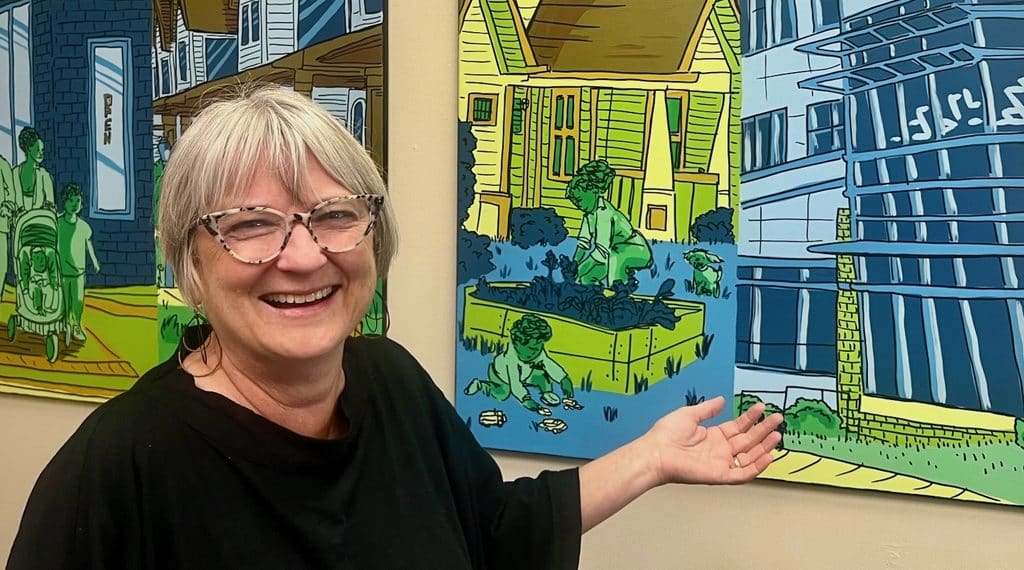
The idea behind a new LISC program called the Heirs Property Program is to help them untangle the titles so they can keep the house in the family and avoid letting it fall into massive disrepair, and avoid being purchased by an outsider or investor.
“We want to keep wealth in the family,” Koney says. “We want to keep the most important asset that a family has in that family. And that helps us keep displacement from happening.”
The Heirs Property Program has been seeing success over the past two years at LISC in Jacksonville, Fla., and it is being scaled to use at other LISC communities. Koney estimated that it may benefit about 500 families in Kalamazoo.
Pugh says LISC doesn’t have answers to fix all things. But, he says, “What works for the organization is that we are one of the most competent organizations working as an intermediary. We understand how to bring public and private partners together, and we do that in a number of critical ways.”
The most important way may be by providing technical assistance that helps prospective partners understand the real issues they face, then galvanize a plan to find the capital needed to address those issues.
Koney, who joined LISC a year ago, says she thinks technical assistance is what sets LISC apart when coaching tenderfoot property developers and small business owners to clear project hurdles. “Literally, someone will come in and say, ‘I have an idea. But I have no idea how to do this,’” she says.

Without assistance, she says, “Not only would these emerging developers not get funding from traditional banks, they’d never get the hand-holding that we do.”
LISC walks them through the development process and connects them with public and private help.
“It’s a source of pride for us when a developer gets to the point where we’ve helped them all along the way, and we’ve provided them capital, but then they can go ahead and access bank money,” Koney says.
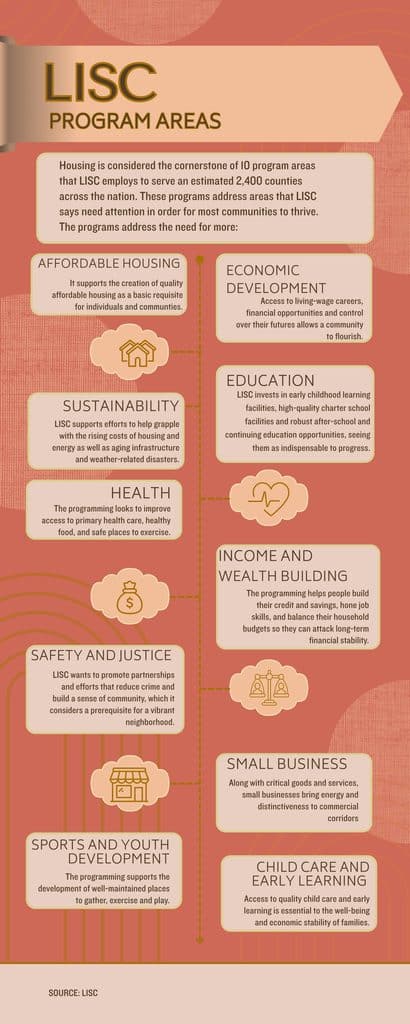
Housing is considered the cornerstone of 10 program areas that LISC employs to serve an estimated 2,400 counties across the nation. The programs address areas that it says need attention in order for most communities to thrive. And Pugh says, “You have to implement these other support systems and programmatic things that allow communities to have opportunities to thrive.”
For example, in one of the program areas, child care, LISC promotes the development of facilities for daycare within housing developments, and it encourages landlords to allow space for such things as home daycare businesses in single-family housing. LISC believes there are a lot of childcare “deserts,” which hinder parents’ work opportunities. But LISC doesn’t own or operate any early childhood programs. It serves as an intermediary and structural support organization for those who do.
Various program areas merge as the organization promotes workforce development. LISC has, for instance, paired young people with local companies that train them to become energy-efficiency technicians. The young people then use those skills to help homeowners develop plans to upgrade their windows, insulation, furnaces, and other systems.
Asked about trends he sees across the United States, Pugh says he is excited that communities are continuing to embrace the need for more effective economic development. That is occurring in the face of federal policy changes that could make the philanthropic community and private-sector partners nervous. While federal dollars may be dwindling, “We have seen a resounding level of support,” he says, referring to local people.
“We have very strong partnerships on the public and private side,” Pugh says. That includes 220 of the nation’s top 1,000 companies. “We are the largest community development financial institution of our kind.”
New York-based LISC has offices in 38 urban areas (including Kalamazoo, Flint and Detroit), but they support programs in hundreds of rural areas in 44 states. It touts its success at channeling some $3.1 billion into projects last year. And according to information provided by the nonprofit organization, its workers helped preserve or create 25,000 housing units in 2025, compared to 12,000 to 15,000 housing units in previous years. Last year was the first of a three-year strategic goal to try to preserve or create 57,000 units.
Koney and LISC’s six-person local staff is working on a three-year strategic plan that she hopes will, among other things, make sure that local organizations work in unison rather than step over one another or let some projects fall through the cracks.
“We have a lot of plans in this town,” she says. “We have a lot of great ideas. We have a lot of resources. We have people doing great work. But what we need some assistance with is making sure that we’re all working together, that we all understand everybody’s roles. … And make sure that there’s someone leading the group in implementation.”
She says she thinks Kalamazoo and Battle Creek need “some structural work to happen around collaboration, setting goals, and determining who’s doing what.”
LISC also plans to focus on more small-scale projects over the next two to three years. Koney envisions a program for emerging developers. “So, trying to get more locally based developers up and running, and running faster so they can do small-scale development in their own communities,” she says.
Koney says that is very important because small companies tend to hire more local workers for their projects. Her organization also hopes to help them find a steady pipeline of work so they can keep the workers they hire.
Will we ever really have affordable housing?
Pugh says he sees no evidence that housing is going to become affordable across the board. So it’s going to continue to be a challenge for many people to find and for communities to build. But he expects LISC to continue to be a part of the solution.
Koney says housing needs to be built in multiple styles and at multiple levels — from Low-Income Housing Tax Credit units to market-rate properties. There are lots of tools to help projects work, she says, but developers will have to connect with state and federal sources for support, as well as private funders and investors.
“We need all kinds of housing,” she says. “We need multi-family (housing). We need single-family. We need duplexes. We need all different kinds here.”
Pugh says, “When we would have talked about ‘affordable’ housing 20 years ago, most would assume that you’re talking about people who are extremely low-income. Today we’re talking about an affordability crisis for working people – nurses, teachers, first-responders, people who have to have a roommate or no chance at all to have a home.”
About Michael T. Pugh

Pugh, who was born and raised in Detroit, has a history of helping underserved communities. That was built during a 30-plus-year career in banking and finance. The Eastern Michigan University graduate started as a teller at Citizens Financial Group and rose to other positions there before joining Capital One for Eastern Maryland, Delaware and Washington, D.C. He joined Carver Federal Savings Bank in New York in 2012 and was named its CEO in 2015.
That bank was founded in Harlem in 1948 to serve an African-American community that was excluded from access to financial services elsewhere. It is now one of the largest Black-owned and operated banks in the United States. Pugh is credited with reinvesting the bulk of its deposits back into the community north of Manhattan, and leading its upgrade in technology to facilitate expansion into other states. He also introduced nontraditional services to help entrepreneurs and small business people obtain financing. Pugh joined LISC in 2023.
Author

Related Articles
Mt. Zion’s Legacy Senior Living opens with a legacy church member as its first tenant
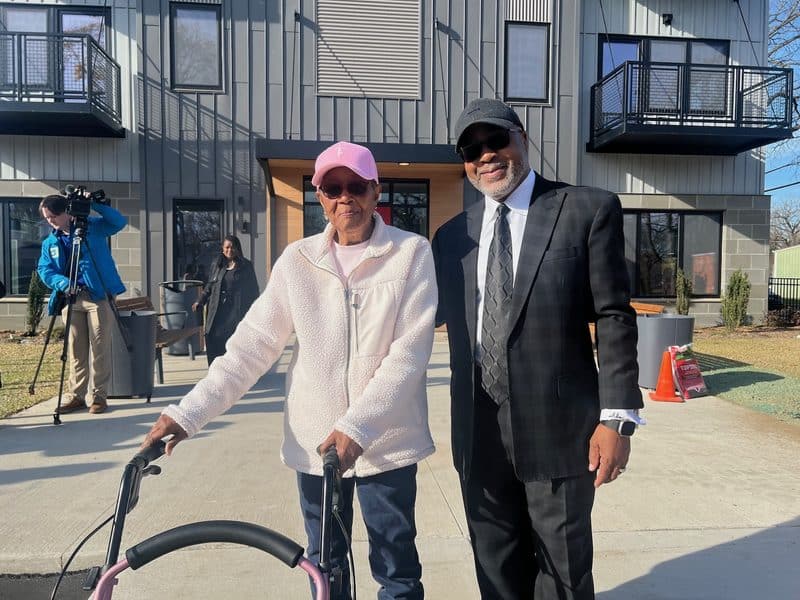
The 70 unit affordable-housing development, built for $27 million, includes a 34-unit North Building at 128 E. Frank St. and a 36-unit South Building at 127 E. North St.

Affordable housing for seniors gets an $11.7 million investment in Kalamazoo’s Edison Neighborhood
City View In The Square is for people age 62 and older with annual incomes less than $44,280. Qualified residents pay no more than 30 percent of their annual income in rent.
Gimme shelter: Kalamazoo agencies reset program to bring the homeless in from the cold
Kalamazoo County is reinvesting in trying to help the homeless come in out of the cold this winter.