
Kudzu and Japanese Knotweed: Two invasive plants, one ongoing fight
The Van Buren Conservation District is continuing efforts to eradicate Kudzu in Southwest Michigan while encouraging residents to help identify and report both Kudzu and Japanese Knotweed, two aggressive invasive plants that threaten native ecosystems and infrastructure.
Editor’s Note: At the height of the growing season, we are sharing information on how to detect and remove two Southwest Michigan invasive species, Kudzu and Japanese Knotweed, both of which are on the Michigan Invasive Species Watch List, and which have been a greater threat in recent years due to a warming climate. The first piece on Kudzu is courtesy of the Van Buren Conservation District. The second piece on Japanese Knotweed is by Mark Wedel, and while it was published 10 years ago, it continues to be one of Second Wave’s most-read pieces of the decade.
Kudzu: The vine that ate the South
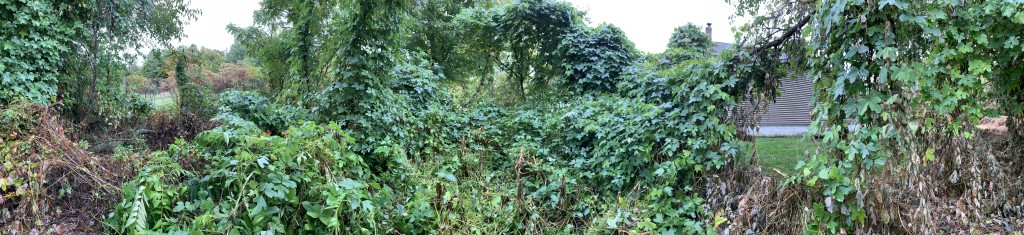
This year, the Cooperative Invasive Species Management (CISMA) Team of the Van Buren Conservation District is continuing efforts against invasive Kudzu. Kudzu is known as the “vine that ate the South,” and its woody vines can grow up to one foot per day. The CISMA Team will continue survey and treatment efforts at the four known kudzu locations in Southwest Michigan.
Two of these locations are very close to being considered officially eradicated. The other two locations have been improving every year since management began in 2021. The Team will also search for kudzu populations that may not have been discovered yet. If new locations are found, CISMA will begin treatment at those locations, pending landowner permission.
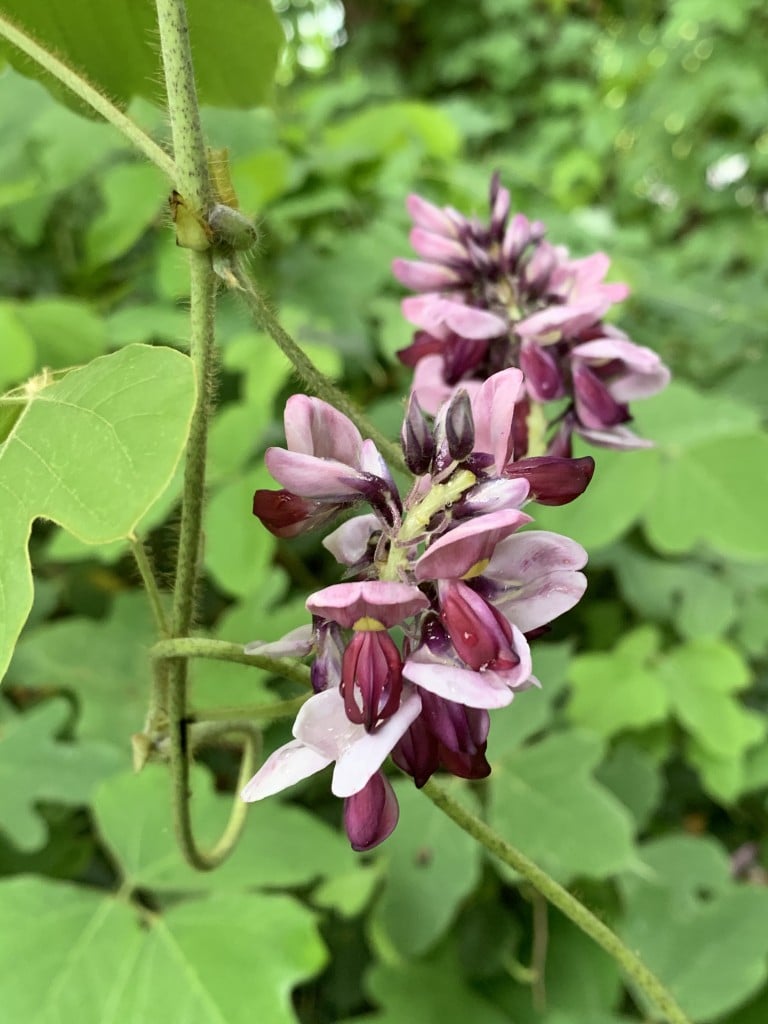
Kudzu’s vines and large, fuzzy, compound leaves can shade out other plants. It can outcompete native species, sometimes killing trees and causing them to fall. Kudzu grows from root crowns that you can see at the soil level. One root crown can sprout up to 30 vines. If unchecked, these vines can take root and develop more root crowns. Kudzu also has showy flowers that bloom in August to September and can be white, purple, or even deep red.
The CISMA Team would appreciate Southwest Michigan residents keeping an eye out for this invasive vine. Please note that poison ivy is often mistaken for kudzu. This is because both plants have woody vines and similar-shaped leaves. However, kudzu has uniquely fuzzy leaves and young vines. Also, the lobes of kudzu leaflets are generally more rounded than those of poison ivy.
You can easily make reports using an app called iNaturalist. Make a free account, and then you can make reports in minutes with a smartphone! You can also contact the CISMA Team with any questions you have. If you think you have found kudzu, email pictures and location information to StrikeTeam@VanBurenCD.org, or call or text 269-366-7287.
To treat kudzu, the CISMA Team will use backpack sprayers to apply herbicides on the leaves of this plant. CISMA may also cut woody vines and treat the stumps with herbicide. These herbicides will have the active ingredients glyphosate or triclopyr. Anyone treating kudzu with herbicides will be MDARD Certified Pesticide Applicators. Applicators will use techniques to reduce herbicide exposure on off-target plants and in water bodies.
The Japanese Knotweed: Don’t try to kill this invader on your own (Feb. 19, 2016)
In February, Japanese Knotweed looks like dead reddish-brown bamboo stalks poking through the snow. But when spring arrives, this monstrous invader will be back. And a growing Kalamazoo coalition of invasive-species fighters will be waiting for it.
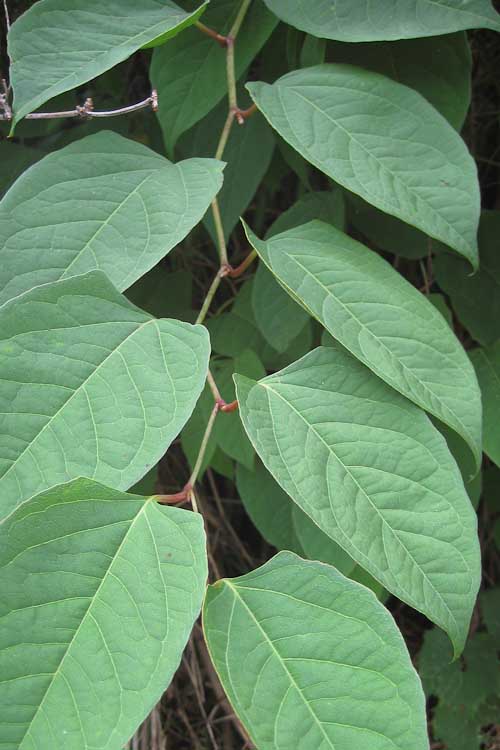
Sometimes known as “Mexican bamboo” or “Michigan bamboo,” Japanese Knotweed bursts up over the summer with massive red-green stalks and broad leaves. The plant displays sprays of stems lined with little white flowers in the late summer, when it can shoot up to form huge walls of green.
With its attractive appearance and ease of growth, knotweed had been sold and planted in yards around the area — before it was outlawed in 2005.
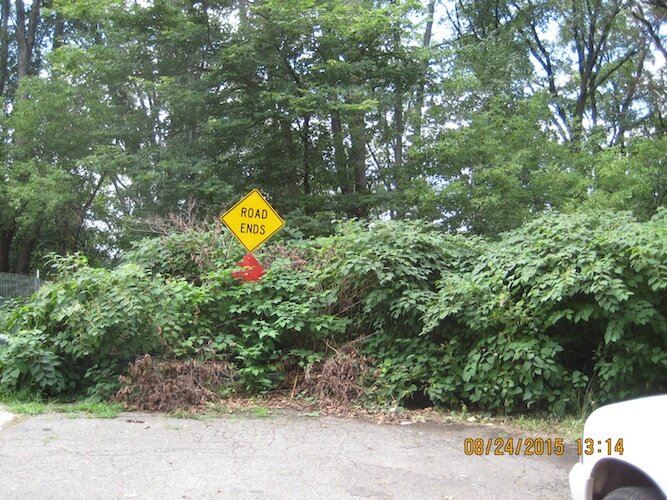
Today, it’s illegal to move or plant knotweed, but it is legal to have it growing on your property (local ordinances may vary). If you see it in your yard, approach with extreme caution. It’s the Incredible Hulk of plants. Whatever you do, don’t make it angry.
It’s not easy to get rid of. If you mow it down, it spreads. If you dig it up, it spreads. Tiny bits of it can take root anywhere. Toss “dead” knotweed into a compost pile, and that pile becomes your next knotweed patch. If you spray common glyphosate herbicides like Roundup on it, it explodes with growth.
Its indestructibility is explained by the fact the plant evolved to thrive on the volcanoes of Japan. It grows a massive root system, which can be 90 percent of the total plant. The root mass slowly stores up energy for hardship periods, for example, when lava covers it. So you can’t even kill it with hot asphalt–it will eventually burst through. This power makes it into a destructive monster. It can break through pavement, foundations and other infrastructure.
Discovery of a monster in Kalamazoo
The City of Kalamazoo hired Hannah Hudson last summer as the tall grass and weeds inspector. She has a background in natural resources, but had never heard of Japanese knotweed. She quickly learned its monstrous ways.
Hudson says the plant doesn’t make her think of the Hulk. It reminds her of “Day of the Triffids,” a 1951 novel, 1962 movie, and 2009 BBC series where “alien plants come to earth, wreak havoc,” she says.
Her favorite line from the old movie: “It’s just a plant! It has to have some weakness!”
While preparing to deal with unmowed lawns and poison ivy, she heard about a resident in the Oakwood neighborhood who’d been complaining to the city for several years “about this monster plant — if you cut one stalk, a few days later, several new stalks are in its place. It’s growing into the alley and kids can’t ride their bikes, people can’t get through…. It almost sounds crazy, but I work with plants, so it’s not completely impossible. Though it is kind of crazy.”
Hudson inspected the site, took photos, and sent them to the Kalamazoo Nature Center’s Great Lakes Ecological Management team.
The team’s field director, Ryan Koziatek, recognized it as a damaging invasive species he’s dealt with since starting land management work in 2008.
Word was passed to Susan Tangora, invasive species coordinator of the Michigan DNR Wildlife Division in Lansing.
Tangora knows the weed well.
She recently visited a 90-year-old homeowner in Livingston County. Japanese knotweed is invading his home from a neighbor’s property. “It’s growing up through his sidewalk, it’s coming through the foundation. He doesn’t have the money to deal with it,” Tangora says.
“He’s just trying to keep his yard mowed. He was struggling so much,” she says. “The homeowner was trying to cut it down — but that made it worse.”
Tangora has a ready list of individuals, businesses, and cities that have seen their investments ruined when the weed breaks through new driveways, takes over mowed fields, and bursts through building foundations.
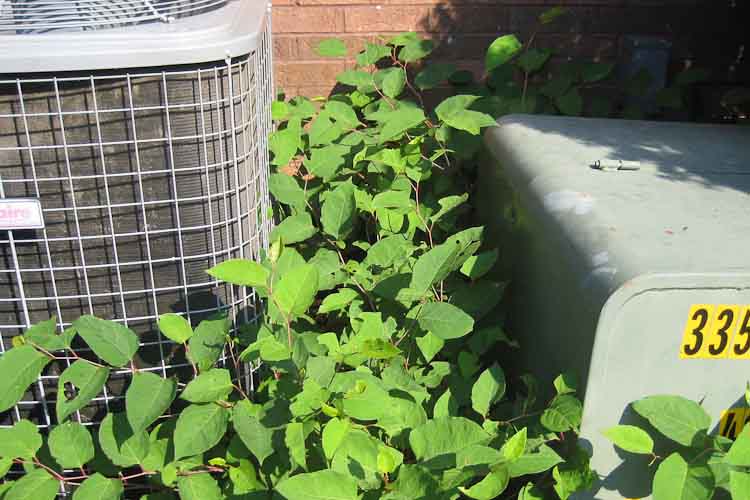
While driving along Michigan roads, one can see where “uninformed roadside maintenance crews” have mowed roadsides, resulting in “these long linear patches of knotweed now taking hold.” It’s since become a major — and expensive — MDOT concern.
Tangora has many Michigan horror stories, but what’s frightening her the most is the way the knotweed has taken over the United Kingdom. It’s possible that it could get that bad in Michigan.
The weed was introduced to the U.K. in the mid-1800s and became a popular ornamental plant sold by nurseries in the following decades.
Knotweed is known to behave itself for a generation or two, building up growth potential in its root system. When conditions are right — usually under stress of some sort — the plant explodes with growth.
Tangora calls it a “time-bomb,” which has exploded all over the U.K. “That’s what we’re really headed toward…. They say that no hectare in the U.K. does not have knotweed on it.”
It’s ruining property value all over the United Kingdom, she says. They’ve learned to treat land it’s grown on “just like a toxic spill, they’re determining that those soils are now infected and need to be removed as if it were a toxic substance… it can re-sprout from any little fragment.”
Not to be too alarmist, but Tangora also brings up a 2013 United Kingdom case in which stress over the knotweed may have triggered a murder/suicide.
Good news, the plant has a weakness: Information
“I’ll get a lot of gardeners saying, ‘I’ve seen this around for years, it’s not a problem.’ Sure, if you have one patch and you don’t disturb it, if you leave the giant sleeping, you may not have an issue with that plant,” Tangora says.
Sooner or later, though, someone might wake the giant.
A major goal for coalitions sprouting up around Michigan is to get the word out. Once people find out its destructive potential, knotweed starts to “rally communities,” Tangora says.
Towns in the Upper Peninsula and northern Lower Peninsula have begun work on controlling the weed, she says. Treatment is possible, often involving years of injecting the right herbicides into the plant. The other method of control is simple education.
When asked about nightmare stories in the Kalamazoo area, Tangora says she’d rather mention a “success story” about a Kalamazoo city weed ordinance inspector who “sounded the alarm” after discovering knotweed.
That’s Hannah Hudson.
After seeing the weed in the Oakwood neighborhood, Hudson began spotting it on her daily rounds. She saw it breaking through a Kalamazoo laundromat parking lot, infesting dead ends on the east side, thriving on the Kalamazoo River’s banks, taking over an area farm. She sat in on St. Joseph city commission meetings on how the weed was spread during the installation of that town’s new sewer lines.
She realized that it wasn’t only a threat to Michigan’s wilderness and rural areas, it was also a big urban threat. “It destroys city infrastructure,” Hudson says.
Hudson downloaded an app by MSU’s Midwest Invasive Species Information Network that can help a citizen scientist identify and report invasive species. While doing her rounds, she’d drop a pin on its map to report knotweed infestations. In three weeks, she dropped about 15 pins on the Kalamazoo area.
Hudson educated residents with an article in the city’s “View from the Curb,” the publication on waste, recycling, and yard issues. That drummed up reports of other patches.
Her position with the city is seasonal (Hudson will return as an inspector May 1), but she’s continued gathering contacts and information for the city. She’s working on a web page about the weed, and expects it on the city’s site by the end of February. She is also behind “Fighting the ‘Bamboo’ in Kalamazoo” Facebook page, not affiliated with the city.
CISMA to the rescue
Meanwhile, the Nature Center’s Koziatek has been helping to organize the Cooperative Invasive Species Management Area for Barry, Calhoun, and Kalamazoo counties.
A Cooperative Invasive Species Management Area (CISMA) is a partnership of federal, state, and local governments, and other groups and individuals, combating invasive species.
On Feb. 11, the Michigan Invasive Species Grant program awarded $3.6 million to 19 CISMA’s and others around the state. The Nature Center’s CISMA got its share, a grant of $276,846.
The money will pay for invasive outreach educators in the three counties, and help identify high-priority areas needing treatment.
“It’s a lot of area to cover,” Koziatek said. A major goal of the education effort is to make sure there are more citizen scientists and property owners who can spot and report invasive species. Reciprocity is key to the fight, with education and treatment leads coming from the CISMA, and reports of weeds coming from many eyes on the ground.
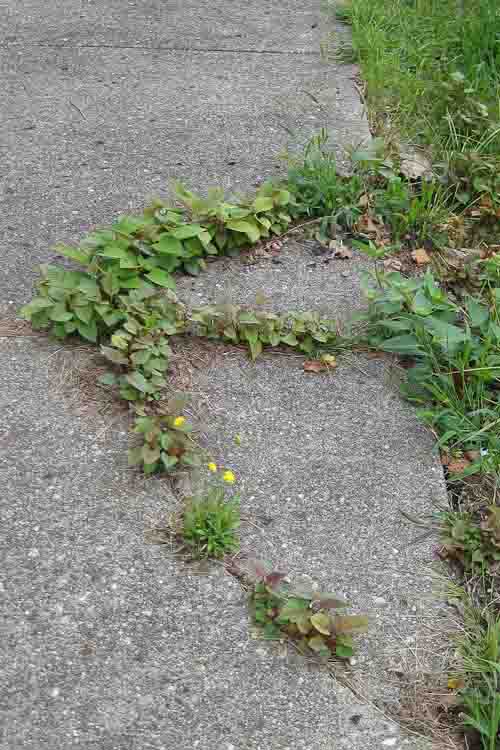
So, what are citizens to do if this knotweed might be that plant that’s taking over their property?
“No Mow!” Koziatek says is a good motto to keep in mind. Identify it, and contact the Nature Center’s CISMA or the Midwest Invasive Species Information Network. He also recommends downloading the MISIN app to help identify and report.
Don’t try to eradicate it yourself. The CISMA is forming “strike teams,” Koziatek says. If they can’t help, they’ll find someone who can. They hope to find ways to share costs with property owners, find grants and other funding sources to help eliminate a patch.
“This spring, we are going to be getting a lot of public outreach, asking for information from the communities,” he says, “not only to get an idea of where some populations might be, but to also work together to come up with treatments and solutions that are both safe for people and the environment, and be most effective and efficient for removing those plants.”
It needs to be repeated: Knotweed cannot be treated like your usual Michigan weed.
“That’s what makes dealing with invasive species such an intriguing and complicated endeavor, they are plants we’re not used to seeing,” he says.
Koziatek adds, “Learning about invasive species, we learn about ourselves and the world around us.” We have to “understand what some of our actions in the past have done,” he says.
“The world around us, which we’re not separate from, is poking us in the side, saying, ‘ Hey, not everything is as easy as it seems. There are such things as unintended consequences. Things we might not be able to predict.'”
Authors


Related Articles
Nature beneath the power lines: Transforming utility corridors into public trails
In Portage, trails through Consumers Energy Co. utility corridors offer a place to encounter nature close to home, as well as a look at what sharing a landscape entails.

From 65 farms to one table: Allegan County celebrates local food
Allegan County will celebrate its farmers, food and community Sept. 25 with a farm-to-table experience featuring local food samples, a performance of “Seedfolks,” and a community dinner and conversation at Griswold Auditorium.
From cannabis to AI: Proposed Kalamazoo data center sparks questions about its future in Milwood
A proposal to convert a former Kalamazoo cannabis grow facility into an AI data center has sparked community debate over its potential impacts.