Work with HeroRATS brings praise for WMU professor
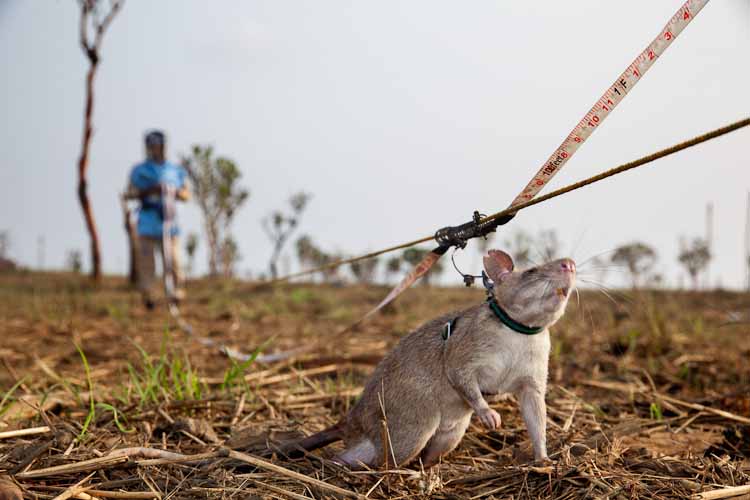
Dr. Alan D. Poling has done years of work with rats that detect landmines that now is being recognized for the good it is doing across the globe.
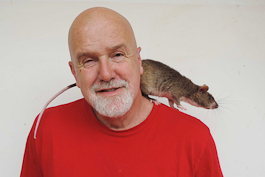
The American Psychological Association has given its highest honor to Dr. Alan D. Poling, a Western Michigan University psychology professor for his work with rats that have been trained pinpoint buried land mines and identify tuberculosis in laboratory samples.
It’s one of three awards Poling has received this year. He has been recognized by the California Association for Behavior Analysis for his lifetime contributions to behavior analysis. He also was recognized by the Society for the Advancement of Behavior Analysis, which presented him with its 2016 Award for Scientific Translation.
He has worked since 2009 with APOPO, a Belgian humanitarian organization based in Tanzania. APOPO trains African giant pouched rats. The rodents—known as HeroRATs—offer a cost-effective way to detect these two scourges in low-income and low-resourced countries.
Poling says the rodents are so light they hardly ever trigger a mine, and they have highly sensitive noses as well as several behavioral characteristics that keep them healthy and working hard.
“They’re remarkable in their physical abilities,” Poling says. “They climb well. They dig well. They’re quick. And they learn readily.”
APOPO’s founder, Bart Weetjens, recognized the potential value of detection rats in 1998. His organization spent years breeding, domesticating, and training HeroRATs. Poling joined the team in 2009 to help on multiple fronts. He worked to increase its research capacity, improve the scientific rigor of that research and further streamline rat-training processes. He has been going to Tanzania periodically since then, often with students.
Weetjens says at first APOPO wasn’t producing many scholarly papers, so not everyone appreciated what HeroRATs could do. He credits Poling with the steep increase in overall reliability and effectiveness of detection-rat technology in recent years and for scientifically substantiating the rats’ value as land mine and TB detectors in Africa and Asia.
“If APOPO’s HeroRATs were finally accepted as a reliable detection tool, credits go to Dr. Poling and his researchers,” Weetjens says. “Looking back over the last seven years…it is not exaggerated to claim that Dr. Al Poling and his team of researchers have significantly impacted humanitarian action in the world.”
Source: Western Michigan University
Related Articles

GVSU Symposium brings national voices together to support Black men and boys in Battle Creek
More than 500 people gathered in Battle Creek for GVSU’s Black Men and Boys Symposium, focused on improving educational, health and career outcomes.

Don’t wait: Local housing advocates explain what to do when eviction looms
Facing eviction in Kalamazoo? Local housing advocates, fair housing experts, and Legal Aid attorneys explain tenants’ rights, common eviction pitfalls, and the critical steps to take before a housing dispute leads to court.

Poet’s Press: Medicine of the Edison
For our third edition of Poet’s Press, we feature a poem about Kalamazoo’s Edison Neighborhood by Jezreel Cruz alongside the artwork of Savannah Scheffers.