Kalamazoo

Kalamazoo’s name is so distinctive strangers around the world have been known to break into song at hearing the name. With such a recognizable moniker you’d think Kalamazoo wouldn’t need nicknames, but through the years changing names have reflected the city’s refusal to stand still. The Zoo, Celery City and the Mall City are a few. The innovative thinking that brought downtown K’zoo the nation’s first pedestrian mall in 1959 continues to work today. Innovators have developed thriving life sciences, biotechnology and pharmaceutical firms. They build on the expertise of Kalamazoo’s universities. Western Michigan University, Kalamazoo College, Kalamazoo Valley Community College and Davenport College all are centers of research, development and technology. They surround a downtown vibrating with condos, apartments and homegrown, top-notch restaurants. The universities are woven into the city’s social fabric and contribute to a cultural scene that Kalamazooans love to boast about. The Kalamazoo Symphony, Kalamazoo Institute of Art and a vibrant local theater community are a few of the offerings. Locals also love their festivals that fill the air with music and the scents of ethnic foods wafting over the Arcadia Festival grounds and the Kalamazoo River. Outdoor activities from biking on the Kal-Haven trail to disc golf and standard golf on a nationally-acclaimed course in Milham Park are the start of the city’s leisure side. Sports fans have competitive college teams, minor league baseball and hockey to follow. And it all comes with a Promise. All high school graduates who live in Kalamazoo qualify for a scholarship that pays 100 percent of their tuition at any public university or community college.

Pulling out all the stops to woo Google

The full press is on to convince Google to make Kalamazoo one of its test sites for its ultra high-speed broadband network. As the Friday March 26 deadline approaches to apply to be one of several trial locations around the country, city officials,  local boosters and residents are holding meetings, recording video pitches to Google and spreading the word in a number of ways to anyone who will listen, asking them to join in in nominating Kalamazoo. Support has been building in the Kalamazoo area ever since the project was announced.In Kalamazoo Wednesday, March 24,  there was a town hall meeting to talk about why Google Fiber is important. Residents were asked to share their thoughts on video in hopes to convince Google decision-makers that Kalamazoo is the right place for the pilot project, which would provide a fiber-optic network to at least 50,000 homes and businesses at 200 times the current speed, at a price Google says is comparable to existing services. The local grassroots effort, Kalamazoo Google Collaborative, is bragging about Kalamazoo's past and present innovations, its prime location between Detroit and Chicago and its dedication to education as witnessed by the Kalamazoo Promise, a college scholarship program for all grads of Kalamazoo Public Schools, and four institutions of higher learning — Western Michigan University, Kalamazoo College, Davenport University and Kalamazoo Valley Community College."Many people may not know that Kalamazoo has quietly taken risks and leads the nation in many ways throughout its history," says Kalamazoogle.com backer and  Newmind Group Owner Daniel Jefferies. "From the science and innovations of Upjohn and Stryker, to its downtown walking mall, to the role in creating one of the first public high schools, and most recently the creation of the Kalamazoo Promise."Over the weekend, supporters passed out 30,000 fliers about the project in hopes of encouraging nominations for Kalamazoo. Official support for the effort has come from the cities of Kalamazoo, Portage and at least 13 of the county's 15 townships.Writer: Kathy JenningsSource:  Daniel Jefferies, Newmind Group

WMU takes first step toward medical school

Western Michigan University has taken the first of five steps that could lead to national accreditation for establishing a medical school with its partners Borgess Health and Bronson Health Care.The process is moving forward thanks to a $1.8 million anonymous gift made to provide seed money for the next steps in the process, including the accreditation application and the search for a founding dean for the school. The dean search was launched in February.A school of medicine in Kalamazoo has been under discussion and in the planning stage since late 2007. Representatives of Borgess, Bronson and WMU traveled to Chicago for the initial meeting with the Liaison Committee on Medical Education in January to begin the accreditation process.To get the process under way, WMU filed a formal letter of intent with the accrediting body for medical schools in the United States, the Liaison Committee on Medical Education (LCME).Western is one of seven schools now seeking accreditation that have "applicant school status." To achieve that status the LCME must determine the university meets basic eligibility requirements to proceed with accreditation. The school also must pay $25,000.In the next step, the university earns "candidate status." In that step the school submits the required medical education database and planning self-study documents. They must be get a favorable review from LCME. At that point the accrediting body schedules a visit to the school.In the subsequent "preliminary accreditation" step, the LCME reviews a report from the team that visited the school and determines whether the program leading to the M.D. degree meets LCME standards.Once preliminary accreditation is granted, the program may begin to recruit applicants and accept applications for enrollment.In the fourth step in the process, "Provisional Accreditation," the LCME reviews the school's progress toward implementation of its medical degree program and evaluates the status of the school's plans for later stages of the program. If LCME determines that its standards are met, it can vote to grant "provisional accreditation." Once provisional accreditation is granted, enrolled students can continue their third- and fourth-year medical studies. Enrollment of new students can continue.A "full accreditation" survey visit  takes place late in the third year or early in the fourth year of the curriculum. The survey team then prepares a report of its findings for consideration by the LCME. If the survey team determines the M.D. program fully complies with all standards, a vote to grant "full accreditation" for eight years is taken. The clock on the eight-year full accreditation status starts when the program was first granted preliminary accreditation.Writer: Kathy JenningsSource: Cheryl Roland, WMU, and the Liaison Committee on Medical Education

National community enrichment program comes to Kalamazoo, Comstock

Temple University in Philadelphia has picked two Kalamazoo County Foundation projects to be a part of the school's national intitiative to create opportunities for young and old to live and work together. Local residents and the foundation worked for more than a year to figure out how to foster connections across generations and to develop projects based on what they learned. The acceptance from Temple's Intergenerational Center, which administers the Communities for All Ages, CFAA, project, will help those projects go forward. Specific programs to be implemented are in Comstock Township and the Northside neighborhood of Kalamazoo. It also brings dollars to implement the projects.Each will receive a $20,000 grant for each of the next two years for a total of $40,000. Temple is supplying half and the Community Foundation matches it. The two projects came about after a lot of ground work at the neighborhood level. Team members went door-to-door in specific number of blocks on the Northside. They found people worried that some youngsters are not ready to take advantage of the Kalamazoo Promise when they graduate from  high school, says Amy Slancik, of the Kalamazoo Community Foundation. A project working with middle school students in an Alternative Middle School connected with New Genesis Learning Center has been proposed.The hope is that the experience gained here will be applied to other communites, says Carrie Pickett-Elway, of the Kalamazoo Community Foundation.In Comstock Township, the teams on the project suggested the development of a Community Service Corp to build connections among residents who did not feel connected to their neighbors and who did not know how to connect to availablw services. One possibility is that the Community Service Corp be located in the Comstock Commuity Learning Center. The center is slated for renovation this summer. Work on the two projects is ongoing. The Kalamazoo Community Foundation is one of six community foundations working on the CFAA initiative. The work was in part made possible by a grant from the W.K. Kellogg Foundation, based in Battle Creek. In total, CFAA works with 25 urban and rural communities to promote the well-being of all age groups.Writer: Kathy JenningsSources: Amy Slancik, Community Investment Officer, Initiatives, and Carrie Pickett-Erway, Senior Community Investment Officer, Kalamazoo Community Foundation

Internships aim to keep young pros in Michigan

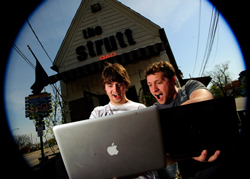
The availability of internships has been shown to help states keep educated young people from fleeing for other places to live and work.The importance of Internships definitely is on the rise. According to the National Association of Colleges and Employers, the percent of interns converted to full-time employment rose form 35.6 percent  in 2001 to 50.5 percent in 2008.Kalamazoo Valley Community College's Lois Brinson-Ropes, the internship coordinator for the Student Employment Services, works with local employers to find the right young people for intern positions, which ideally bring an advantage when seeking full-time work.KVCC's Community Partners Internship Program has recently arranged for five winter semester placements. They are:-- David Curtis, a graphic-design major, Paw Paw Wine Distributors.-- Graphic-design/illustration student, Amy O'Donnell, Wraps & Signs By Trim It.-- Brittany Bauman, another graphic-design enrollee, The Strutt.-- Morgan Wellman as an administrative assistant, Abies Chiropractic Clinic.-- Chelsea Spencer, a business-administration major will do a marketing internship at Global Clinical Connections, which is located at M-TEC of KVCC and sponsored a graphic-design intern during the fall semester.The placements are funded for a three-year period by the KVCC Foundation. With $100,000, at least 55 students can be placed with enterprises interested in a grow-your-own-workforce alliance.The bulk of the grant funds is being used to pay up to 50 percent of the wages for each intern. The companies they work for pay the balance. The program runs through December of 2011.Salary terms are established on a case-by-case basis and agreed upon prior to the start of the internship.  The pay can range from the minimum wage of $7.40 to $12 per hour.An internship usually lasts 15 weeks, but students can apply at any time and assignments are made year-round.Writer: Kathy JenningsSource: Lois E. Brinson-Ropes, KVCC

Business booms nationwide for Kalamazoo’s iyeTek

Demand keeps growing for software developed for law enforcement agencies by the Kalamazoo information technology company, iyeTek.When iyeTek moved into Western Michigan University's Business and Research Park two years ago it had six employees and three interns. Today, 10 employees are on staff, and at any one time six to eight interns work on the company's software solutions for law enforcement agencies. Those are now used in 28 states compared to eight states that used iyeTek two years ago.When it moved into the research park in March 2008, iyeTek occupied 1,300 square feet of space at 4664 Campus Drive. Business has been so good since then the company has nearly doubled the amount of space it uses.The company's various software, including electronic ticket writing and crash reporting systems and information sharing with local, state and federal agencies, is now used all across Michigan. The software is used in handheld and mobile devices.Company co-founder and Director of Operations Salman Anwar gives much credit for the company's success to the support it has gotten in the BTR Park and its partnership with WMU. Among iyeTek's successes is the crash reporting system that has proved to be the most popular of its products, Anwar says."We're making the roads safer for people who drive on a daily basis," Anwar says. The iyeTek crash reporting system is one way it does that. The system helps police officers document crash details that give law enforcement agencies and traffic engineers information to analyze. It can help them determined the causes of crashes and also lead them, if need be, to take actions to make roadways more safe. "It's all about saving lives of police officers and citizens," Anwar says. Another popular software package involves information sharing that alerts officers during traffic stops and calls to be notified of any NCIC — National Crime Information Center — and FBI warnings related to a vehicle or suspect.The company was founded in Kalamazoo by Anwar and Jeremy Vainavicz, both alumni of WMU's College of Engineering and Applied Sciences.Writer: Kathy JenningsSource Salman Anwar

$350,000 supports WMU’s study of greenhouse gas storage

A total of $350,000 in grants to Western Michigan University will further studies into greenhouse gas storage as the push for clean coal energy heats up.WMU researchers are looking for ways to further develop clean coal technology by capturing the greenhouse gases it creates and storing them deep under the earth.Success could mean economic development opportunities for the state, including the creation of high-tech jobs, more affordable energy costs for consumers and reduction of pollution from the gases.The research, which has been ongoing in some form at WMU for six years, recently got a boost of $350,000 from federal stimulus funds.Most of the money comes from the U.S. Department of Energy and the University of Illinois, which is studying four states for their suitability to store the greenhouse gas or CO2. Together, they contributed $306,000. The remaining $44,000 comes from the Department of Energy and Wolverine Power Supply Cooperative Inc., a nonprofit member-owned utility in Cadillac and is being used for engineering design and cost estimates for the capture of 1,000 metric tons of CO2 per day from a proposed power plant in Rogers City, MI.In science-speak, what WMU is doing is carbon capture and geological carbon sequestration research. In layman's terms, they are looking at deep geological formations underground in Michigan to figure out if they could be used to store captured carbon gases.Dr.David A. Barnes, professor of geosciences at WMU, is the principal investigator on the two research projects funded by the American Recovery and Reinvestment Act of 2009."Fossil energy has been fundamentally responsible for development in modern industrialized societies, but the associated greenhouse gas emissions are seriously threatening our environment," Barnes says. "The capture and deep geological storage of greenhouse gas emissions provide a critical bridging technology as we move, as aggressively as possible, to renewable energy technologies."Writer: Kathy JenningsSource: David A. Barnes

Studio 246 writes a new script

In the new script theater lives long and prospers. Downtown, at Studio 246, they're keeping the spirit of alternative theater alive. With a little help from their friends, they're fixing up the place and everyone's invited to see what's up next.

Eaton Corp.’s hybrid system powers buses for the military

The federal government has purchased 35 fuel-sipping shuttle buses outfitted with hybrid electric power systems developed in Galesburg bythe Eaton Corp. The U.S. General Services Administration,using stimulus funds from the American Recovery and Reinvestment Act,bought the buses for use on U.S. Military bases. They will replace older, less efficient models, according to the GSA.Last year,the GSA announced it would spend $77 million in stimulus funds to buy3,100 fuel efficient hybrid vehicles. Altogether a hybrid fleetis expected to save an estimated 16.7 million gallons of fuel over thenext seven years. Using the vehicles could prevent the release of 334million pounds of greenhouse gases into the atmosphere. The hybrid system used in the shuttle buses was developed at Eaton Hybrid Power System headquarters in Galesburg with assistance from the company's division in Southfield. Bus manufacturer Capitol Coach Works, Inc. of Capitol Heights,Md., purchased the system to use in the shuttle buses.  The hybrid business has proved to be a growth area for Eaton and the company has hired 10 engineers in the past year to support it. Buses powered by Eaton's hybrid power system have the pontential to have a big impact on environmental sustainability, says William Batten,Director of Government Accounts for Eaton's Vehicle Group."We've seen many positive results from commercial customers around the world,"Batten says, "and we hope that this announcement will lead to overall greater acceptance of hybrid technology within the U.S. federal fleet."Vehicles with Eaton hybrid systems typically see fuel savings up to 35 percent, with similar percentages in emission reductions. The vehicles also have extended brake life and idle time reductions of up to 87 percent. Writer: Kathy JenningsSource: William Batten, Eaton Vehicle Corp.

Local company’s parts help build soccer-playing robots

High school students around the world are building competition robots with parts provided by Parker Hannifen in Otsego.Parker Hannifin donated brass fittings and valves — a contribution valued at between $10,000 and $50,000 — in the kit of 577 items given to teams of robot builders as part of the  competition, which combines science, technology and a sporting event. A variety of companies provided part for the kits used in US FIRST — United States Foundation for Inspiration and Recognition of Science and Technology - competitions worldwide.US FIRST was founded in 1989 to inspire young people's interest and participation in science and technology.As part of the FIRST Robotic Competition, teams of high school studentsreceive motors, batteries, a control system, a PC and a mix ofautomative components. No instructions on how to assemble a robot areincluded. Instead, teams work with mentors to build, design, programand test their robots over a six-week period. The goal of the competition is to put the latest technology in the hands of students, give them the opportunity to use the same tools as professional scientists and engineers and ultimately impart skills they could carry into the workplaceThe robot-building kits were distributed to more than 1,800 teams of high-school students in January. More than 45,000 students from 12 countries will design and build robots for regional competitions, which are now underway. The world championship is scheduled for April 15-17 in Atlanta. Participants are eligible to apply for nearly $12 million in scholarships offered by universities, colleges, and companies.This year's competition is called Breakaway and it calls for robots that can shoot soccer balls into a net,  drive over a bump to round up soccer balls,and hang suspended from a tower. Robots that can hang from another robot earn extra points for their team.Paul R. Gudonis, of FIRST, praised Parker Hannifen for its contribution, saying the Fluid System Connectors Division has helped "to create a world where science and technology are celebrated… where young people dream of becoming science and technology leaders."Writer: Kathy JenningsSource: Paul R. Gudonis

Wind-turbine technician academy ready for second go round

If you can function in tight quarters and work at great heights Kalamazoo Valley Community College's unique wind-turbine technician academy is looking for you.Applications are being accepted for the second 26-week program slated to begin June 1.The academy has 16 openings for students this year and the program is growing with funding from the federal government and instruction opportunities from a private donor.The federal government, through the United States Department of Education's Fund for the Improvement of Post Secondary Education, kicked in $550,000. KVCC is awaiting word on how it will be able to spend the money on the program.A new opportunity for hands-on-experience comes from Crystal Flash Renewable Energy, of Grand Rapids. Academy trainees will work under the supervision of professional wind-turbine technicians, climbing the tower with them to learn preventive and corrective maintenance."This represents a way for us to invest in the future of the industry," says Martin Hamilton, of Crystal Flash Renewable Energy.The academy can be completed in six months, making the program attractive to retraining workers. The program also provides graduates with the credentials that are highly sought after by the wind-power industry for the construction, operation and maintenance of utility-size wind turbines, according to Cindy Buckley, executive director of training.KVCC's wind-technician academy is certified by the leading trainer for wind-turbine technicians across Europe and Asia — Bildungszentrum fur Erneuerebare Energien (BZEE). (That's "Renewable Energy Education Center" in English.) The certification makes academy graduates that much more attractive to employers.Companies already are contacting KVCC to find out how they can meet the academies graduates, Buckley says."The projection is that between 1,500 and 2,400 new technicians are needed annually to support the growing wind-energy industry," Buckley says. "Starting wages range from $14 to $21 per hour."Applications to the wind-turbine technician academy are accepted throughout the year. Qualified applicants who do not get into the June 1 class will be placed on the waiting list for  training that begins in December. A math test, results of a medical exam and documentation work experience in technical fields are part of the screening process. Writer: Kathy Jennings Source: Cindy Buckley, KVCC

Our Sponsors

Gilmore Foundation

Our Media Partners

Battle Creek Community Foundation
Enna Foundation
BINDA Foundation
Southwest Journalism Media Collaborative
Southwest Michigan First
Milestone Senior Services
Consumers Energy

Common Ground Is Brewing

Support local stories and receive our signature roast straight to your door when you join at the Standard level (or above).

Drink Better, Read Local

Close the CTA

Don't miss out!

Everything Southwest Michigan, in your inbox every week.

Close the CTA

Already a subscriber? Enter your email to hide this popup in the future.