PitchMI offers Michigan startups a shot at $1.25 Million
Recognizing that lack of capital is a leading cause of startup failure, Michigan’s PitchMI competition offers young companies a chance to secure up to $1.25 million in funding while showcasing the state’s growing innovation ecosystem.
Editor’s Note: This story is part of Momentum: The people and companies shaping what’s next, a weekly series that explores new ventures, founder support, and the resources powering entrepreneurship and small businesses across seven counties in Southwest Michigan. This project is sponsored by Southwest Michigan First.
Most new businesses don’t fail because of a bad idea — they fail because they run out of money. Whether it’s insufficient cash flow, weak revenue, or a lack of funds to pursue growth, financial shortfalls are often the deciding factor.
Michigan is doing something about this, and one way is an annual chance for a young business to win more than a million dollars. This is through a statewide competition in which entrepreneurs make a presentation to try to convince judges that their business most merits investment and expert support. The contest is called PitchMI (pronounced pitch-me) and is organized by the Michigan State University Research Foundation and the Michigan Economic Development Corp.
PitchMI 2027 will start with four preliminary, industry-specific rounds to be held this fall in four cities: Sept. 15, Grand Rapids, defense and aerospace; Sept. 22, Kalamazoo, artificial intelligence and software; Sept. 24, Marquette, advanced manufacturing, materials, and outdoor innovation; Oct. 1, Detroit, healthcare and life sciences. The winner in each category will advance to the championship contest next spring.
PitchMI 2026 attracted 375 applicants from more than 100 cities and towns throughout Michigan, and more are expected to enter the next competition. The application process will be announced this summer. To be eligible for PitchMI, a startup business must be headquartered in Michigan, must have been founded in 2021 or later, must have earned less than $1.5 million in revenue during the past 12 months, and must have less than $2.5 million in dilutive funding. Such funding is external investment in a business in exchange for partial ownership.
From the hundreds of applicants for PitchMI, five are selected for each of the four preliminary, industry-specific rounds. The winner in each category gets a $250,000 prize and advances to the championship contest. The champion wins $1 million, so the entrepreneur collects $1.25 million total.
Money for PitchMI mostly comes from the $60 million Michigan Innovation Fund created in early 2025 by the Michigan Legislature.
The lead organizer of the pitch competition is Pete Martin, director of portfolio management for the MSU Research Foundation. “This is the largest pitch competition that Michigan has ever done,” he says. “It’s one of the largest in the country. I think it’s one of the largest in the world.”

The research foundation has many partners across Michigan that promote PitchMI. For the Sept. 22 artificial intelligence and software competition in Kalamazoo, partners include Kalamazoo Forward Ventures and Startup Zoo. Martin expects at least 200 people to attend. “We’ll see students, investors, other founders, probably legislators, and folks in corporations that are interested in these industries.”
He continues, “The purpose of this pitch competition is not just to be loud about something, but to actually wrap our arms as a state around the companies that are building here and help them succeed. We know that the companies that are building here are great, and this pitch competition is primarily designed to say, ‘Hey, world, look at the great things that are happening here.’ That’s so everyone in Michigan can see it, but also so people outside of our state can see it, too.”
PitchMI received funding from the Michigan Innovation Fund for two years of operations. “We’re hopeful that we’ll be able to continue this for a very long time. I think the data speaks for itself that this has been wildly successful,” Martin says.
“We got roughly a million dollars of state funding; we co-invested, so we had $2 million. We had venture-capital funds co-invest with us, and then, because we were able to validate that these startup companies are worthy, the 20 companies that participated this past year raised $8 million. So a $2 million pitch competition turned into $8 million that was raised across these companies that participated. And that is much faster than a founder in the Midwest would typically see.”
Author

Related Articles

Gene the Pumpkin Man’s legacy lives on at Evans Acres
After 67 years of growing pumpkins and creating fall memories, the late Gene “Pumpkin Man” Rhodes’ family legacy continues as Evans Acres Family Farm opens with plans to offer year-round family experiences.

‘We go where they are’: Lucinda Stinson’s vision for a more connected Rotary
Lucinda Stinson, the new president of the Rotary Club of Kalamazoo, aims to broaden the organization’s community outreach, increase its diversity and engage members more directly with people and neighborhoods in need.
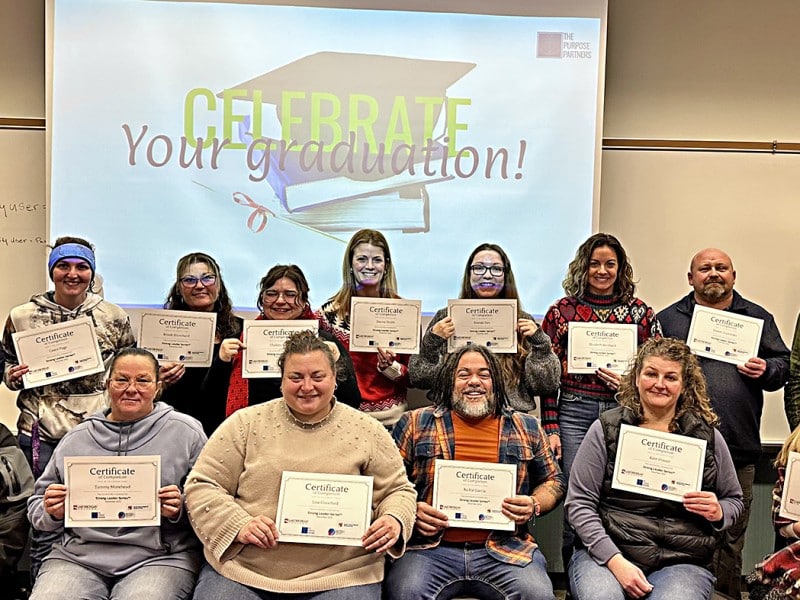
Strong Leader Series offers practical leadership training for Southwest Michigan
The Strong Leader Series offers Southwest Michigan professionals a three-part, hands-on opportunity to strengthen communication, strategic thinking and team-building skills while learning to lead more effectively.