
Packed Kalamazoo forum grapples with fear, rights, and how to protect neighbors
Kalamazoo residents packed a public forum to learn their rights, discuss safety, and organize community response amid growing fears of ICE activity.
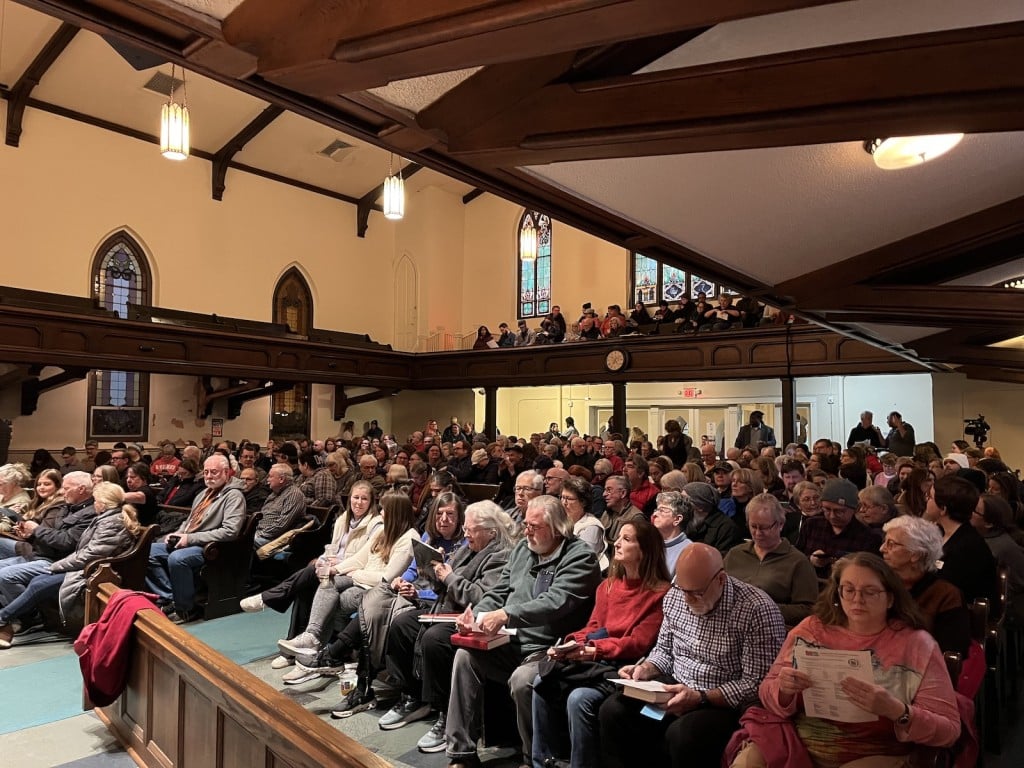
Editor’s Note: All photos were taken by Mark Wedel.
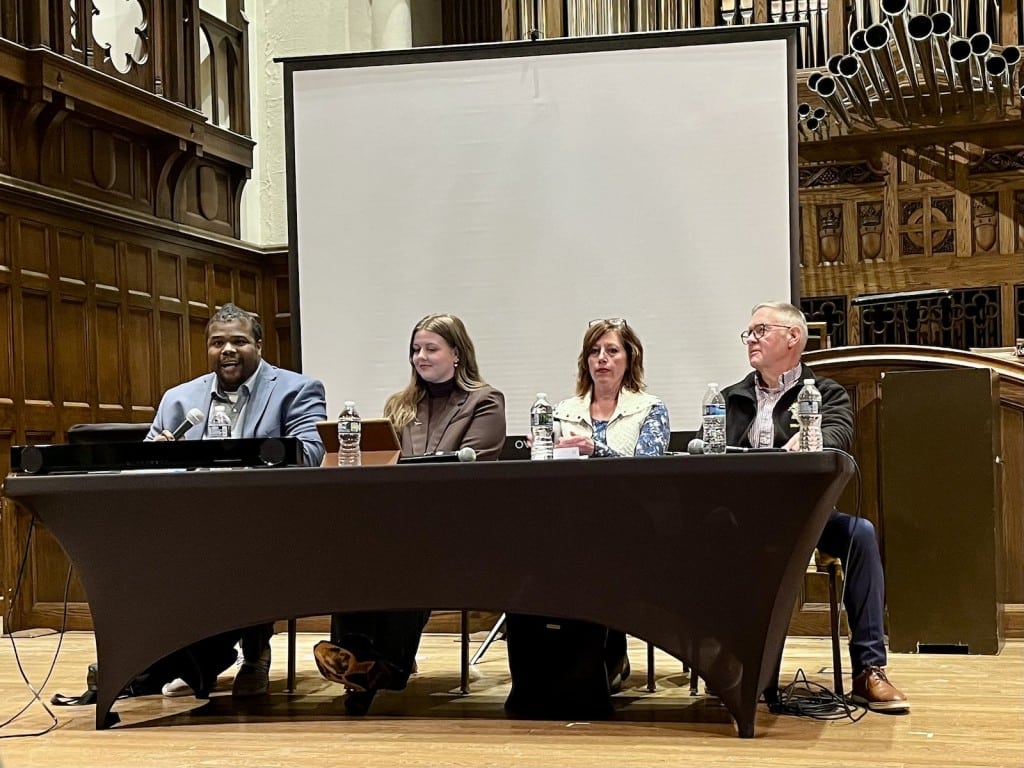
KALAMAZOO, MI — There was one point of disagreement on the panel of the “Do Something” talk at the KNAC on Tuesday night.
Vice Mayor Drew Duncan said, if U.S. Immigration and Customs Enforcement (ICE) or U.S. Customs and Border Protection (CBP) stage operations in Kalamazoo similar to what they’ve done in the Minneapolis area, residents need to “obstruct everything,” from blowing whistles to signalling that federal officers are in the area, to walking “slowly in front of their cars.”
When it was his turn to speak, Kalamazoo County Sheriff Rick Fuller said, “So, only one thing I would say is, don’t stand in front of their cars.”
To Fuller’s comment, there was nervous laughter from the audience. One thing the country has been learning from what’s going on in Minnesota is that ICE/CBP will violently detain anyone, do searches without judicial warrants, and use lethal force in situations where, if what’s seen in many videos that captured the shootings of Renée Good and Alex Pretti is accurate, lethal force is not justified.
The audience had a lot of questions. How would Kalamazoo react if the same happened here? How could we protect neighbors legally and safely? What even is the meaning of “legal” if federal officials are violating the United States Constitution when they’re acting against both citizens and immigrants?
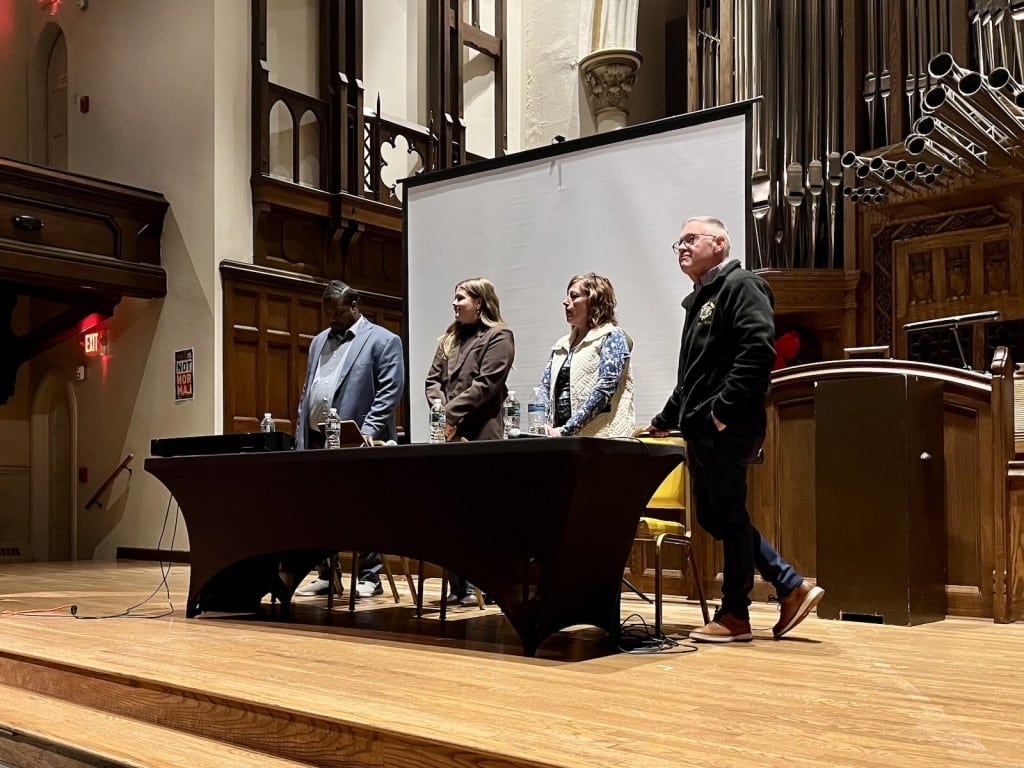
“Everyone in the United States has constitutional rights,” Fuller affirmed, to applause. “Let that sink in.”
The Do Something ICE Response Network, a new effort from the Kalamazoo County Democratic Party, held the public forum. Initially, it was to be in KNAC’s Crawlspace theater, but it was moved to the larger space of the old Baptist church, with people in the lower-level theatre able to watch on video.
Both spaces were packed to capacity, and many people had to be turned away at the door.
“Sick to my stomach”
Clearly, judging from the size and determined enthusiasm of the crowd, Kalamazoo residents would “Do Something” if the same were to happen here.
Panelists, including American Civil Liberties Union (ACLU) organizer for Southwest Michigan Lily Eggers and State Representative Julie Rogers, did their best to answer written questions from the audience. Questions were read by moderator Mariah Bryant of Voters Not Politicians.
Bryant summed up the first round of questions as all concerning rights people have when encountering feds: “Who do I call? Do I call local law enforcement, or are they going to come and back up ICE? Can I demand a warrant? What if they show up in a school or outside the school?”
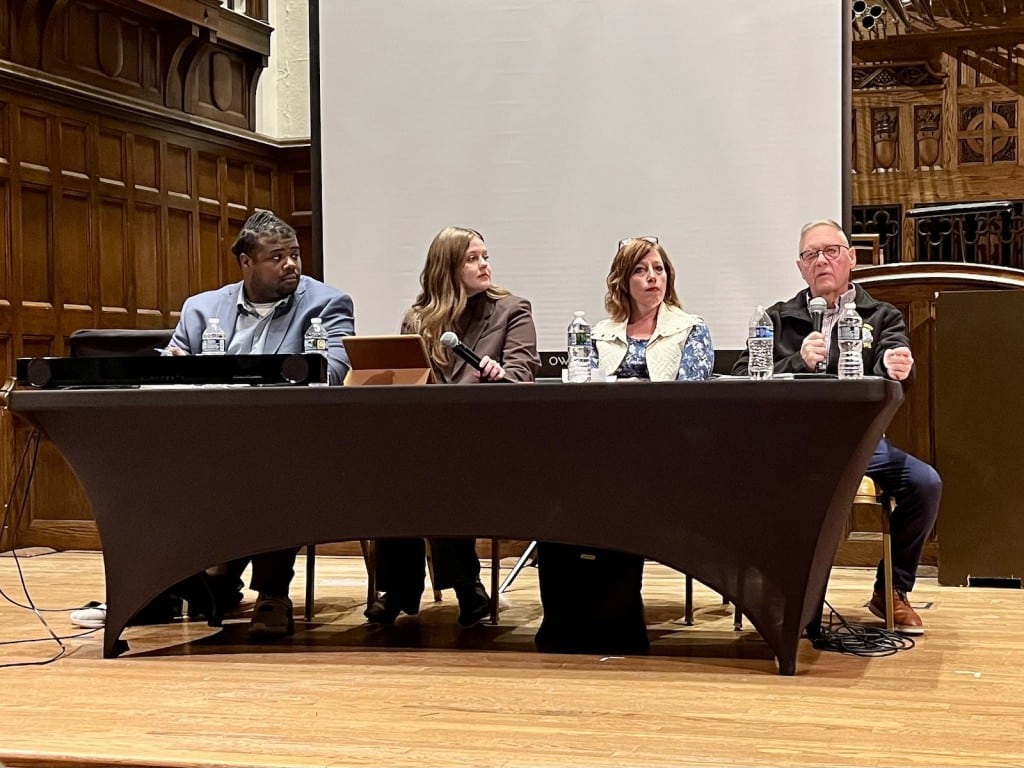
Duncan recommended filming federal agents to document all the details “for when the trials start.”
But, he said, “do not aggravate. I know that this is a heightened emotional state when we see our neighbors getting kidnapped. But agitating and aggravating puts you in danger. And if you’re recording, it might be likely we don’t get your point of view if they snatch (your iPhone or camera).”
If possible, ask people being detained by ICE/CBP for their name, and names and phone numbers of people one can call on their behalf, he says. “You might be the only lifeline to that person having any type of advocacy under this regime.”
Eggers recommended the ACLU’s “Know Your Rights” site, which explains the legal rights for those recording law enforcement, immigrants, and protesters.
She outlined what to do if officers demand entrance to one’s home: “Ask them to show you the warrant signed by a judge, a judicial warrant…. If they come to your home, you can ask them to pass it under the door or put it up to a window so you don’t have to open the door,” she said.
“That’s the only way that they can legally arrest you, is with a judicial warrant that is signed by a judge,” Eggers said. But, she added, CBP “claim additional authority” within 100 miles of the border, which includes all of Michigan.
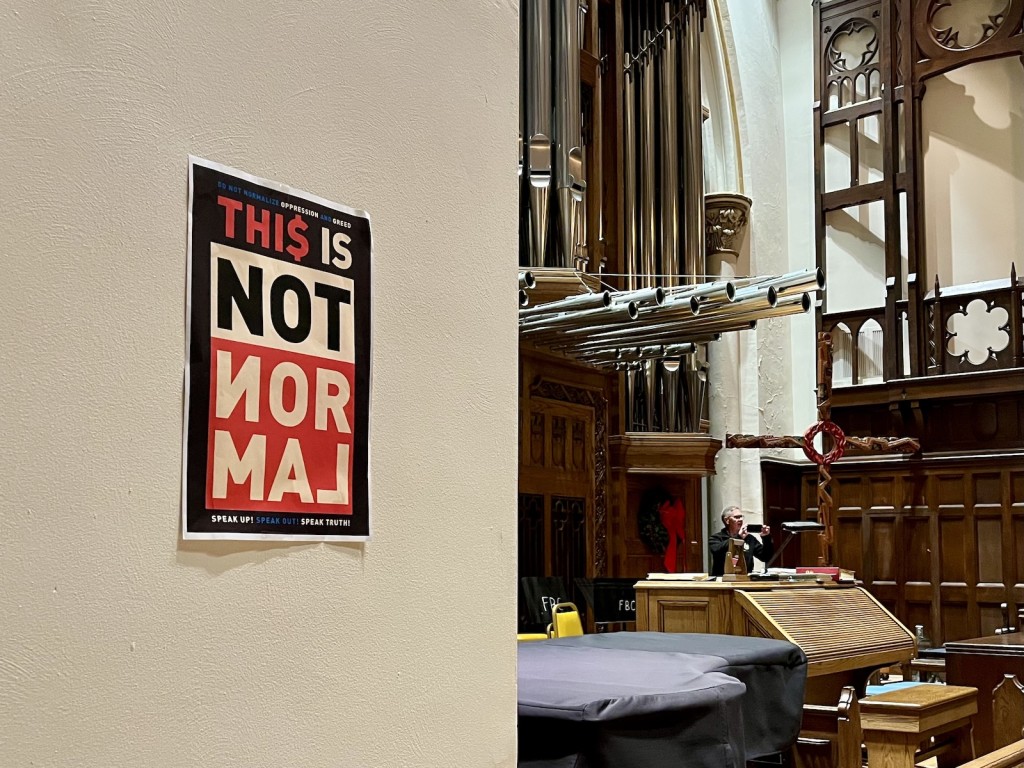
Rogers emphasized Duncan’s point about “being safe…. In this chaotic and volatile time, we’re informing you of a lot of your rights, but then common sense, and not trying to exacerbate the situation, unfortunately, is where we’re at.”
Though you might be acting within your rights, you’ll need to keep your hands visible, make no sudden movements that could cause ICE to think “that you might be reaching for a weapon,” Rogers said.
Fuller reminded the crowd of their Miranda rights, mainly, “You have a right to remain silent.”
He added, “That’s difficult for me to have to sit here and tell you that, because as a law enforcement official, I need your cooperation when we are trying to investigate something. I need your cooperation to find out further information.”
But the actions by ICE/CBP are different, he said. “In these cases, what we’re finding is that the system is not working for everyone. And I want us to make sure we hold people accountable, and that’s me, that’s my team, that’s any law enforcement.”
As an officer of the law, Fuller said again, he doesn’t like saying this, but in a situation where you’re detained by ICE/CBP, “like, you really should remain silent.”
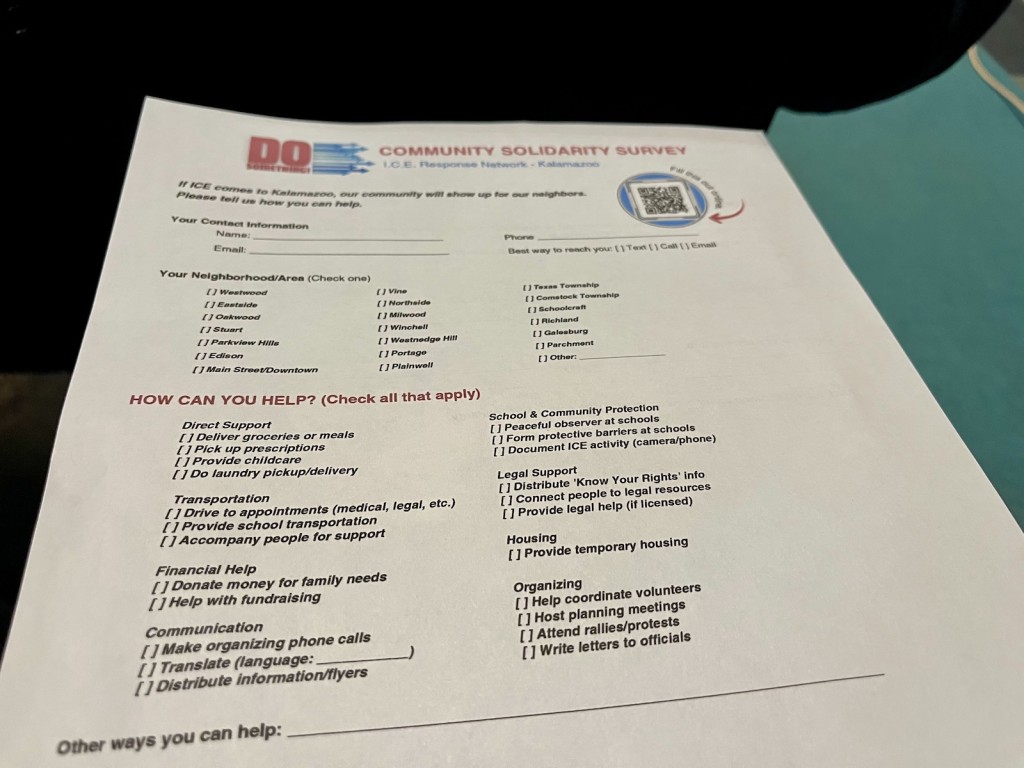
Kalamazoo County Democratic Party’s “Do Something” form, asking attendees what they could do.
He also recommended knowing the various laws that could be used to silence a protester or stop one from documenting their actions. For example, “there are laws that say you cannot be in the street,” potentially blocking traffic.
Fuller advised making a plan for possible detainment. If one has an attorney, memorize their number, make sure it’s in one’s phone, and share it with one’s spouse or friends, he said.
“I recommend anybody that is in the eye of the public or out here doing any of this work have those things in place,” he said.
The sheriff added, “It makes me sick to my stomach to think that we are in a place in our world where the whole country has to start thinking like this, and that we should all understand that it’s not just one population that’s the focus. It will be the next population.”
He said, to murmurs from the audience, “And the scary thing is what I worry about is there’s a desensitizing going on. And I think more that we can recognize that and hold officials accountable to these facts and tell them, we’re not going to fall for that. We’re not going to start dehumanizing different groups of people. We’ve seen this done in the past.”
ICE/CBP’s actions put local law officers in a very bad position, he pointed out. “I can tell you law enforcement in this community has worked very hard and very long to make sure you believe that we are legitimate law enforcement. And the actions we’re seeing right now are difficult, very difficult for us as well. There are many chiefs, many sheriffs standing up and saying this can’t keep going on.”
“Stick with love”
The event was partisan. But there’s been no word of any similar public forum on the subject organized by local Republicans. WWMT contacted Republican U.S. Representative Bill Huizenga about the panel. His communications director, Brian Patrick, told them Huizenga usually doesn’t comment on “political party events,” according to a News Channel 3’s story.
Duncan did not mince words, often calling the actions of the second Trump administration the actions of a “fascist regime.”
But he said there should be Republican concerns about ICE/CBP’s actions, concerns that align with the GOP platform.
Duncan compared the situation in Minneapolis to the shutdown of COVID, with targeted people who are afraid to leave their homes.
“They’re locking themselves away, the city is not going about business day to day, and that’s going to be a problem,” he said.
“Let’s say you are a Republican…. Sensible Republicans that I’ve talked to care about the economy. I think we all could agree on that.
“What’s your economy look like when your city is shut down? What’s your economy look like when people aren’t showing up for work? What’s your economy look like when people are on mass strike?
“If you’re a Republican, these immigration raids are bad for business, and we thought you cared about that, besties,” Duncan said to laughter.
He pointed out that Minnesota being targeted “is yet again another instance of the federal government pushing, and trying to bring to heel a state that hasn’t voted red in longer than I’ve been alive.”
As during COVID, neighbors would need help. Rogers said, “know your neighbors, providing mutual aid support, helping kids get to school,” would be ways to be helpful when feeling helpless.
Duncan said, “It’s time for you guys to get on some Duolingo and learn some simple Spanish phrases so we can tell our friends things like ‘don’t open your door, remain silent, don’t sign anything, and speak and ask for a lawyer.'”
All on the panel noted that ICE/CBP have been targeting people of shades that are darker than white. “If you are not white, you are being stopped and may be deported,” Duncan said.
“When I’m looking at this, I keep thinking about the past 300 years, Black, Indigenous, people of color, they’ve seen a lot of this,” Fuller said.
“And the difficult part for everybody right now is to get in our heads that psychology, that this community I just mentioned has had to deal with all the different things that we’re seeing today for all these years — that should give you an idea of how everyone else is going to feel, in nine months, ten months down the road,” Fuller said to big applause.
There are “no easy answers” to how to respond to a situation where populations, cities, and states are targeted by the federal government, he said. “Answers only come from showing up, voting, showing up encouraging, showing up for the neighbor, and feeding a neighbor sometimes. There are a lot of things we’re going to have to do.”
Fuller said he turns to a favorite quote from Martin Luther King, Jr., “I have decided to stick with love. Hate is too great a burden to bear.”
Duncan closed with how “it’s important that our neighbors, all of them, whether they look like us, sound like us, etc., know that we have an unyielding love for this community…. It’s the people that make up the lifeblood of the city of Kalamazoo, and this county. And loving means showing it out loud.”
He added, “And I’ll be damned if I let anyone come kidnap anyone in my community.”
Author
Related Articles
Voices of Youth Q&A: Understanding immigration concerns in Kalamazoo
Amid rising nationwide immigration enforcement and fear, a Kalamazoo youth interviews El Concilio CEO Adrian Vazquez to explore how local organizations support immigrant families facing detention, uncertainty, and community-wide impacts.
Distance isn’t a barrier to supporting LGBTQ youth in Battle Creek, Vermontville, and beyond
Christine Terpening founded “I’ll Be Your Rock” in Vermontville to create supportive spaces for LGBTQ youth, and her organization is now expanding to rural communities across Michigan and beyond.
Tribal Officers go undercover to combat human trafficking along I-94 corridor
The Nottawaseppi Band of the Huron Potawatomi received a $900,000 federal grant to combat human trafficking in Indian Country through undercover operations, victim-centered interventions, and collaborative efforts with local law enforcement along Michigan’s I-94 corridor.