New complex at Burdick and Vine will mark the intersection of needed housing and healthy living
Jamauri Bogan is partnering with Bronson Healthcare to build an 85-unit, mixed-use residential complex that helps address the critical shortage of housing in Kalamazoo County.
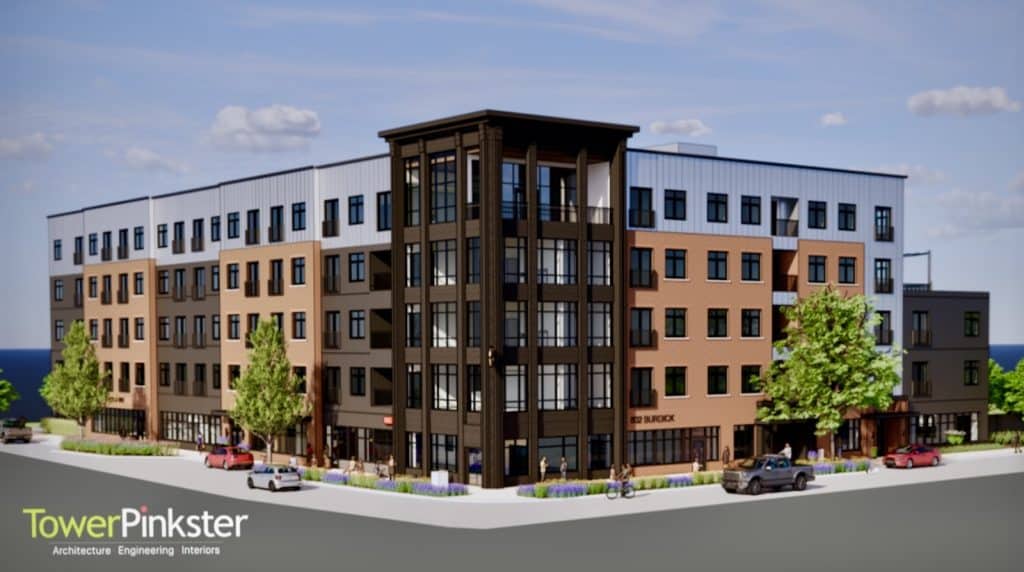
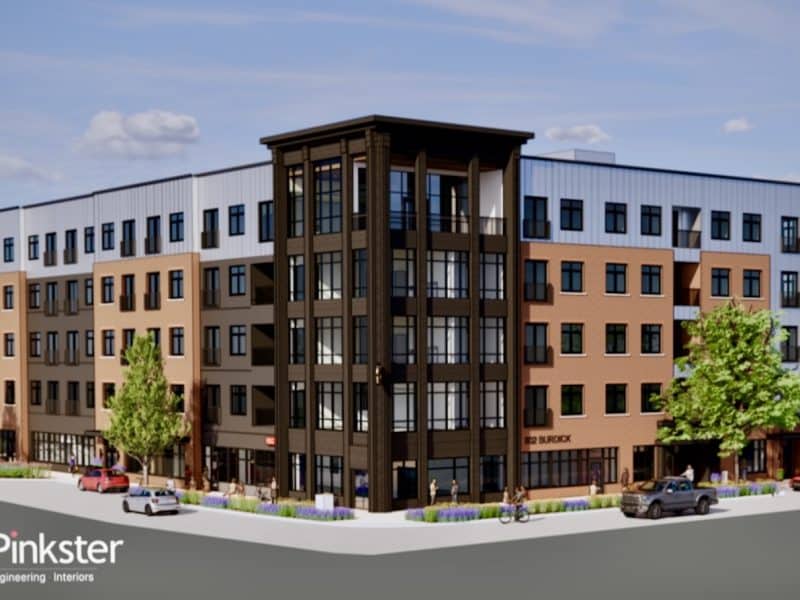
An artist’s rendering of the 101,000-square-foot B on Burdick apartment complex. It will be on the southwest corner of Burdick and Vine streets. Photo: Courtesy of Bogan Developments LLC
KALAMAZOO, MI — Having a stable and affordable place to live is a key to a healthy lifestyle.
The folks at Bronson Healthcare Group recognized that in 2016 when they partnered with Kalamazoo Valley Community College to open the KVCC/Bronson Healthy Living Campus in downtown Kalamazoo.
Local developer Jamauri Bogan embraced the concept in 2024 when Bronson Healthcare shared its vision to build housing that its employees can afford and, at the same time, try to improve the quality of life just west of its main campus in downtown Kalamazoo.
“There are several different components that are the social determinants of health, and one of them is housing,” says Bogan. “Health experts have said that having somewhere to stay helps improve folks’ outcomes.”
That is especially true, he says, if the housing is of high quality and is priced to be affordable.

So he is partnering with Bronson to build an 85-unit, mixed-use residential complex that helps address the critical shortage of housing in Kalamazoo County and helps redevelop some vacant or underutilized parcels owned by Bronson.
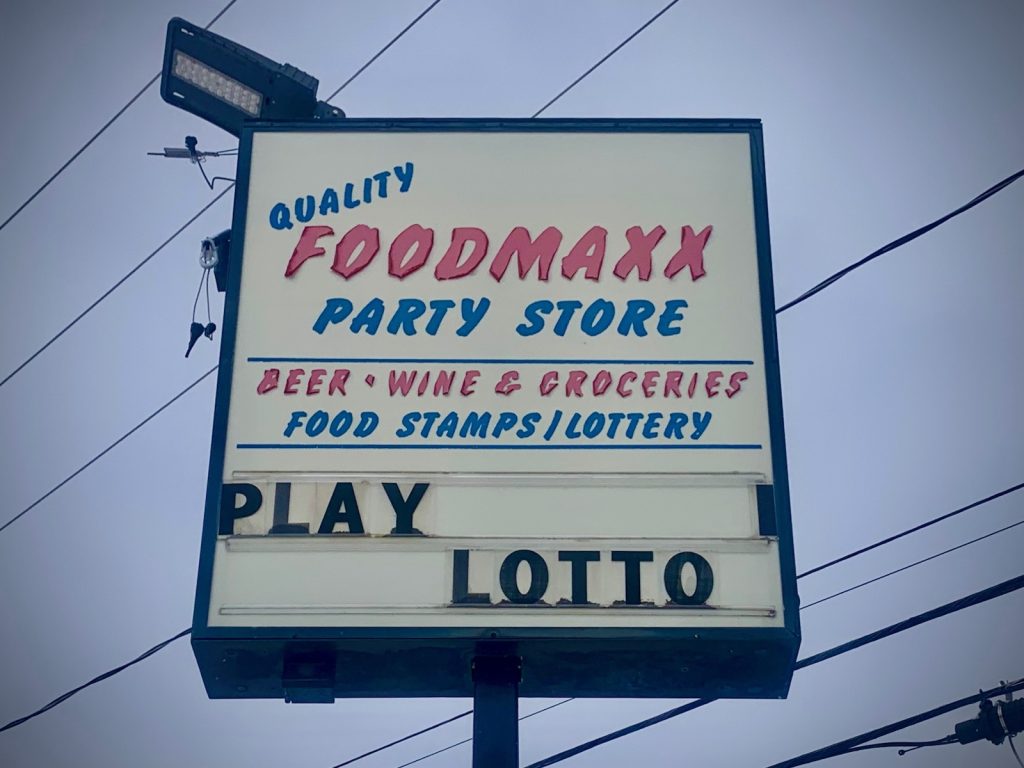
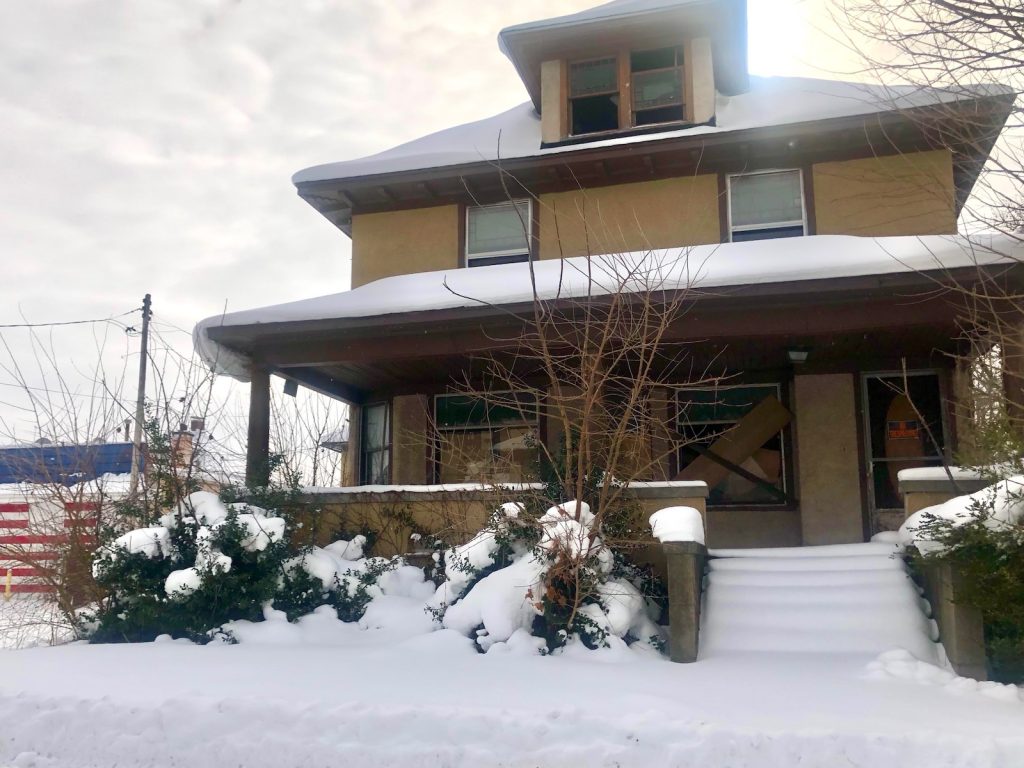
Called The B on Burdick, the $40 million development is expected to include a grocery store, a childcare facility, and a fitness center. along with upscale yet affordable one- and two-bedroom apartments for working people. The development will replace the now-closed FoodMaxx Party Store and four vacant houses that bracket the southwest corner of Burdick and Vine streets.
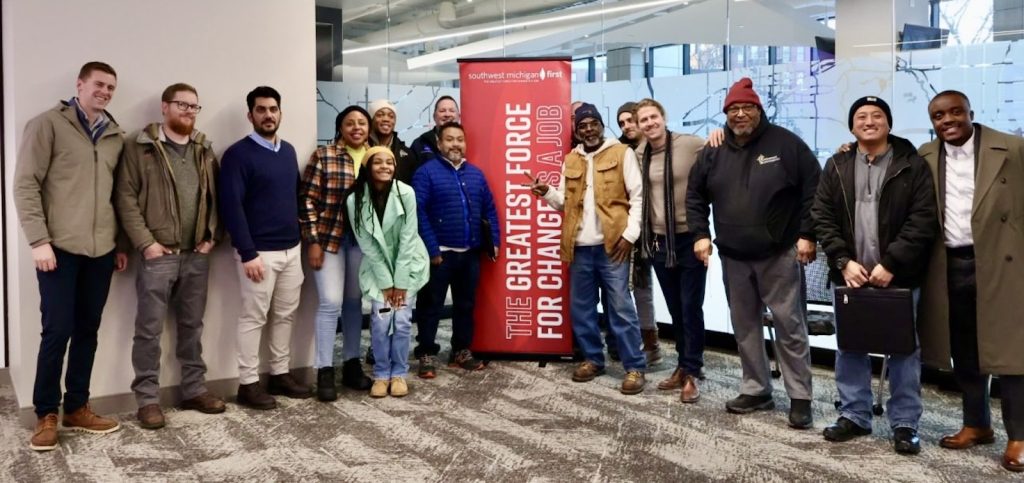
A ground-breaking ceremony is anticipated in June, with AVB Inc. as the construction manager of the project and Tower Pinkster as the architect. Thirty-three percent of the construction work is being earmarked for minority and women-owned firms. Recruitment of those contractors started with a late-January session to bring together potential participants. When all is said and done, the development is expected to be ready for occupancy during the first quarter of 2028.
For Bronson, the lack of adequate housing is an ongoing healthcare issue, but a practical issue as well. Twenty of the new apartment units are intended to be dedicated for use by Bronson employees.
“Housing. It’s one of those primary needs in life,” says Gregory Milliken, director of Bronson Properties and Building & Real Estate. “If you don’t have quality housing, you’re not going to be thinking about your doctor’s appointment or your physical therapy appointment or your diabetes medicine. Making sure people have quality housing choices ensures that they can then make quality health choices as well.”
Bronson and KVCC worked together to invest more than $40 million in the Healthy Living Campus. But Milliken says, “When that was wrapping up, Marilyn Schlack (then president of KVCC), Mike Way (vice president of Facilities Services & Materials Management at Bronson Healthcare), and the leaders of the two different groups got together and said, ‘OK, how do we leverage this investment and catalyze (accelerate) some further improvements around this area?’ So internally, we created this Health Living District Plan. It identified some things that we would work on with the city, like streets, trails, and things like that. But then we looked at this block (bordered by Burdick, Burr Oak, Rose, and Vine streets) and said this is a block where we’d like to catalyze housing.”
The overall idea has been to maximize the use of the property the healthcare group has amassed over the last nine years just west of its downtown campus, to create workforce housing. That is housing affordable to middle-income households — those with annual earnings between 60 percent and 120 percent of the Area Median Income for Kalamazoo County. AMI represents the halfway point between the highest and lowest earnings in a county.
Sixty percent of Area Median Income for a one-person household in Kalamazoo County is about $40,280. It is $57,480 for a family of four. Since April 1 of last year, 120 percent of AMI is $80,520 for a one-person household and $114,960 for a family of four.
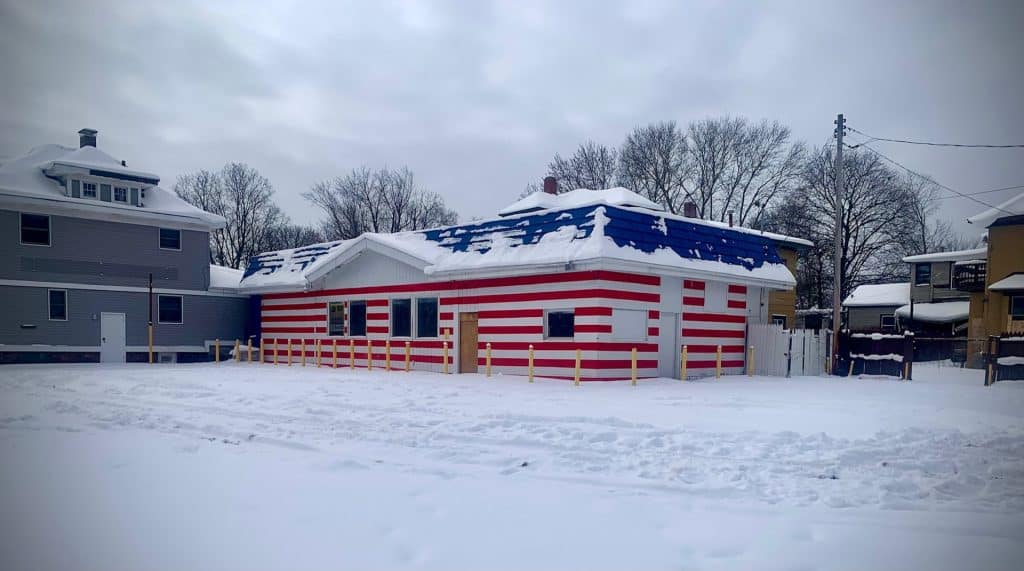
The FoodMaxx party store at South Burdick and Vine streets has closed. Its candy-striped building will be razed to make way for an 85-unit residential and commercial development. Photo: Al Jones
Milliken says working with Bogan fits Bronson’s vision for trying to work with emerging developers so they can grow and take their skills into the wider community to create other housing developments. He says The B on Burdick is not going to be the partnership’s only project in the immediate area. “There will probably be a Phase II, a Phase III, or something. So we’re creating different housing types, different structures, different models, and then those can be copied and pasted in other parts of the community, depending on the size of parcels that people have.”
Speaking of Bronson, Bogan says, “Since 2016, they’ve been doing a lot to ask their employee base: What are their needs? How far away do they live from their jobs? But also they did a lot of research and talked with the community.” However, Milliken says the healthcare group has not quantified how much additional housing its workforce needs.
Bogan acknowledges Bronson’s dedication to including minority- and women-owned subcontractors and contractors, allowing them to play a role in revitalizing the area. “That vision is shared by us,” he says.
Bogan is a 29-year-old African-American entrepreneur who dove into real estate development after receiving bachelor’s and master’s degrees in Business Administration from Western Michigan University in 2017 and 2019 respectively. This will be the third large housing project for which he has received funding from Kalamazoo County’s Housing-For-All Millage. The project has been approved for $2 million from that housing millage and $2 million from MSHDA’s Employer-Assisted Housing Program.
The $2 million from the Michigan State Housing Development Authority was awarded “so we can create 20 units for use by Bronson employees who make 60 percent to 120 percent of the Area Median Income,” Bogan says. The entire B on Burdick project will be considered workforce housing — available to anyone in the community in that range of earnings.
“Traditionally, there’s low-income housing, and then there’s market-rate housing,” Bogan explained. But he says very little housing has been built to target folks making $40,000 to $80,000 — called “the missing middle.”
Since its start in 2020, Bogan Developments LLC has focused on building mixed-income, affordable housing, and luxury affordable housing for the missing middle. All the rental rates at the five-story, 101,000-square-foot B on Burdick complex are being priced to be affordable for those between 60 and 120 percent of AMI. Parking will be in the rear of the complex with a secondary driveway adjacent to the Hospital Hospitality House of Southwest Michigan at 828 S. Burdick St.
Rents will range from $957 per month for a studio apartment to $2,400 per month for a two-bedroom, two-bathroom corner unit in the complex. According to current plans, there will be:
- 18 studio apartments, leasing for $957 per month;
- 48 one-bedroom apartments, leasing for $1,400 per month;
- 19 two-bedroom units, primarily leasing for $2,100 per month.
But is that affordable?
“That always gets people tripped up,” Kalamazoo County Housing Director Mary Balkema says about “affordable” housing. “What’s ‘affordable?’ If you’re a 30 percenter and you’re looking at what the AMI is (at The B on Burdick), it’s not affordable for you. If you’re looking at workforce housing or people who are working at the hospital, hopefully it’s affordable for them.”
Thirty percent of AMI in Kalamazoo County is a single person who makes $20,130 per year or a four-person household that has annual earnings of $28,740.
She says The B on Burdick will accommodate different AMI levels. And she pushes hard to have developers include at least one or two units that are affordable for lower-income families. But she says it is difficult for builders to structure plans that cover construction costs and ongoing maintenance in lower-rent projects.
The new project will have rents at different levels, she says. “But if you’re super-super low (income), can you move there?” Well, I don’t think he has super-super low units. So it’s affordable but obviously not for everybody.”
Balkema welcomes the new development because she says it is a good project that will eliminate some blight, it will provide housing for folks who work at the hospital, and take demand off parking. “I think people should be happy,” she says.
Katie Bach, director of communications for MSHDA, says the state’s contribution to the project is part of a $10 million pilot program that is providing funding for 10 projects that help employers who want better housing opportunities for their employees.
“We were trying to tackle one of Michigan’s most pressing economic challenges,” Bach says, “which is ensuring that workers have access to affordable homes near their jobs. … It was an issue that employers had been trying to tackle themselves for quite some time. And we heard it enough from employers that they weren’t able to solve this issue on their own.”
She says the Employer-Assisted Housing Program was designed to help employers invest in housing solutions for income-eligible households “by bringing together employers, local governments, and housing professionals with us.”
“It has been a pretty universal problem if you look at where we (granted funding),” Bach says. “Traverse City, Grand Rapids, Petoskey, Royal Oak, Flint, Wyoming, Battle Creek, Newberry, Kalamazoo, and Detroit were all recipients of Employer-Assisted Housing funds.”
It is targeted at projects that help create housing for the missing middle, Bach says, “Those are your teachers, your firefighters, your nurses, your professional workforce.”
Milliken says The B on Burdick is also an effort to create something that can accelerate more development.
‘When you think about the social determinants of health and healthy living,” he says, “the original concept of the Healthy Living District was around food and food innovation and food sourcing. Another determinant is housing.”
This story is part of the Southwest Michigan Journalism Collaborative’s coverage of equitable community development. The SWMJC is a group of 12 regional organizations dedicated to strengthening local journalism. To learn more, visit here.
Author

Related Articles
Housing pros answer the question: Are these places really affordable?
How do you define “affordable housing”? It turns out there is a precise definition.
From blue light to green light: Former Kmart site set for affordable housing and childcare
Eight years after plans began, redevelopment of the former Kmart site in Battle Creek is moving forward with an 80-unit affordable and workforce housing development with an on-site childcare center, backed by tax credits, philanthropic support, and local partners.
Battle Creek unites to build 1,000 homes and power economic growth
Battle Creek leaders launched a new Housing Fund to address a 3,000-unit shortage, aiming to build and rehabilitate 1,000 homes by 2035 to boost workforce growth and community stability.