Lighting the Northside: How one church is helping to transform Kalamazoo
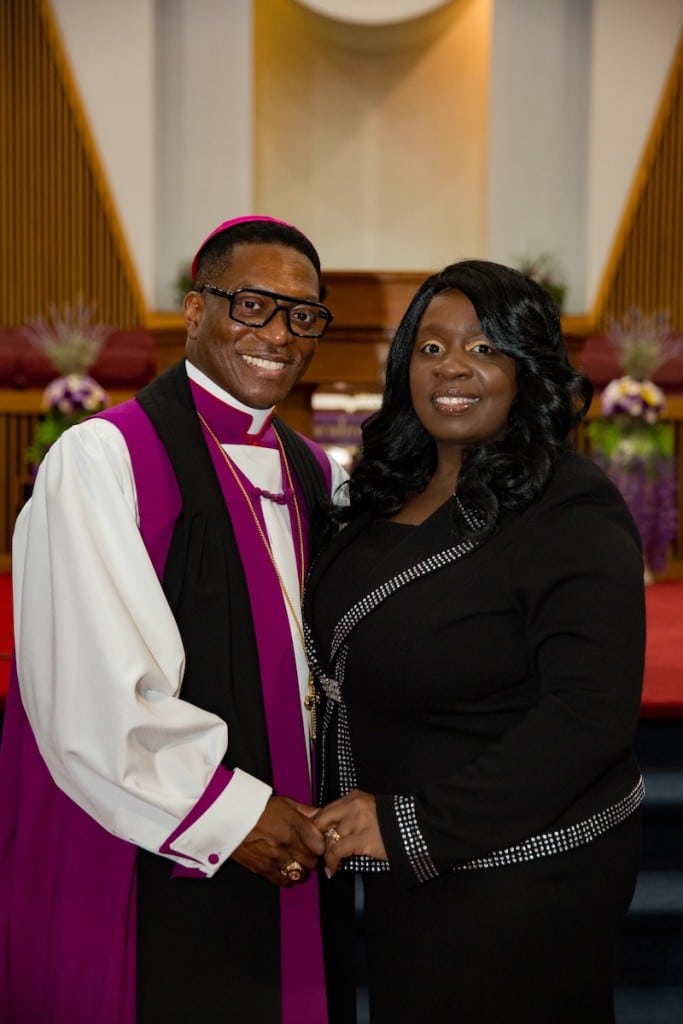
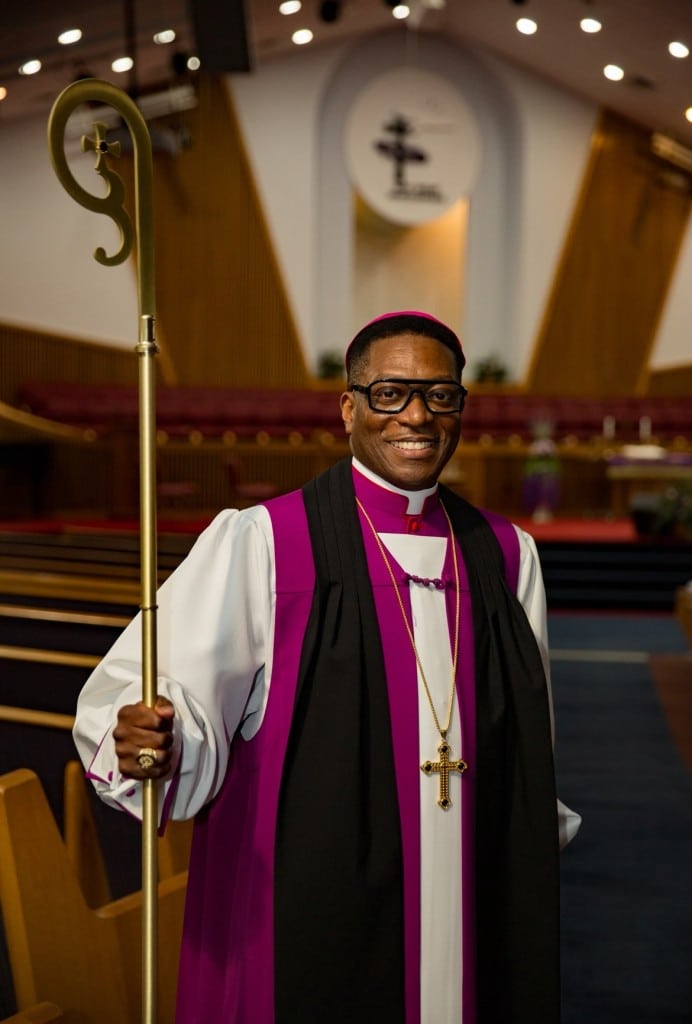
From mentoring students and supporting seniors to launching literacy programs and expanding neighborhood resources, Bishop Michael Scott I and Galilee Baptist Church are redefining what it means to be the hands and feet of faith in Kalamazoo’s Northside.
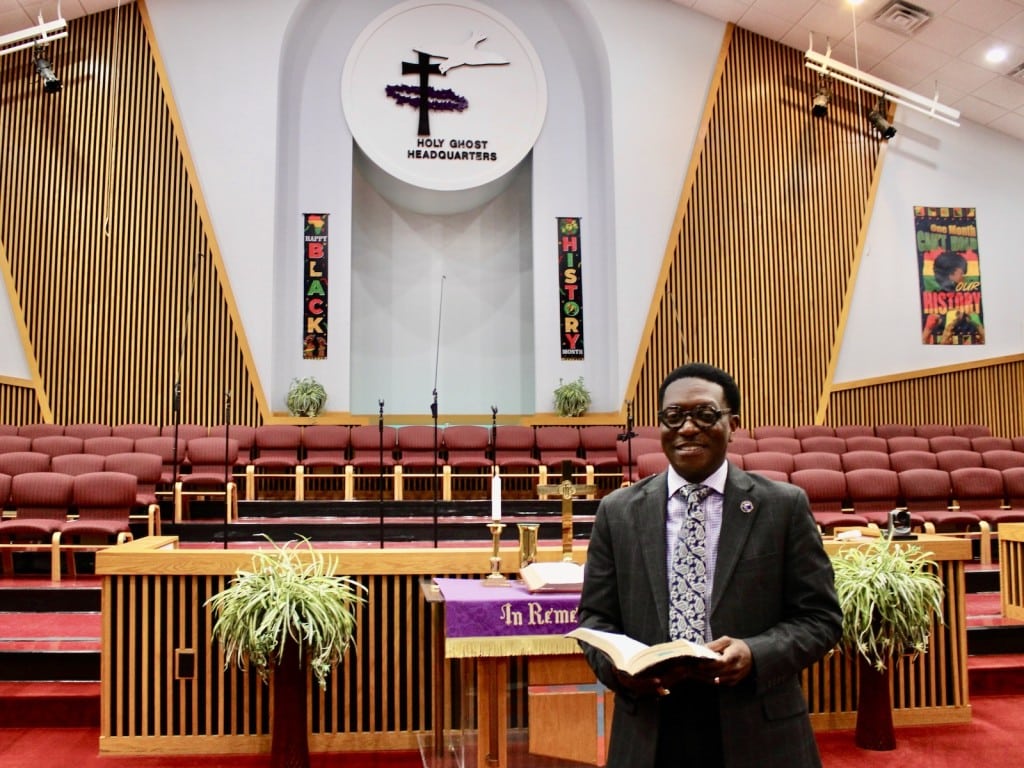

Editor’s Note: Voices of Faith is a series that amplifies the insights of local faith leaders — voices too often missing from conversations about community development, city planning, and civic life. The series explores how these leaders address pressing issues such as housing, safety, equity, mental health, climate, and youth engagement through love, faith, and action. All photos are courtesy, unless otherwise noted.
KALAMAZOO, MI — “I’ve been up since dawn,” Bishop Michael Scott I says with an easy smile as he settles into a chair in the front conference room at Galilee Baptist Church. It’s just after 3 p.m. on a brisk Wednesday, but his day is far from over.
He’s dressed in a crisp grey suit and a dotted navy tie — the same attire he wears in the near life-sized posters lining the wall behind him. In each one, his name stretches boldly across the image, a visual reminder of his role as shepherd of one of Kalamazoo’s largest predominantly Black congregations.
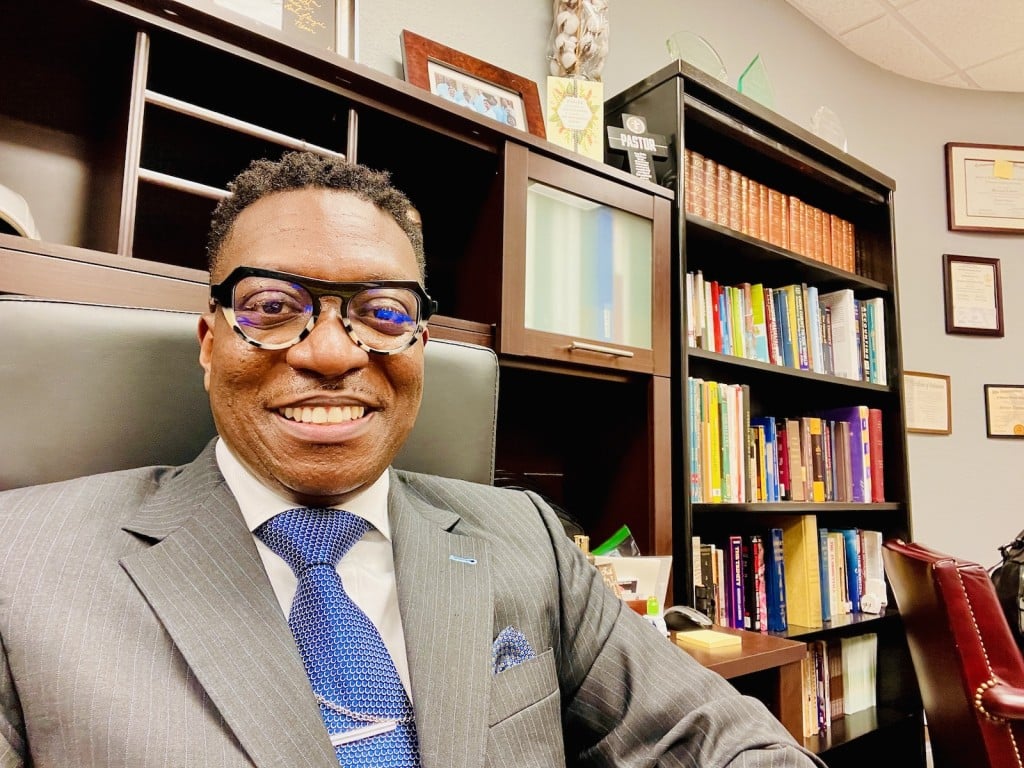
The schedule that carried him from sunrise to midafternoon reads like a cross-section of the city itself: back-to-back meetings with parishioners in need of counsel, strategy sessions with fellow clergy, conversations with local school principals about student support. Ministry here extends well beyond Sunday mornings.
This week, the pace has quickened. Galilee is launching the second week of its revived afterschool program, an effort aimed at addressing literacy gaps widened by the pandemic. And tonight marks the culmination of a three-day “Spiritual Awakening Revival,” a joint effort with four other historically Black congregations — Mt. Zion Baptist, First United Baptist Church, Friendship Baptist, and historic Second Baptist. The services, designed to help participants rediscover their purpose within God’s plan, are expected to draw hundreds through Galilee’s doors.
For Scott, the long hours are not a burden but a calling.
“I love what I do,” he says. “I love touching people’s lives.”
A ‘practical theology’ and Physical Fitness Sundays
When Scott first arrived in Kalamazoo, the uphill battle for individual and community transformation was daunting. The year before the Bishop and his family arrived, Kalamazoo County had its deadliest year in over a decade. The Northside neighborhood he now resided in accounted for over a quarter of the previous year’s homicides. The impact of the economic recession was just hitting its peak, as the number of Kalamazoo families in poverty increased by one-third between 2007 and 2010.
Yet the Scotts and the Galilee congregation were not deterred.
“We aim to be a beacon of light in a very dark world,” he says. “My theology is a practical theology. The church is the hands and feet of Jesus Christ. You may never see the physical Jesus Christ, but you should be able to see him in the work of the church.”
Over the past 15 years, Scott has allowed his congregation to shape Galilee’s mission, beginning with a focus on strengthening and supporting its own members.
“If you build people, they will rise up and say what they need,” says Scott. “We are the needy. We are the poor,” says Scott, regarding some congregation and neighborhood members. “Before the news gets to it, we feel and see it here. With the tears, the pain.”
The church has four pillars that frame its efforts to build its people: spiritual, mental, emotional, and physical.
Bishop Scott says he was frequently hearing from churchgoers about their health problems. According to National data, Black Americans have higher rates of elevated cholesterol levels and hypertension, leading to increased rates of cardiovascular disease and death. In an effort to address the physical pillar of his members, Scott instituted “Physical Fitness Sundays,” which is time dedicated during the normal two-hour service for physical exercise.
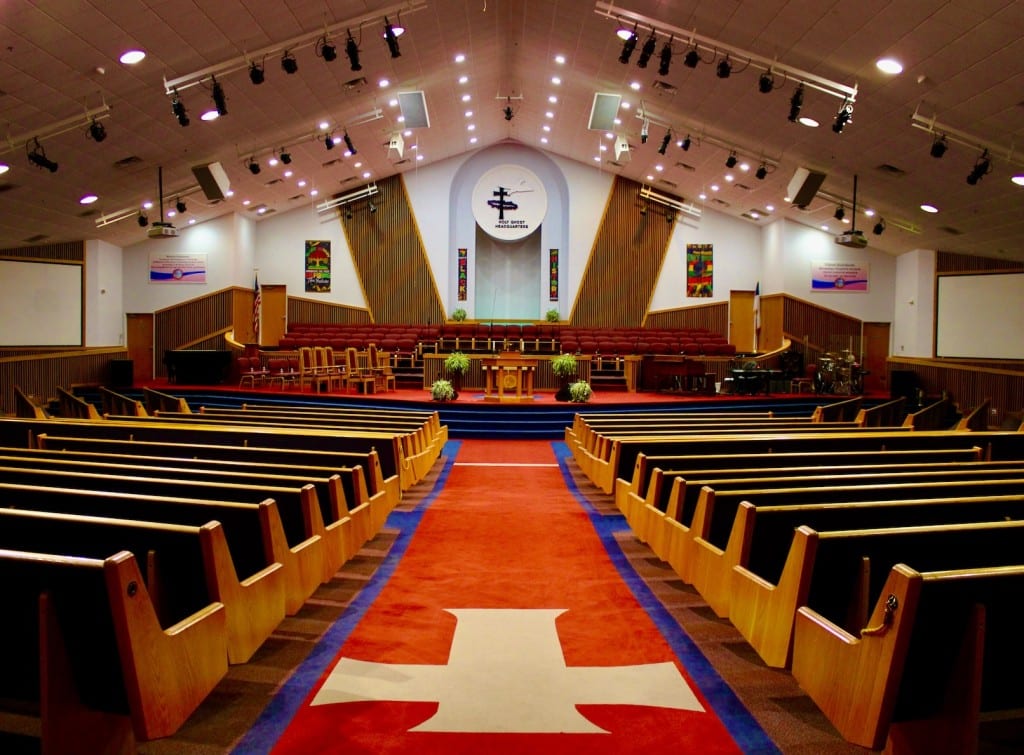
“We have some professional trainers who are members, so we give them the mic and play the music,” says Scott. “We had some resistance at first from our more traditional members. But we didn’t stop, so people slowly started moving. Next thing you know, they are having fun.”
To address the other three pillars, the church aims to help people achieve emotional and spiritual transformation over a single year, betting their emotional well-being will reap the rewards from the expected growth. For new parishioners to the church, they are enrolled in Galilee’s “Disciple Connect Orientation.” The program does not have baptism as the end goal, but rather setting people up for success on the journey after baptism. New members are connected with a senior member of the church who serves as an anchor for discussion, prayer, and mentorship.
For current members seeking transformation in life, the Scott’s center their efforts on building spiritual disciples. This is achieved through engaging them with the practical side of the Biblical Gospels, supporting one of the 40 ministries the church has created to serve the larger Kalamazoo community.
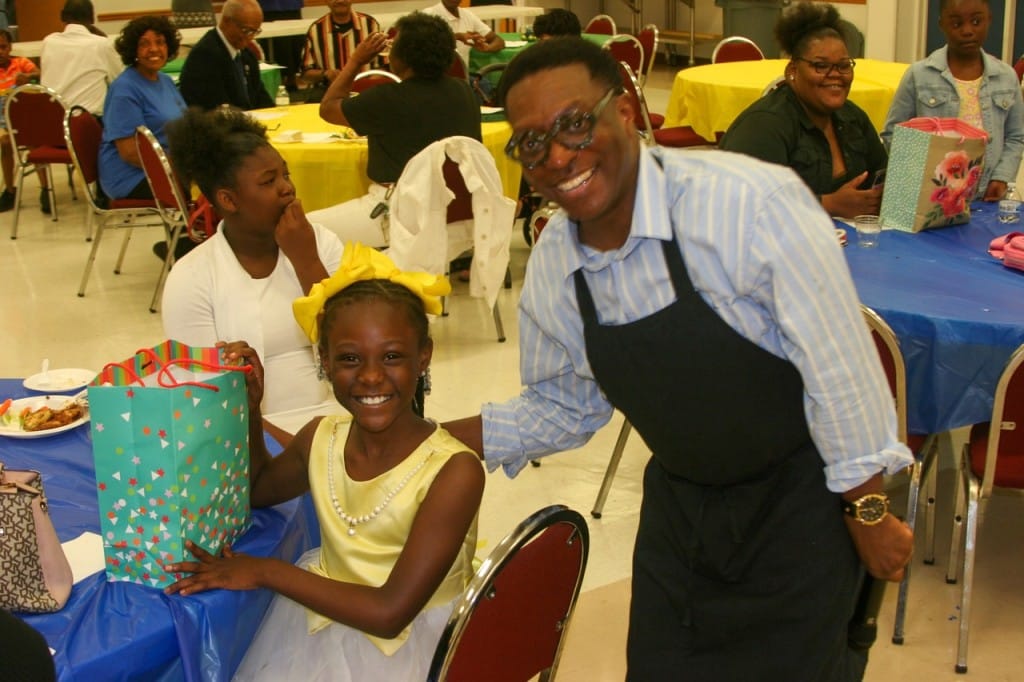
“I believe we are here to facilitate transformation in our community, starting with the people in the church. When they are transformed, then they can go out and effect change on others. I think that is what the church is for.”
Just as with his own personal transformation from poverty to seminary school, crutches to preaching in the pulpit, youth church to leading a congregation, Scott says he desires his congregation to have internal and external conversions in life. When he arrived in Kalamazoo in 2011, his vision for his new church was, “Becoming a Kingdom-Focused, Christ-Centered Ministry for People on the Grow!”
“That has not changed the whole 15 years,” he reflects. “My focus has been to get people behind Christ and to do his work. There is plenty of work to do, and you are going to grow in the process.”
From pain to promise
Scott’s journey to Kalamazoo began in Dover, Delaware, the capital of the nation’s first official state. Born in the 1970s, Scott says his home life was not easy. His mother, Shirley, was a single parent while his dad spent the majority of his childhood incarcerated in prison. Shirley relied on federal programs such as WIC and SNAP to feed her family, and moved in and out of other family members’ homes, all to ensure her son had surrounding love and positive role models in life.
As Scott moved around school districts, though, he often dealt with bullying because of his short stature, which awakened a rebel spirit in him.
“I challenged authority. I challenged my mother. I challenged my teachers. I just wanted to be accepted. I would like to think those challenges shaped who I am today. It was in that environment that I had a village,” he says. “It informs how I do ministry today.”
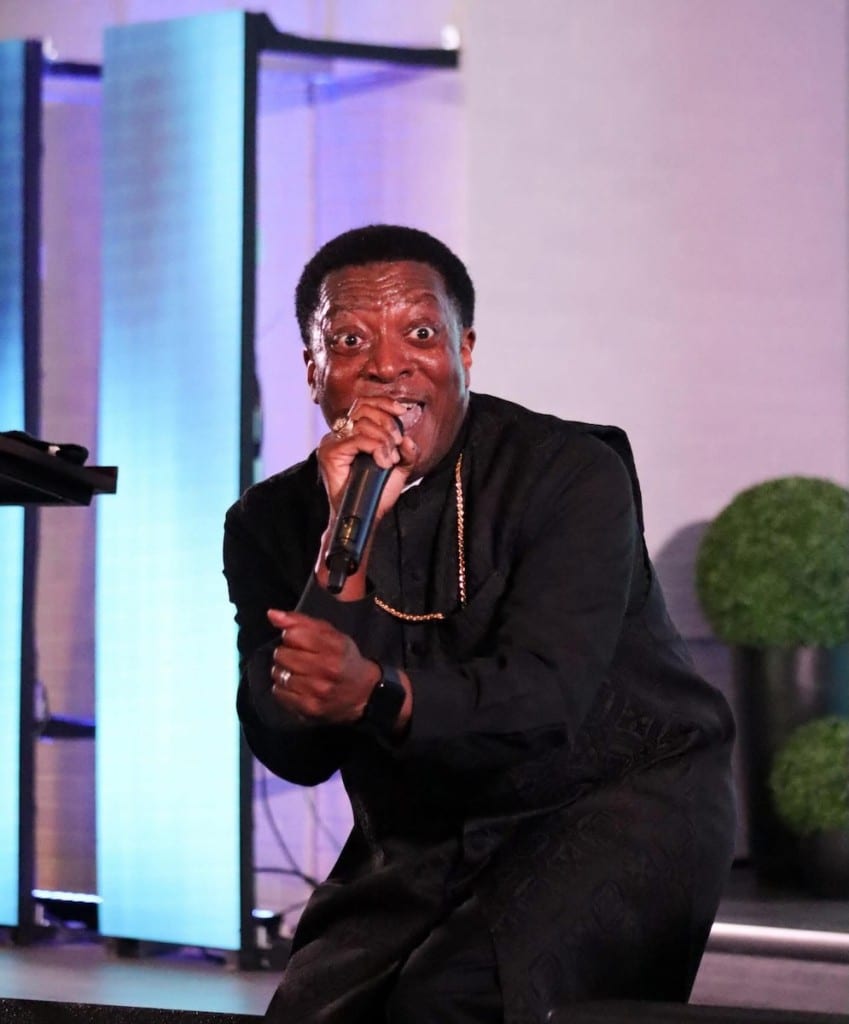
Eventually, life started to take shape around him. His aunt’s teaching role at a local religious private school, Faith Elementary, got him discounted tuition, and his mother wasted no time in registering him. It was at Faith that he truly witnessed the Bible in action and also developed his lifelong passion for playing the piano, an instrument he has since used to channel the spirit of God while leading from the pulpit.
Shirley soon had her own conversion to faith, giving her life to Christ and joining a local Baptist church. This shift in her life led Scott to ask, “Can I get to know Christ the way you know him?”
At the age of 13 and with tears in his eyes, he took the first real steps towards joining the church by getting baptized. Providential or not, this was a moment of real transformation for him, he says. “This was not to fill some obligation. I wanted it.”
Scott says he now sees the younger version of himself as someone who was beginning to live out his calling. In the church’s Youth Church, in which all the roles of the “adult” church — pastor, Bible study leaders, ushers, etc. — were taken on by youth, Scott was a junior deacon, sang in the choir, and played the piano.
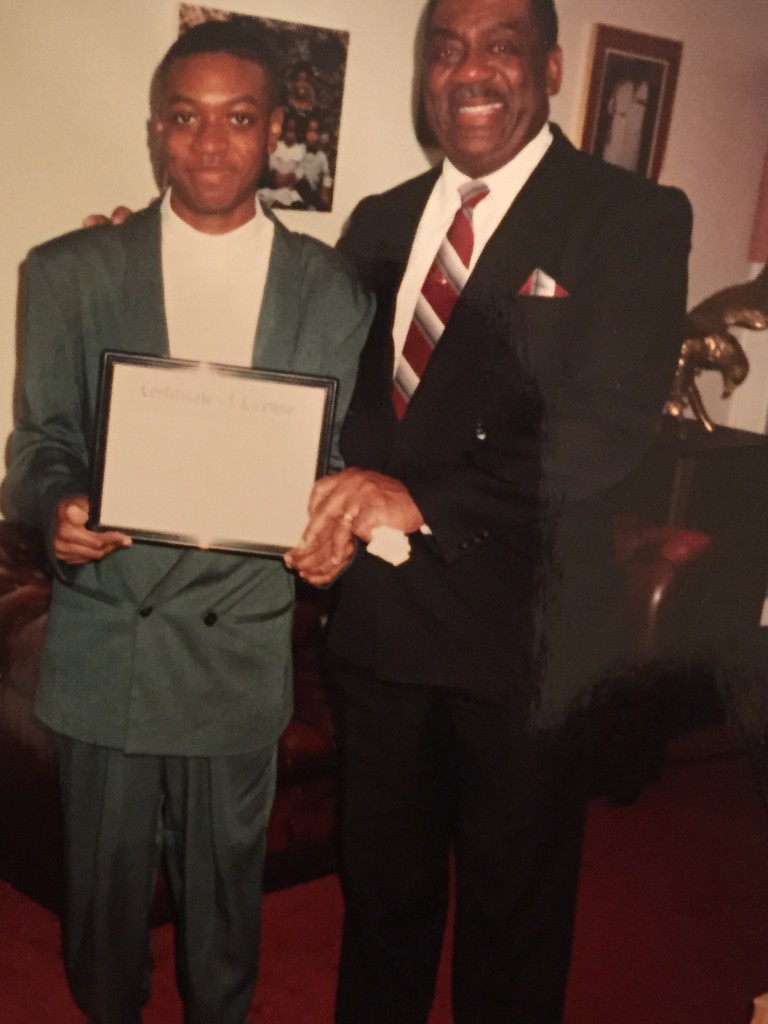
But he needed money, and the Youth Church didn’t come with a salary. So he found other jobs. Scott reflects on his first job as a paper boy with a smile. “I began delivering paper. Now I am delivering the good word!”
Another providential plan was in place. A relative worked in a funeral home and needed assistance. Scott jumped into the new job and loved it. He was able to wash the businesses’ many vehicles, assist during services, and even provide a helping hand during embalming. One day, however, as he was picking up a casket, a sharp and deep pain hit his back.
Scott was taken to the emergency room as the pain wouldn’t subside. X-rays showed the early impacts of scoliosis, a slight and unnatural curvature of the spine. The doctor called the family a few days later for a medical recommendation: surgery to implant two Harrington rods, stainless steel implants, along the spine to stabilize it. Such an invasive surgery was sure to cause a lot of complications. The family prayed on whether a teenager should endure such a trial, but saw the long-term necessity and trusted in God’s will.
“I was in incredible pain afterwards. Nothing like it.” Scott describes life after the surgery. “I would lie flat on my back, anything, to try to take the pain away.”
As he lay, he began to pray for God’s assistance. At his breaking point, he finally called out and said, “I promise you I will do your will. I will preach your work. I will let my light shine.” The pain soon subsided, and life became more bearable. One of his first actions when finally able to walk — albeit with a cane at the age of 13 — was to tell his pastor that he made a vow to the Lord to become a preacher and that he wanted to make good on that promise.
While he received mentorship within the church, it was his neighborhood that was the real proving ground for letting his light shine. Scott first visited the local youth detention center, preaching to his peers about the power that God could have in their lives to be transformed. He then focused his attention on the streets closest to his home, which were infested with drugs, crime, prostitution, and violence, with a local nightclub serving as a linchpin to all the problems.
Scott led marches in protest of the impact the club had on his neighborhood. Within a year, the club was shut down and later became home to a Head Start program.
With his faith in action, Scott prepared to become a pastor. He attended Virginia Union University, graduating in three years and completing his master’s in the seminary on campus. After graduation, he sent out an application to Jerusalem Baptist Church in Temperanceville, Virginia, a town of a few hundred.
He says his vision of growing a church with a few dozen parishioners was not challenging.
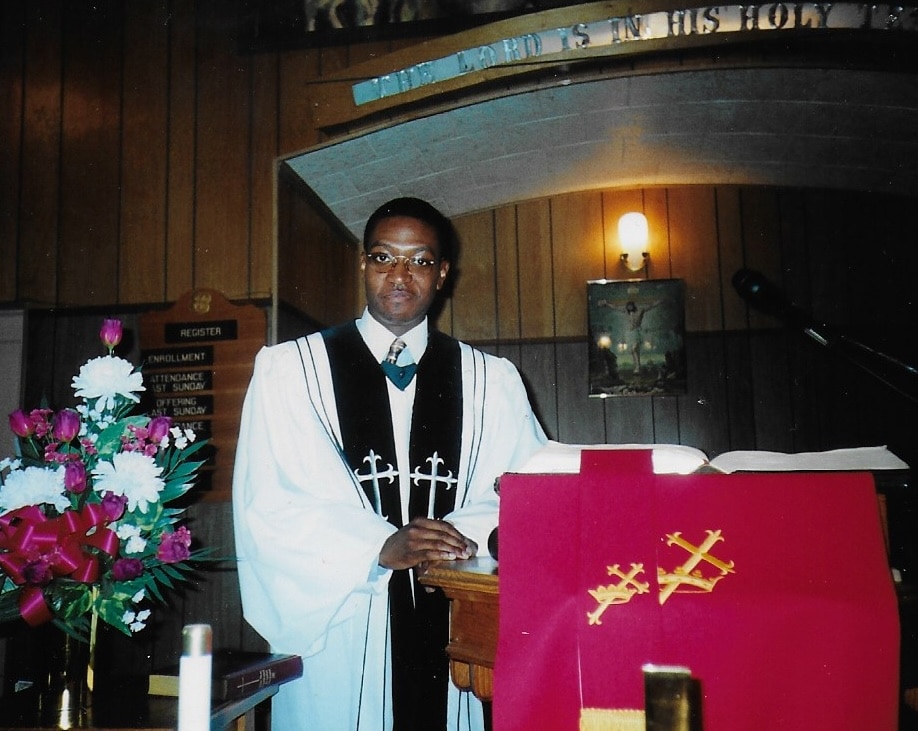
“In a rural setting, you learn a lot about your people. You minister to people’s needs without a lot of resources,” he says.
Over the 12 years he ministered at Jerusalem Baptist Church, he grew the congregation from 50 to 400, and helped purchase 55 acres of surrounding land with the goal to create a “holy city.” He centered his efforts on addressing the root causes of common deaths for rural Black Americans, such as hypertension, high blood pressure, and heart failure. He helped the church build a community center for recreation and invested in farming a portion of the land to help bring fresh food to the tables of his parishioners.
It was also during this time that he married his “Sunday school sweetheart,” Tamara. Tamara and Michael originally met in Dover and maintained a long-distance relationship during college. She began her career as an English teacher, but later joined Michael in the pursuit of ministry.
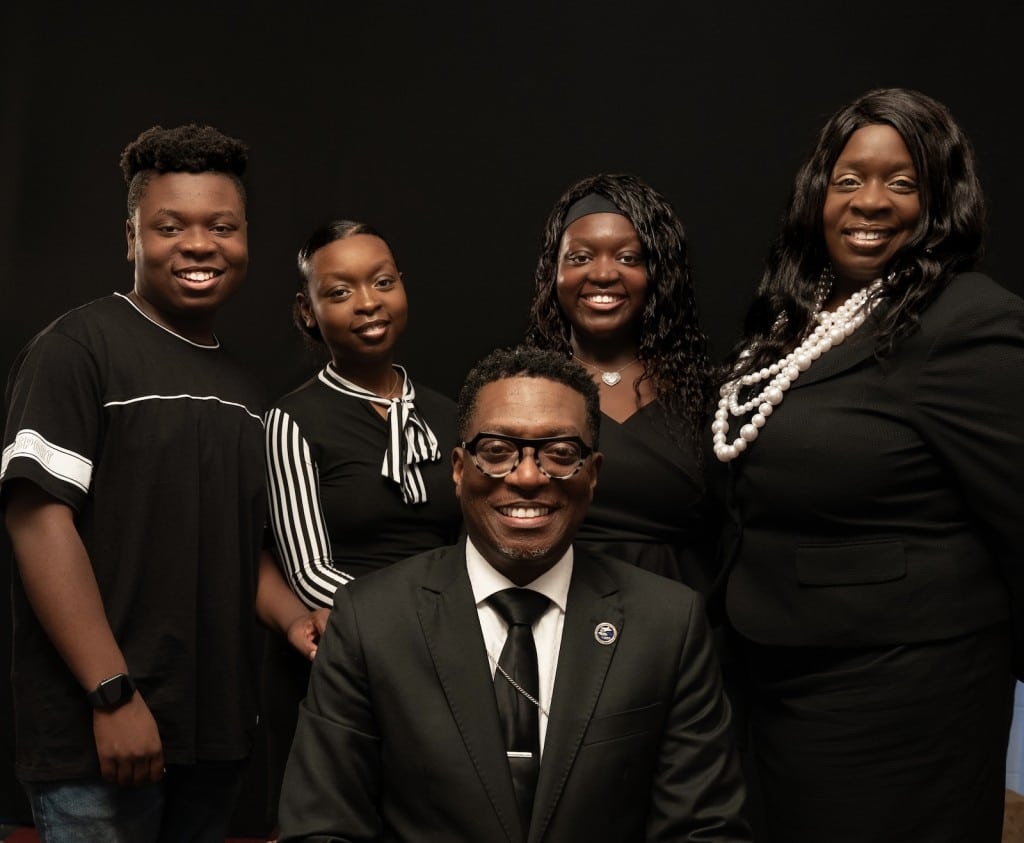
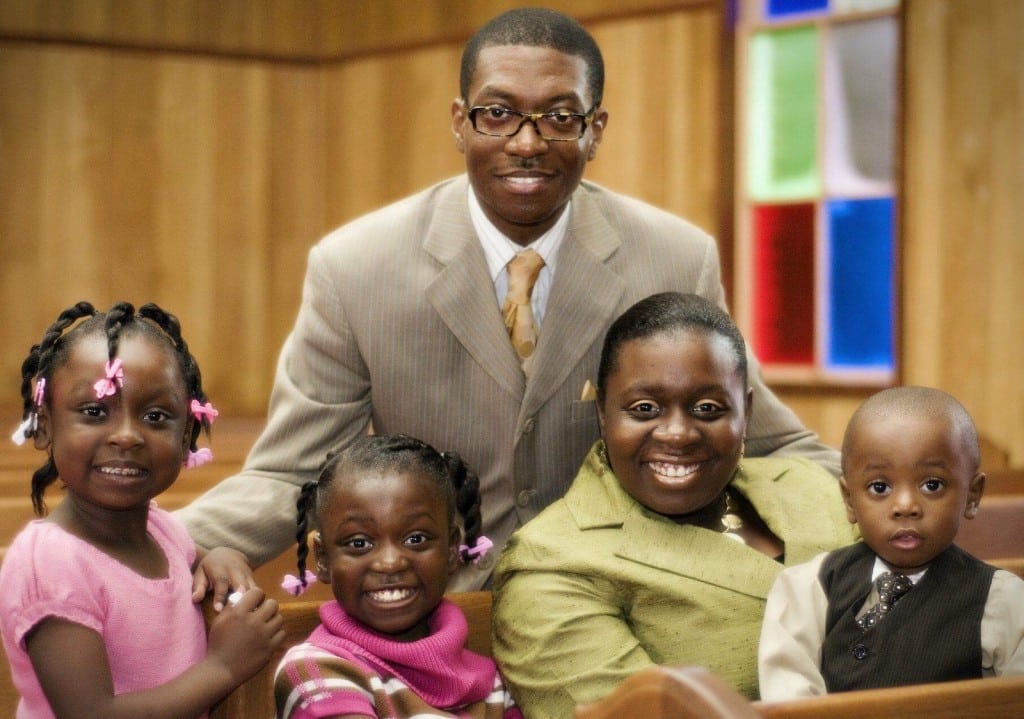
While still in Virginia, their family grew to five as they welcomed their children, Trinity, Morgan, and Michael, into the world. To help their kids succeed, questions began to swirl around how they would afford college for all three. The salary of Jerusalem Baptist and other side employment did not seem promising. So they prayed.
Soon after, Scott saw an open pastor position for Galilee Baptist Church in Kalamazoo. “And God said, ‘Well, you never heard of this place called Kalamazoo. What is the worst they can say? No?’”
After applying, he conducted an interview, sent in videos of him preaching, and visited Galilee three times to guest preach and teach Bible study classes with parishioners. These same parishioners were responsible for selecting their next pastor out of an initial candidate pool of over 150. They selected Scott.
After finding out his selection, a church trustee offhandedly shared with Scott about an amazing college scholarship program called The Kalamazoo Promise.
“God answered my prayers,” he says.
Lighting Kalamazoo, one life at a time
While most news headlines on Galilee Baptist Church highlight their holiday meal programs, it’s their behind-the-scenes efforts that shape their ministerial work in Kalamazoo.
Galilee has adopted two elementary schools, Woodward Elementary and Washington Writers Academy, to mentor and provide for their students. At Woodward, members of Galilee support the entire third grade by providing winter clothes, school supplies, and other personal household items. At Washington Writers’ Academy, they instituted a mentorship program that follows students from third through fifth grade. Every week, students meet with their mentor to discuss their lives and receive guidance on navigating an evolving world. These students also get new shoes on the first day of school, Christmas gifts, and winter gear. In 2026, mentors will take the kids on the program’s first field trip outside the city.
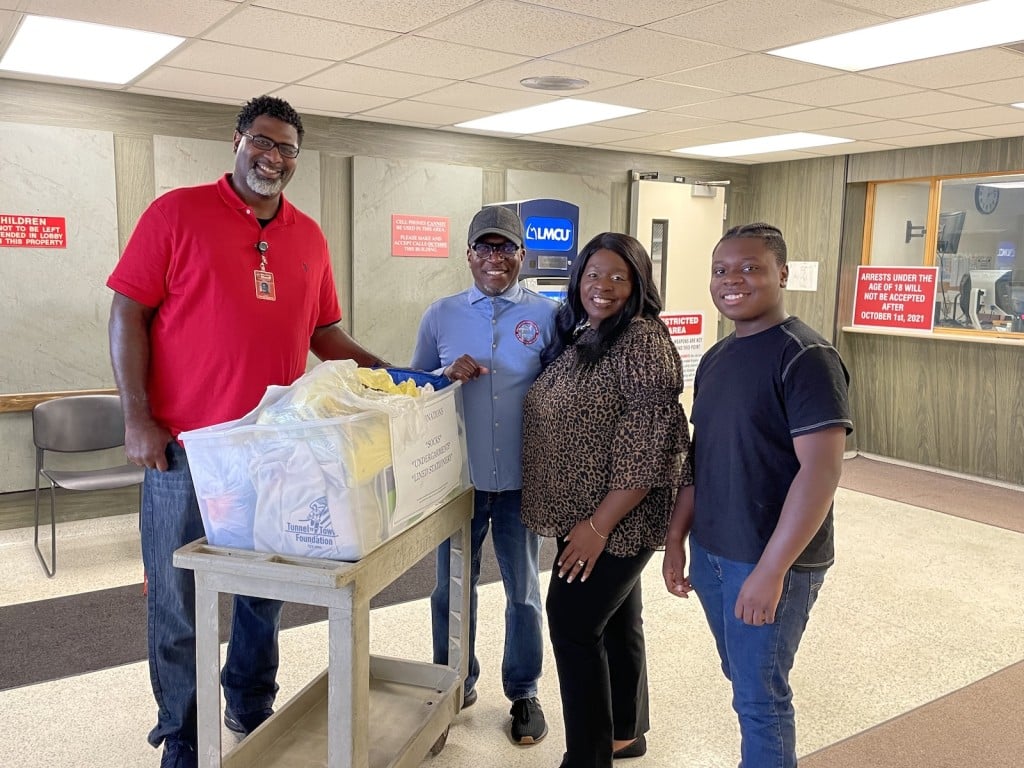
Dr. Tamara Scott, who helps lead this program, says, “Some kids have never been outside the city. We can’t wait to take them.”
Another adoption they have undertaken is of residents at MediLodge in the Westwood neighborhood.
“We want to reach people that are often considered the least of us,” says Bishop Scott. “So how is God calling us to get out to people who need it, but are often overlooked because of priorities?”
After noticing the nursing home residents didn’t have internet or computer access, the church decided to bring the service to the residents’ building. Every Sunday, Galilee assigns church members to preach and sing before making it back to the regular service at 10 a.m. Even some of the church’s older parishioners who can’t travel out to the nursing home as often, who the Bishop calls his “seasoned saints,” stay engaged by writing letters to those who are homebound.
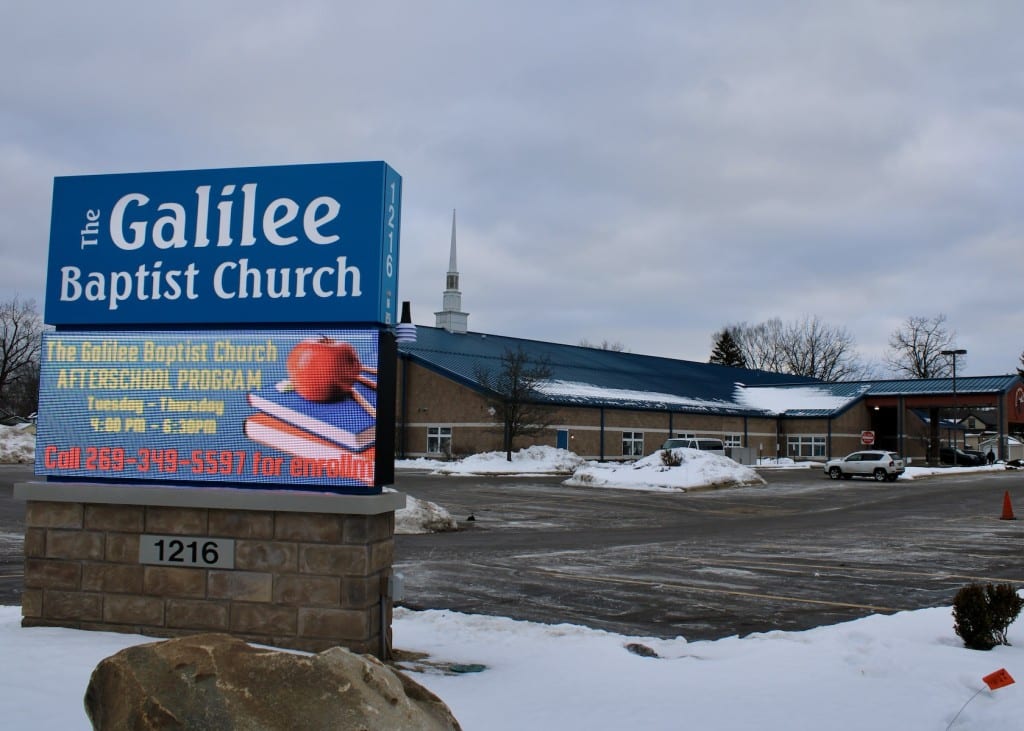
Starting in 2026, the Scotts are attempting to relaunch Galilee’s afterschool programming after a decade-long pause. Again listening to his congregation and the surrounding neighborhood, Scott was hearing frequently of the impacts the COVID-19 pandemic had on child learning, especially with literacy.
“There appears to be a great need for education, and it seems to me that faith communities really have not been included in that process,” he says.
That was until this past year, when the state put out a funding opportunity for churches in West Michigan to provide programming, and Galilee was one of 10 recipients.
While they are still working to hit their attendance goals, the Scotts are engaging daily with parents, teachers, and principals to share the program information and connect neighborhood children. Students receive help with homework, a free meal, and a supportive space Tuesdays through Thursdays until the end of May.
“Our light shines through as we are working with the children,” says Tamara Scott.
Much of what the Scotts and their congregation members do at Galilee seldom makes headlines. This includes a benevolence fund that assists parishioners in making car payments, utility payments, or rent. When the federal government paused SNAP benefits in 2025, Galilee took funds straight out of the church’s account to help people navigate the uncertain times. They also conduct jail ministry visits, bringing supplies and resources to the incarcerated, some of whom are members of the church, hoping to return upon their release.
Scott meditates on all of this at length. “We hear people ask, ‘Why are you not doing anything for the Black community?’ It may not be on our website, but it’s our priority. If we were not here, it would be worse. We are praying for and preserving the neighborhood.
“I can look back on my childhood and look at where I am today. Some may say that I am not famous or rich. But that is not my goal. My goal is to look back and have been a blessing to people. I would like to think I have done that, and I plan to keep doing that.”
A Church on the Move
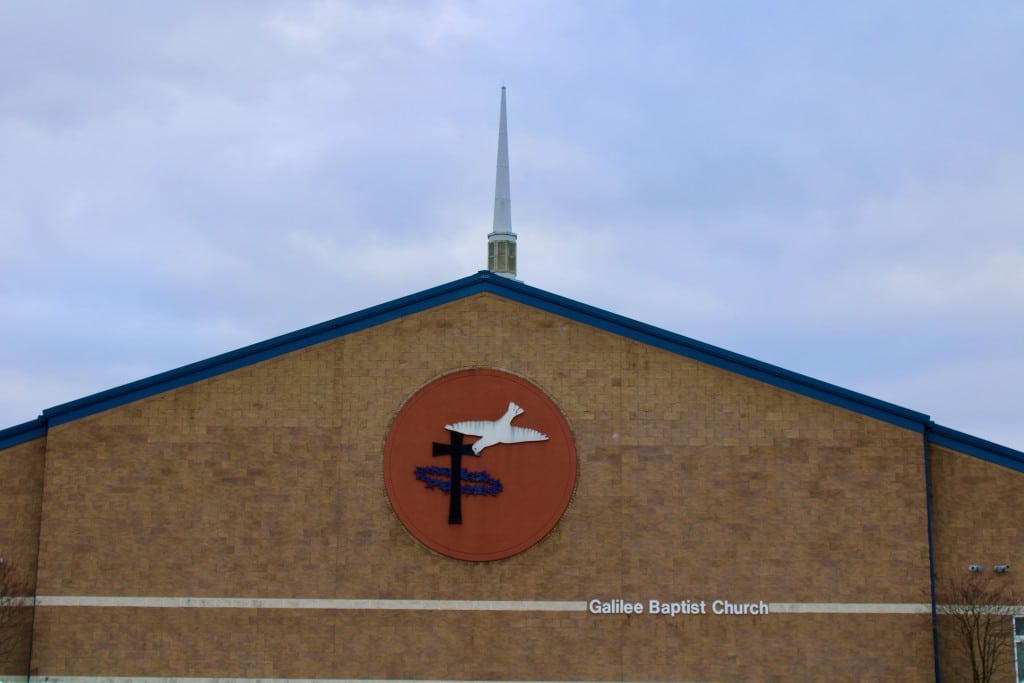
Galilee Baptist Church is one of the oldest Black churches in Kalamazoo. What started as a small Bible study group in 1958 has grown into a church that spans half a block in the Northside neighborhood.
Before its current location, the old AFL-CIO Union Hall on Cedar and Davis Streets in the Vine Neighborhood served as the first home to the fledgling Galilee group. No more than 56 founding parishioners showed up across the first two services on opening Sunday. The church, then known as Galilee Missionary Baptist Church, relocated to Gull Road from 1960 to 1971 before its current location at 1216 N. Westnedge.
Proceeding Scott, the congregation was led by a larger-than-life figure in Pastor Dr. J. Louis Felton. With nearly 20 years of pastoring Galilee, Felton left a legacy that still reverberates today. He was a lead founder of the Northside Ministerial Alliance, a board member for the Kalamazoo Community Foundation, opened the doors for women to join Galilee’s board of trustees, and even ran for state office as a Republican in 1980.
“I stand on the shoulders of giants,” said Scott when reflecting on the church’s history.
Remarkably, Scott is only the fourth pastor in Galilee’s 68-year existence. As he approaches his 15 years of pastorship, he says he appreciates the consistency and presence Galilee’s leadership has had in Kalamazoo. He says he believes his providential placement has been marked by his unique focus on ministry and transformation.
Time for growth: ‘Family life transformation center’ on the horizon
Just like his work at Jerusalem Baptist in Temperanceville, Virginia, or the work of his predecessor, Pastor Felton at Galilee, Scott says that a new time to grow has arrived. After paying off the church’s $2.5 million debt in 2021, Scott says, “I believe that I am here to assist the congregation in the next phase of their expansion and growth.”
A plan is in place to expand Galilee to the south, extending its physical building to the end of the block along Norway Avenue. This $3.5 million project was voted upon and approved by the church and will be dubbed a “family life transformation center.” Plans include a multi-purpose area for a gym and auditorium, a banquet hall, a chapel for small weddings and funerals, and a childcare facility. Knowing his congregation and neighborhood, he says he hopes for the childcare options to include 24-hour programs to serve families who work the third shift at a time when Kalamazoo has been dubbed a ‘child care desert.’
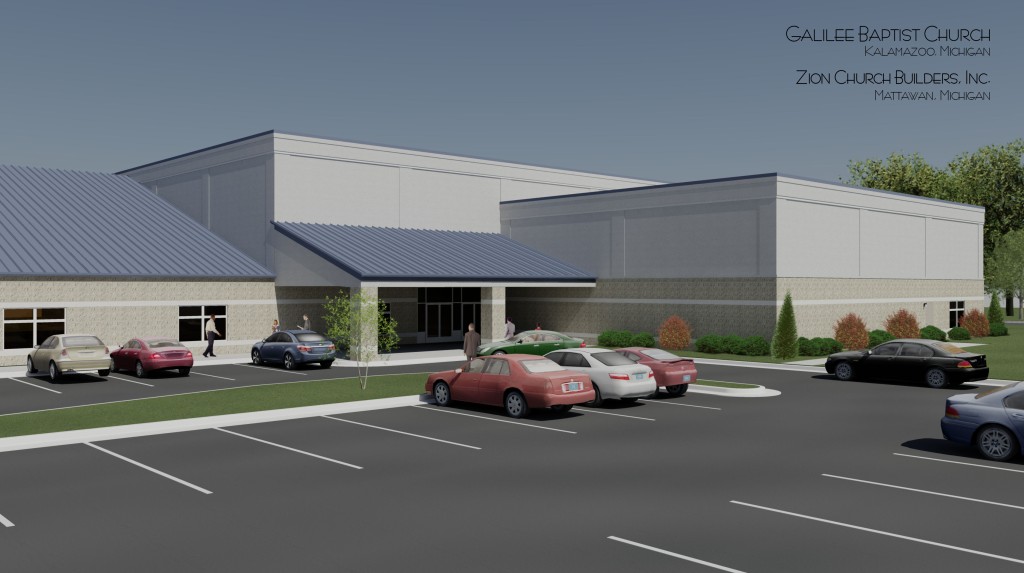
The groundbreaking will occur this summer. And it comes at the same time that the new Kalamazoo Event Center’s construction shadow looms large over the Northside. Bishop Scott knows he has allies in city hall and among downtown power players, but is concerned that not everyone has the Northside’s interests at heart.
“Some people want to reduce this area, and are encroaching upon it,” says Scott. “We are encouraging people to hold on to your property and your land. Take care of what God has blessed us with.”
Sustained in silence
At the end of a long day, Scott seeks solitude, setting aside time for silent prayer and reflection. In those quiet moments, he listens for the same Spirit that eased his pain after invasive back surgery at age 13, the same Spirit that united him with his faith-filled partner, Tamara Scott, and the same Spirit that ultimately led him to Kalamazoo. It is this guiding presence, he believes, that continues to shape his lifelong ministry and service to the community.
When he does pray aloud, he says, his words begin not with requests, but with reverence.
“I start with adoration and thankfulness for who God is and what He has done in my life,” he says. “Sometimes I never get to asking for anything at all.”
Author
Matthew Miller is a social worker and freelance writer who started with Second Wave in 2025. He is the lead writer for the Voices of Faith series and resides in Kalamazoo.
Related Articles
Baseball great Darryl Strawberry to share his faith journey at Battle Creek Community Prayer Breakfast
Former MLB star Darryl Strawberry will share his powerful journey from fame and addiction to faith and redemption at the 2026 Battle Creek Community Prayer Breakfast, offering a message of hope and healing to the community.
Sisters leading a revolution of love — for the earth, the elderly, and every ‘dear neighbor’
Once nearly a thousand strong, the Nazareth Sisters of St. Joseph helped shape Kalamazoo’s identity. Today, even as their congregation shrinks, their commitment to serving the “dear neighbor” is only growing deeper.