Know Your Rights: Protesting without fear of retribution in Battle Creek
A recent “Know Your Rights” panel in Battle Creek brought together community leaders, legal experts, and organizers to educate residents on how to protest safely and effectively — emphasizing nonviolence and the power of collective civic action.
Editor’s note: This story is part of Southwest Michigan Second Wave’s On the Ground Battle Creek series.
BATTLE CREEK, MI — “No Kings” protests in Battle Creek have been about “as joyful as it gets,” says Diop Harris, a Community Organizer and candidate for Michigan’s 4th District Congressional Seat.
But this has not been the experience for cities throughout the United States, where ICE (U.S. Immigration and Customs Enforcement) activity is on the rise.
“Certain hot spots nationally coincide where ICE activity has been surging,” Harris says. “ICE in and of itself is a rogue agency which operates on what (President) Trump thinks and says.”
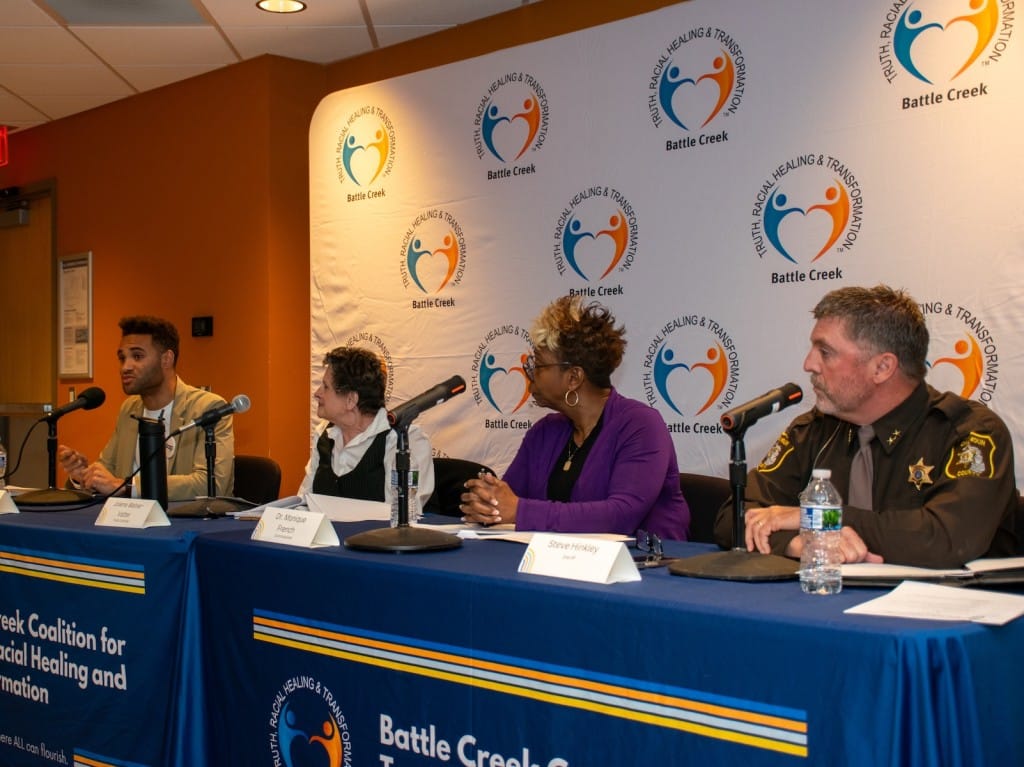
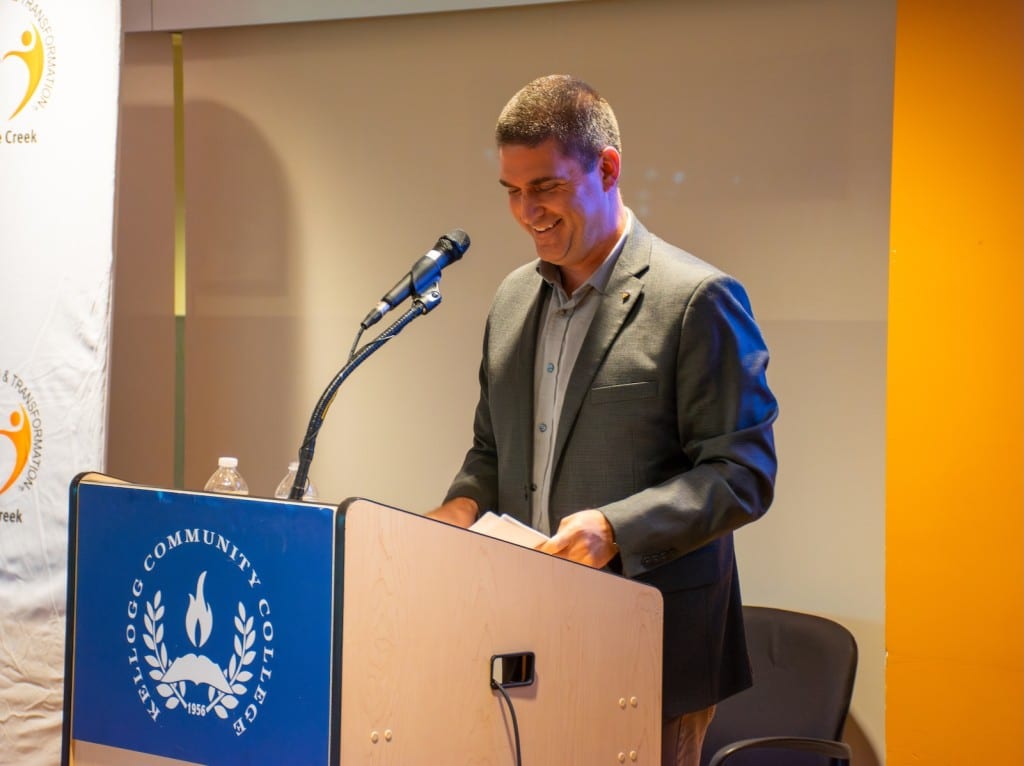
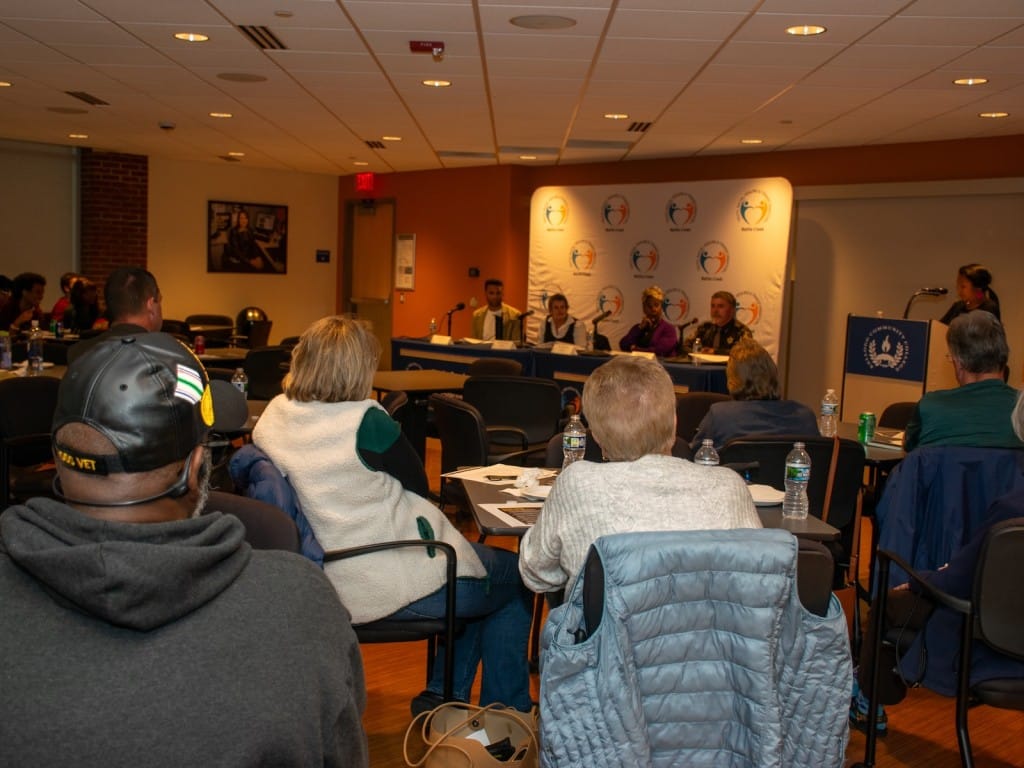
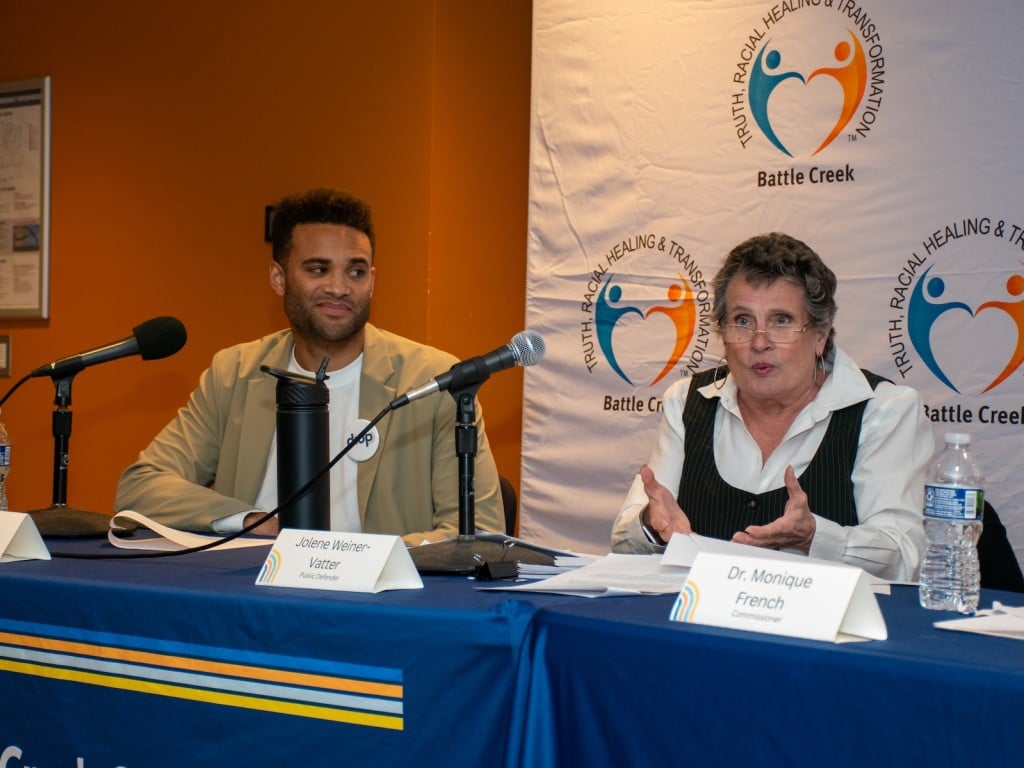
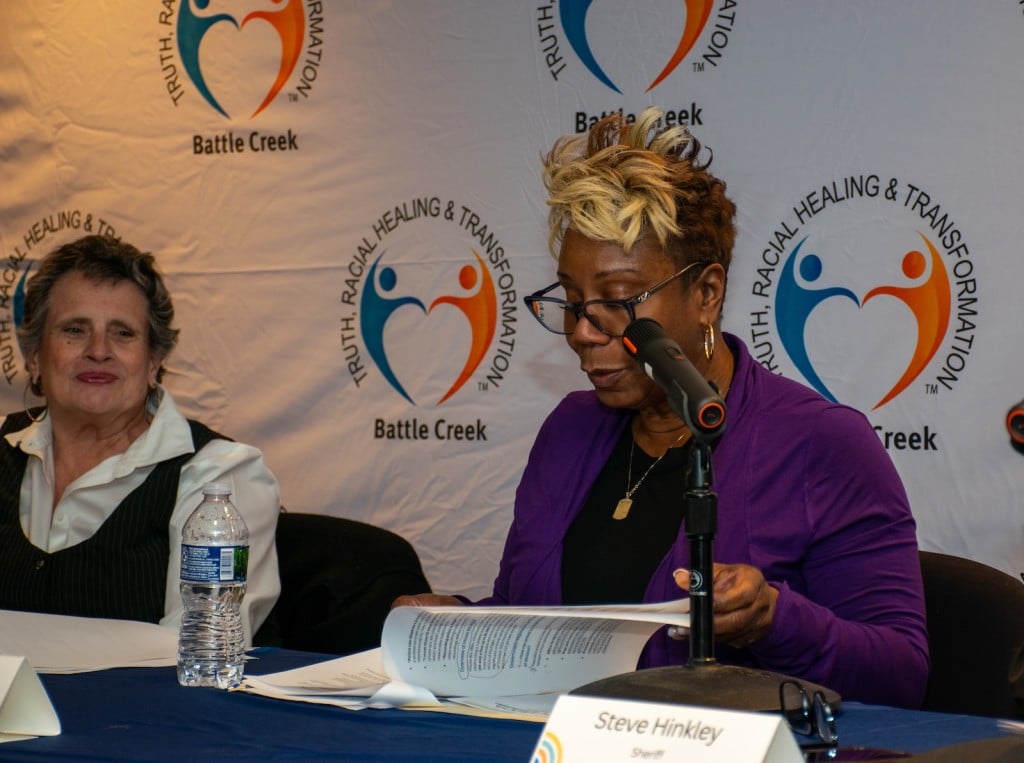
In late October, Harris was part of a four-person panel for a presentation titled “Know Your Rights,” which focused on educating Battle Creek community members about their rights as protesters. The presentation, attended by more than 30 people, was facilitated by Eric Greene, Vice President for Communications and Advancement at Kellogg Community College, and hosted by Battle Creek Truth Racial Healing and Transformation (BCTRHT).
“I think for us, we’ve been recognizing that people are feeling frustrated with everything happening in our Nation,” says Tha Par, Co-Executive Director of BCTRHT. “There are healthy ways you can express your discontent, and one of these ways is in the form of protesting to fight for what you care about. A lot of things people are passionate about and care about are in jeopardy.”
Calhoun County residents, like their counterparts throughout the United States, have the right to protest and demonstrate in a safe, peaceful way, says Jolene Weiner-Vatter, panelist and Calhoun County Assistant Public Defender.
“You need to have a sense of community in your head while demonstrating,” she says. “This means no violence, no destruction of property, and no weapons or fighting. You can have as much of an impact wearing a sandwich board with the words you want to use on it.”
She also floated the idea of wearing headphones so “you’re not hearing people who may respond to you,” staying on a sidewalk so you’re not obstructing traffic, and staying off of private property.
“You can do this and still make an impact,” Weiner-Vatter says.
For Harris, the act of protesting is not so much about participating in a single event, but rather building a network of people to take action.
“If we need to show up at a meeting or have policy that needs to be addressed, we know that there will be people willing to show up,” he says.
As a community organizer, Harris has organized and participated in protests, including one on Labor Day in Battle Creek and another that happened during a monthlong strike with millworkers at Knappen Milling in Augusta. In each one, he says he saw “an energy in the community to fight for workers, stand up for workers’ rights, and build an economy that works for businesses and the people who work there. I want to help communities find the agency to fight back.”
Protestors need to your rights
Knowing their rights allows people the freedom to use their Constitutional rights in a safe way, Weiner-Vetter says. No stranger to protesting, she has been an active participant in exercising her right to peacefully demonstrate, beginning in her teens.
Remembering the era of Community Policing, when officers would walk or ride bicycles to connect with residents, Weiner-Vetter says this has been replaced with police departments turning more militaristic.
“We really are seeing that with police departments, they’re using military tactics instead of community policing. Crime stats indicate that there’s a lot more resisting and opposing because de-escalation tactics aren’t being taught,” she says.
Where Par’s family came from, Myanmar (formerly Burma), these militaristic tactics were commonplace, and de-escalation was a foreign concept. She says it remains this way, which is what led her father to emigrate to the United States, finally landing in Battle Creek in the late 1990’s where his family soon joined him.
Her father was part of a large protest in 1988 in what was then Burma. He was among the large numbers of participants who fled the country over fears of retribution from the military.
“When I was young, neighbors would be missing because they said something the military heard, and they were taken to prison. If we questioned anything, your life is at risk or your family’s livelihood is at risk,” Par says. “For me, growing up and hearing adults talk about America being a symbol of democracy is one of many reasons I think people come to the United States in their journey of resettlement. I don’t know if people really know that in order to maintain democracy, you have to practice democracy. If you don’t take charge of your democracy, it may not exist.”
The missing voices
The history of protest, according to numerous scholars of History, is a long and global tradition of people using various tactics to challenge authority and advocate for change, ranging from ancient revolts to modern online movements. Early examples include the barons who resisted monarchy and led to the Magna Carta in the 13th Century, while later protests include the Salt March in India, the American Civil Rights Movement, and more recent movements like Black Lives Matter.
Nationwide “No Kings” protests are the latest in a long list of present-day events that are compelling ordinary citizens to take up signs, not weapons, to give voice to what they see as unjust policy and activities, Harris says.
“This current movement has ties to our past,” he says. “If we can do a little digging into our history and learn about previous struggles to fight fascism, this is key to taking on this movement now. We are forward and back at the same time.”
Noticeably absent from these protests are People of Color.
Nearly five years after fueling the largest protest movement in American history, Black activism stands at a generational, emotional, and strategic crossroads,” according to an article on the Axios website.
“Many of the Black Americans who flooded the streets in 2020 have stepped back from the renewed anti-Trump protests — torn between the urgency of the moment and the spiritual toll of relentless, often fruitless resistance,” according to the article. “The stakes are huge: President Trump’s second-term agenda is openly hostile to DEI (Diversity Equity Inclusion), police reform, and the civil rights protections that have underpinned racial progress for the last half-century.”
“Voters of color and people who come from disadvantaged communities are exhausted,” Harris says. “We’ve been doing the work, and none of us are surprised. We’re exhausted from the fight and looking for more efficient ways to participate.”
Protesting isn’t going to keep them safe and is a low priority when they’ve got to put food on the table for their children and make sure the lights stay on in their homes, he says.
“Standing on the street protesting is not going to change any of this. They want real change, and that can only come with policy change and economic investments. POC want to see real results.”
Salandra Benton, executive director of the Florida Coalition on Black Civic Participation, says in an article for Word on Black. “We’ve been working first, second, and third shift. It’s time for someone else to pick up the slack. We’re weary, and a piece of our spirit was robbed from us in the last election.”
Benton is mindful of the metaphor, When America gets a cold, Black people get pneumonia and says, “Everyone, save for billionaires, is being harmed by the Trump administration’s policies. Maybe the organizers of these mass rallies should focus on working-class whites who supported Trump.”
Some organizers say Black activism is shifting away from mass mobilization and toward quieter strategies: economic pressure campaigns, digital organizing, and coalition-building behind the scenes, according to the Axios article.
“Activists point to rising fears of targeted state violence under Trump, including the risk that Black protesters could be surveilled, detained, or worse — a fear underscored by the treatment of legal residents caught up in immigration raids.”
Harris says, “Certain communities have targets on their backs.”
“I can understand why people have fears in protesting. I can understand that our criminal justice system has a history of not treating white, black, and brown people equally,” Weiner-Vatter says. “In our current political climate with ICE in our communities and on our streets, I can understand why people can’t be out there.”
She says there’s no disputing that white people, in many cases, don’t face the same treatment that POC do, and points to herself as an example.
“When I protested George H.W. Bush, I did something very wrong. I kind of flipped him off when he waved at me. But I wasn’t arrested, I was spoken to. It was no big deal. That’s white privilege, plain and simple.”
Unlike military-run countries like Myanmar, Par says all people in America have the freedom to advocate and speak out. The key is making sure that they feel safe enough to do it.
“We are creating processes and habits to allow this to flourish. Protest is one crucial tool we need and have to use,” Harris says. “I think people are listening. Seeing so many people out on our streets showing up for what they believe in shows me that these protests are moving the needle.”
Author

Related Articles
Objects of Affection: From a crochet hook to a bowling ball, love stories in Kalamazoo
In honor of Valentine’s Day, Western Michigan University multimedia journalism students explore how everyday objects become powerful symbols of love, identity and memory through photos and captions.
Sisters leading a revolution of love — for the earth, the elderly, and every ‘dear neighbor’
Once nearly a thousand strong, the Nazareth Sisters of St. Joseph helped shape Kalamazoo’s identity. Today, even as their congregation shrinks, their commitment to serving the “dear neighbor” is only growing deeper.
Lights, Camera, Great Lakes: Wolf Tree Film Festival returns bigger and bolder
The Wolf Tree Film Festival returns to Marshall for its 8th year this spring, highlighting Great Lakes filmmakers and fostering community through accessible, regional storytelling.