Kalamazoo’s got jazz, and Crawlspace has ‘that New York energy times ten’
A New York–level jazz firestorm lit up a Kalamazoo church, proving world-class swing doesn’t need a Manhattan zip code.
Editor’s Note: Welcome to Curtain Call — your front-row seat to the unique, lively, and memorable performances shaping Kalamazoo’s arts scene. Supported by the I.S. Gilmore Foundation, this series highlights the creativity and community that make each show something special.
KALAMAZOO, MI or NEW YORK, NY? — It’s a New York room.
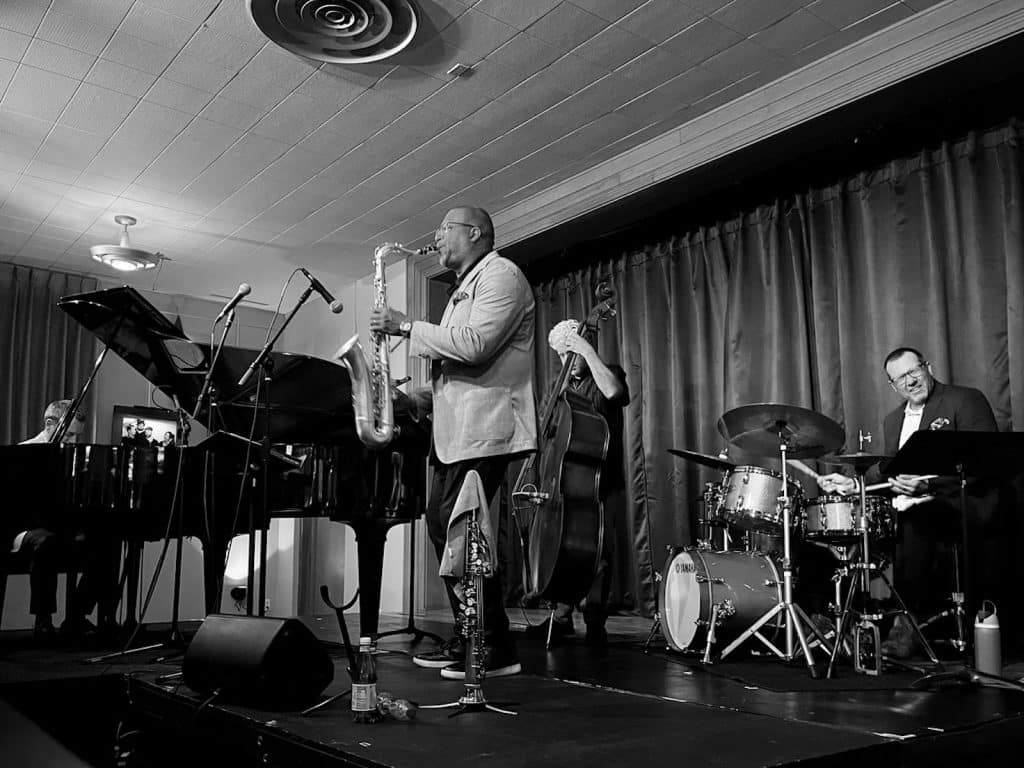
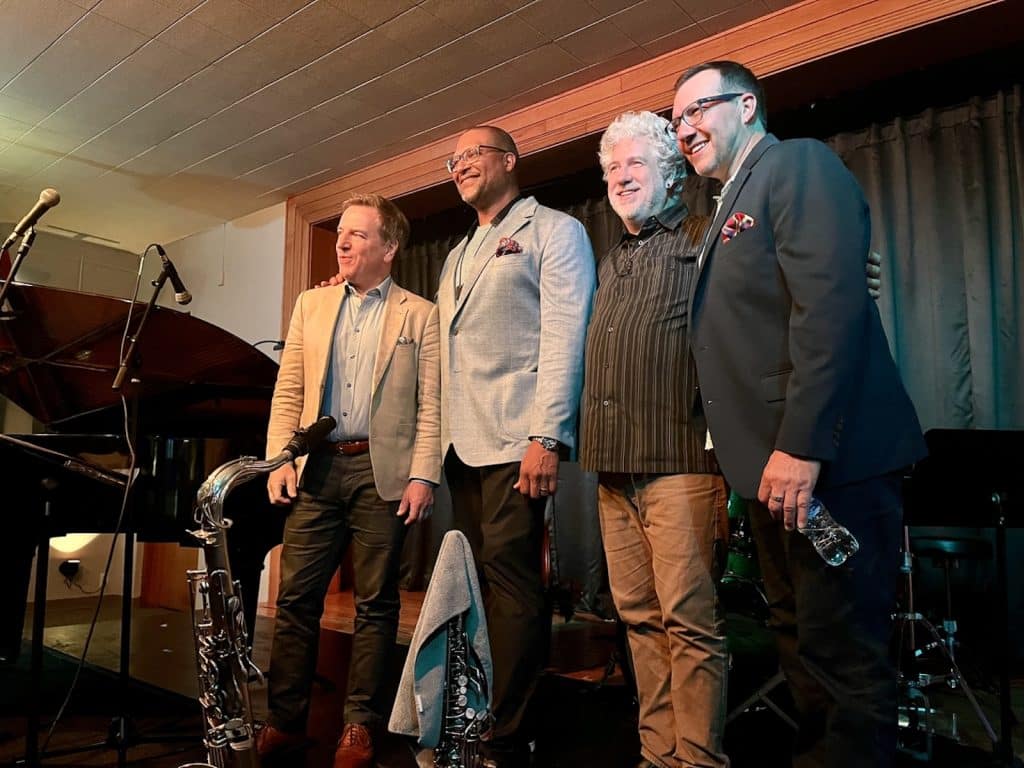
Thursday evening, Sept. 11, Saxophonist Jimmy Greene, with each solo, was transforming into personalities, characters, making statements, ripping out intense truths. Drummer Keith Hall, bassist Carlo de Rosa, and pianist Matthew Fries were keeping up with his intensity and appeared to be having a blast meeting the challenge.
Greene is a jazz-album charting, Grammy-nominated musician, working his magic a yard or so from the tables in the front row, and not too far from the tables in the back. In many towns, you see talent like this far away, in a concert hall or theatre stage. Here, it’s close enough so the vibrations from the instruments are hitting you directly, not just from the sound system.
Having a nice cocktail from the bar, with a contemporary jazz master reaching for the limits right before me — I must be in some classic Manhattan jazz club, right? Not in what used to be a former church in Kalamazoo? It’s sold out, around 90 seats filled — are there that many jazz fans in Kalamazoo?
No, it’s not New York, it really is Downtown Kalamazoo. Jazz in the Crawlspace, running since 2022, has begun its latest series of bringing masters of their art to the Crawlspace Theatre at the Kalamazoo Nonprofit Advocacy Coalition (KNAC ) in the 1853 First Baptist Church building on Michigan Ave.
“We’ve got that room here in Kalamazoo”
Dann Sytsma, KNAC Board President, wanted more events for his Crawlspace Comedy Theatre. Jazz made sense in the space. “Keith (Hall) and Matthew (Fries) are the brains and heart behind the whole thing. They have met all the top jazz players in the world,” Sytsma tells us while working the door.
Fries and Hall, as well as De Rosa, are professors at Western Michigan University’s jazz studies department.
“Keith and Carlo and I are all former New Yorkers, too,” Fries says after the Greene set.
They’ve played on low stages feet from jazz fans, and they’ve been the jazz fans mesmerized by the talents before them.
“To present these concerts in this little intimate room — it’s just such an incredible way to get to hear music.”— Matthew Fries, professor of jazz piano at Western Michigan University
Playing with Greene that Thursday night, Fries felt “the energy of a lot of those New York shows. With a great listening crowd like what we’ve got in that room here in Kalamazoo, it’s just like the New York energy, times ten,” he says.
It’s a special energy, a special experience, for the players backing Greene.
“Having somebody like that who plays at such a high level come in, it just really elevates everything.” It forces Fries, Hall, and De Rosa to focus, “just pull out all the stuff that we’ve experienced and learned over our years. And it all just makes sense, and it feels really great.”
It was their intent to create the special energy of a New York jazz club. Live jazz, up close, can be rare in Kalamazoo. The Union had live jazz, but it didn’t survive COVID. Dabney and Co. has live jazz up close and personal in their lineup of R’n’B, blues, and soul, but they don’t bring in big names in the genre.
Helping to keep it affordable to get the big names at Crawlspace, Fries points out, is the John Stites Jazz Award.
Stites was a Kalamazoo recording engineer for many decades, who was “invested in so many of these student groups and music in the community. When he passed away, it turned out that he was also a pretty smart investor, and he had a huge chunk of money in the bank. And since he didn’t have kids, he just gave this money back to the community,” Fries says.
With funding from Stites’ Award, “he’s kind of facilitated financially for us to be able to create sort of a New York club once a month right here in downtown Kalamazoo and allowed us to bring in people like Jimmy Greene.”
Coming to Crawlspace this season: Oct. 2, Rufus Reid and his quartet; Nov. 13, Bobby Watson, who was a member of Art Blakey and the Jazz Messengers; and acclaimed jazz vocalist Libby York. There’ll be more — the Stites grant funds the series for the next three years.
“To present these concerts in this little intimate room — it’s just such an incredible way to get to hear music,” Fries says.
Singing sax “Praises” and “Heartache”
Fries spoke the day after he, Hall, and De Rosa backed Greene at Ann Arbor’s Blue Llama Jazz Club.
“I was telling Jimmy at the end of the night, I just had so much fun. Your music is easy and hard at the same time. Like, I know what to do because it’s so authentic and it’s so based in the tradition. But at the same time, it’s really challenging because it’s being played at a really high level, and I really have to stay in it to make it work, to really be part of it.”
At Crawlspace, Greene wasn’t wild and unpredictable, but his solos got intense. His style is often categorized as “neo-bop,” or “post-bop,” with roots in the past but not stuck there. He’s definitely taking things in his own direction.
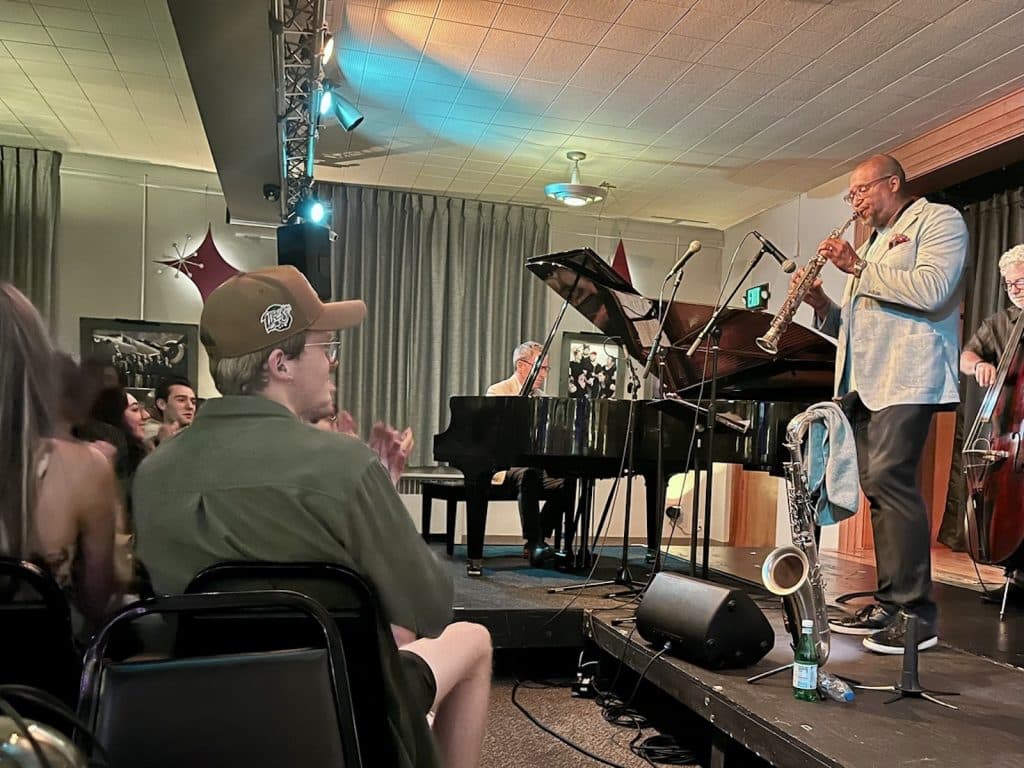
It seemed that each solo represented a journey, a character, some soul going from point A to point Z. For example, a familiar melody, a tune I couldn’t quite place, was a framework for what I swear was a guy, alone on a nighttime street, looking for romance, but getting none.
Maybe he’s smoking a cigarette, maybe it’d just rained, an urban street shiny in the night — the great thing about jazz or any instrumental music is, the listener can have whatever visions conjured up in their head, and it doesn’t matter if they’re correct. Maybe some genres tend to make me think of images from 1950s black and white noir films.
Greene’s second solo in the tune: The guy is just fine being alone. Next, he’s strutting down the street, daring anyone to point out his loneliness. He’s taken a swig from a flask, getting a bit cocky about his state. Finally, the sun is rising, he’s at his apartment, alone, but everything is just cool.
Greene announces afterward that the tune was “Good Morning, Heartache,” made famous by Billie Holiday. She made it about a woman getting acquainted with loneliness. Greene gave it a different emotional spin.
He performed his originals, like “Praises” and “Unburdened” from his latest album, “As We Are Now.” “Praises” opened the set, a cool groove that built in intensity until Greene was emitting a million notes from his sax, speaking in tongues, seeming to reach for something just beyond. “Unburdened” traveled from melancholy to a release.
He didn’t mention it on stage, but faith is part of his music, as well as the memory of his daughter Ana, murdered at six in the 2013 Sandy Hook Elementary mass shooting. His 2014 album “Beautiful Life” was dedicated to her, and rose on the Billboard’s Christian, Gospel, as well as on the Jazz charts.
Greene speaks simply from the stage. In introducing his “Love In Action,” he said, “And during these times, don’t we need a lot of that to be happening in our country and our world?”
He doesn’t preach; he lets the music do that.
Between tunes, Greene spoke of his mentor, Jackie McLean, and his hometown in Connecticut.
Noting the WMU jazz students who mostly filled the front tables, he talked about his first student competition, where he was terrified to play before some of the big names in jazz who were the judges. He passed along what he was told — “Just remember to drink water before you play, and it’ll be alright.”
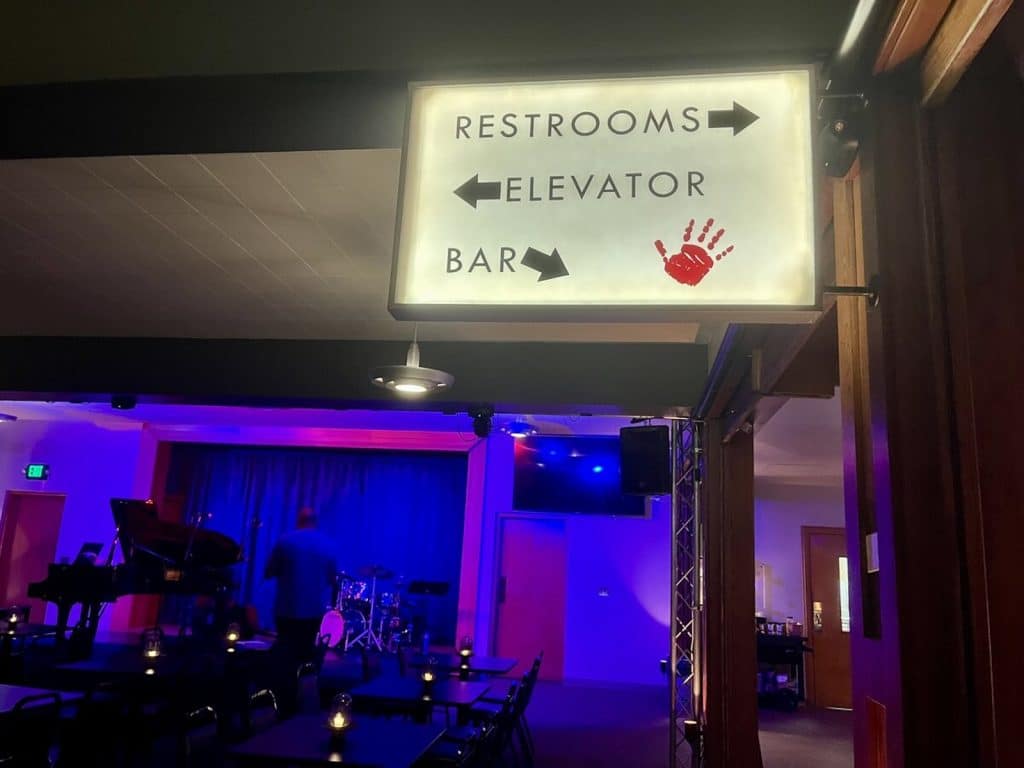
Whenever they bring in a master for the Crawlspace sets, the WMU jazz profs make sure to get their students exposed to the music and the experience of the musicians, Fries said.
“It’s a really special opportunity to have a city and a school that supports bringing these types of people in for us to experience, basically, for free,” WMU jazz student Grant Rupp tells us just after the set. “Just to get to learn from them and watch them, and see how they perform. So it’s really special, and we don’t take a single one of them for granted.”
Free for jazz students, $20 in advance, $25 at the door for everyone else. When considering everything, it’s a cheap ticket for the experience.
Author
Related Articles
Pulp & Press Lit Arts Fest brings world-class authors to rural Southwest Michigan
A new literary festival is coming to Vicksburg this spring, but the idea behind it reaches further than just arts programming.

An artist’s love song: David Small gives ‘Prufrock’ new life
Acclaimed Southwest Michigan artist David Small reimagines “The Love Song of J. Alfred Prufrock” through a limited-edition collaboration with Kalamazoo Book Arts Center.
Groove for Good: Kalamazoo climate night blends beats and big ideas
Kalamazoo residents are invited to a lively night of music, community conversation, and climate action at “Groove for Good – Climate Action Night,” a fundraiser at Old Dog Tavern supporting local environmental efforts.