How Glow Hall is carving out space for Kalamazoo’s loud, eclectic, and community-driven art
With intimate shows that blend punk, experimental music, performance art, and fundraising, Glow Hall’s founder is betting that Kalamazoo’s crowded creative scene still has room for events that are deliberately small, collaborative, and a little extra.
Editor’s Note: Welcome to Curtain Call — your front-row seat to the unique, lively, and memorable performances shaping Kalamazoo’s arts scene. Supported by the I.S. Gilmore Foundation, this series highlights the creativity and community that make each show something special. All photos were taken by Fran Dwight.
KALAMAZOO, MI — The founder of Kalamazoo’s new art/music venue, Glow Hall, has been around a bit. And he has opinions on many cities’ scenes.
Your non-mainstream art/rock/punk/whatever scene in St. Louis is hampered by so many of the scenesters being haters, criticizing so much that they find it hard to do any shows, he thinks.
In Detroit, instead of complaining, they just work to make something new and better in small venues.
In Chicago, well, there’s so much opportunity for unique shows there.
And in Kalamazoo? “If there’s any problem with this community is that there’s more going on than there are people to go to things, sometimes,” Christopher Keener says.
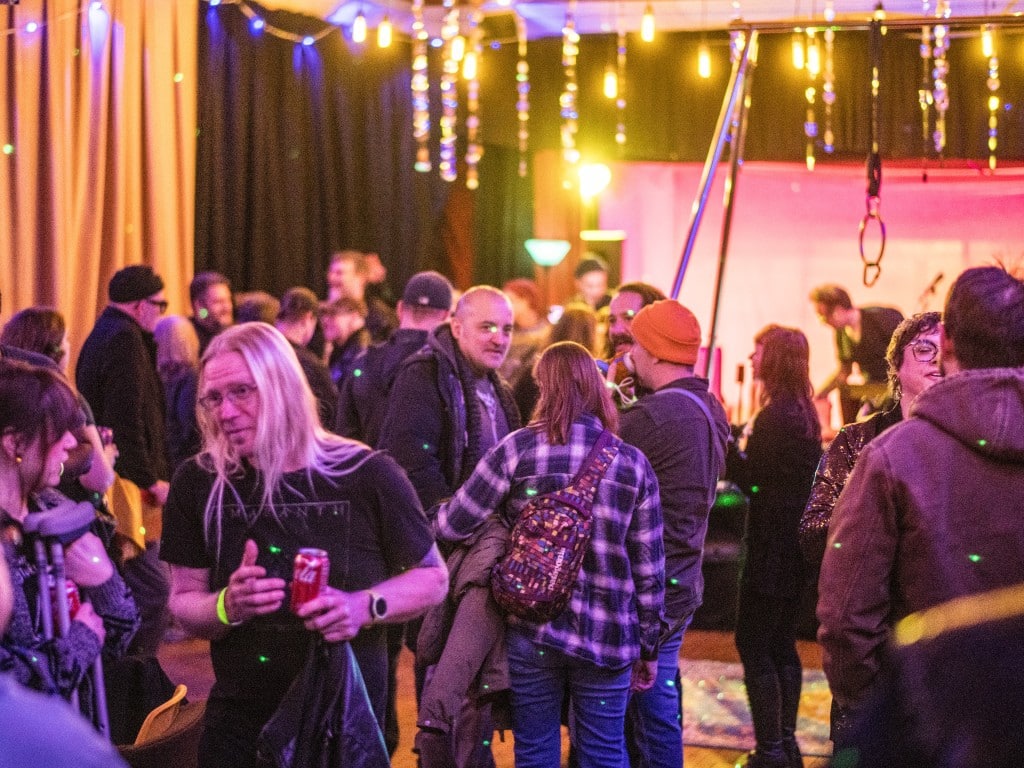
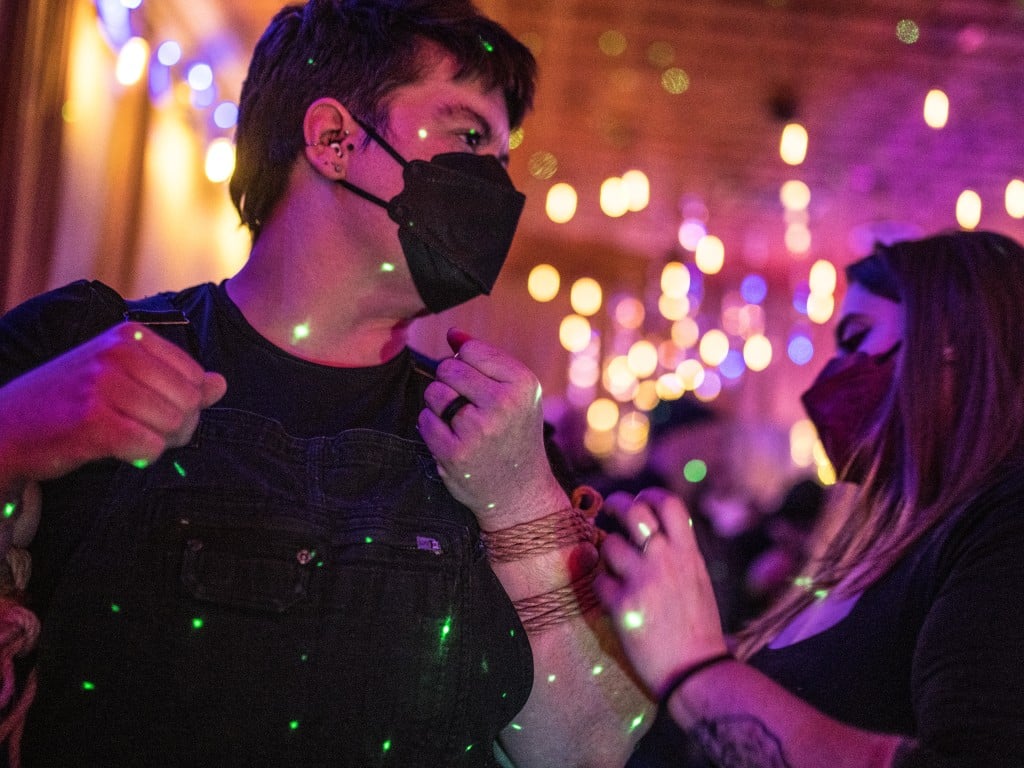
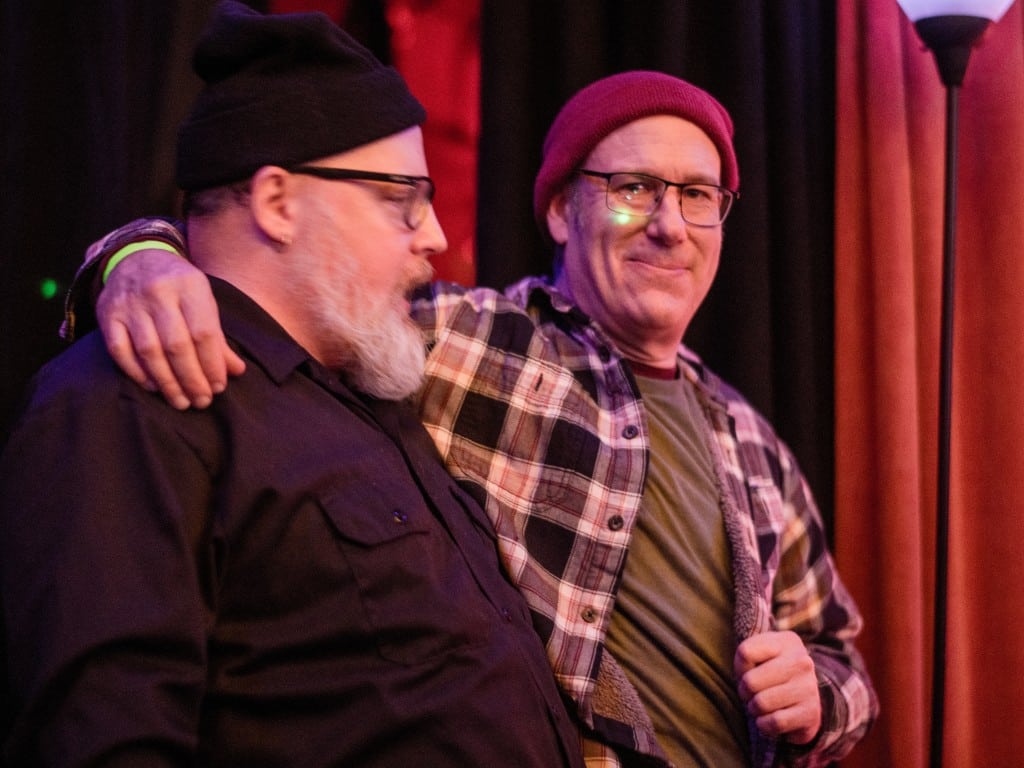
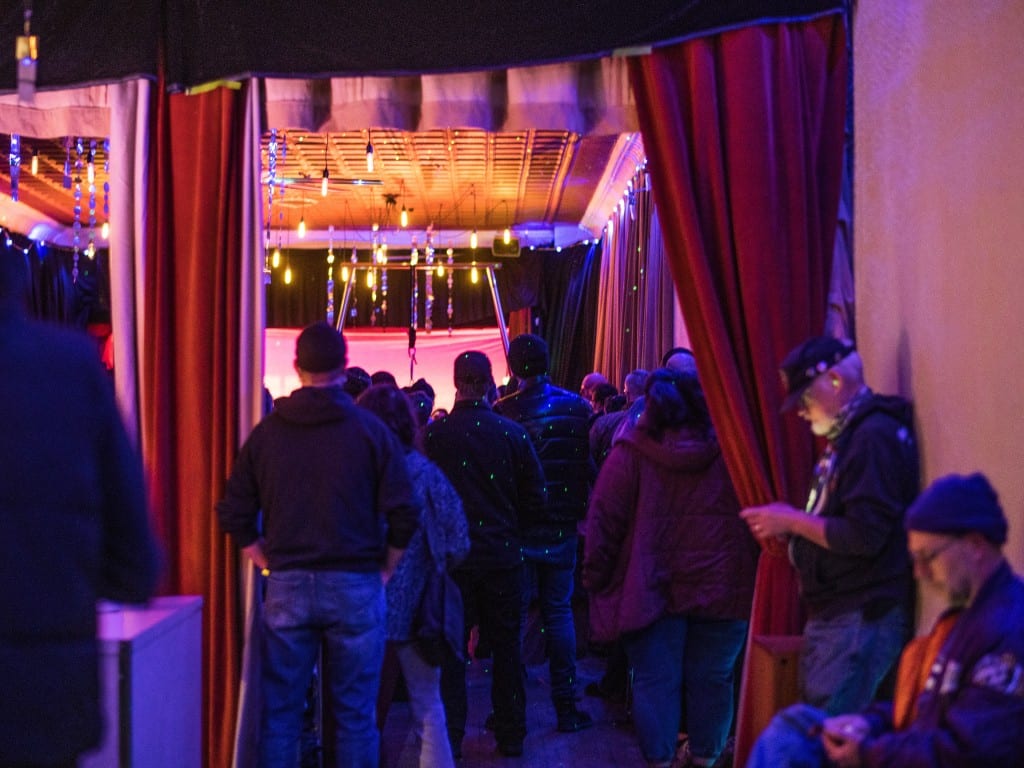
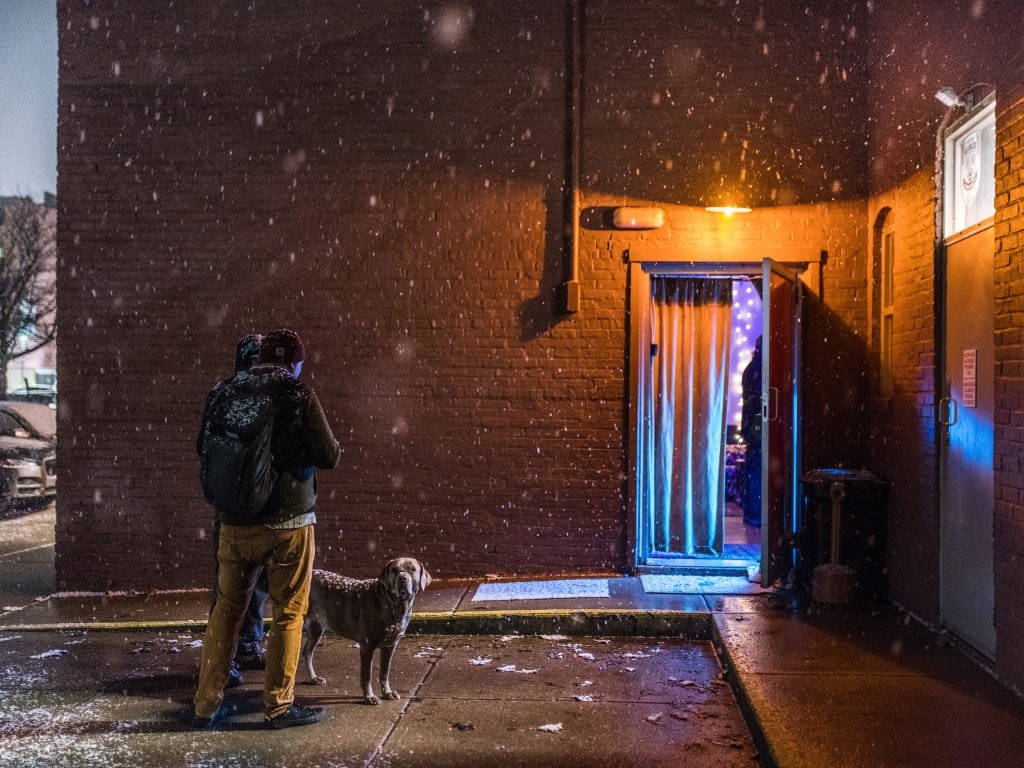
But enough people showed up on a snowy Saturday night to pack Keener’s new club on the Kalamazoo Mall, there to see noise/art/punk bands, with some shibari on the side.

Around 100 people packed the space. Keener and Ike Turner put the show together as a fundraiser to feed hungry students. It raised $700 for Kalamazoo Valley Community College’s Valley Food Share, Turner, an instructor at KVCC, says.
Turner threw in more, with “a generous donation,” he says, coming from local punk charity group Michigan Arts and Music Resource Collaborative, expected to push the total past $1,000.
Not a vanilla show
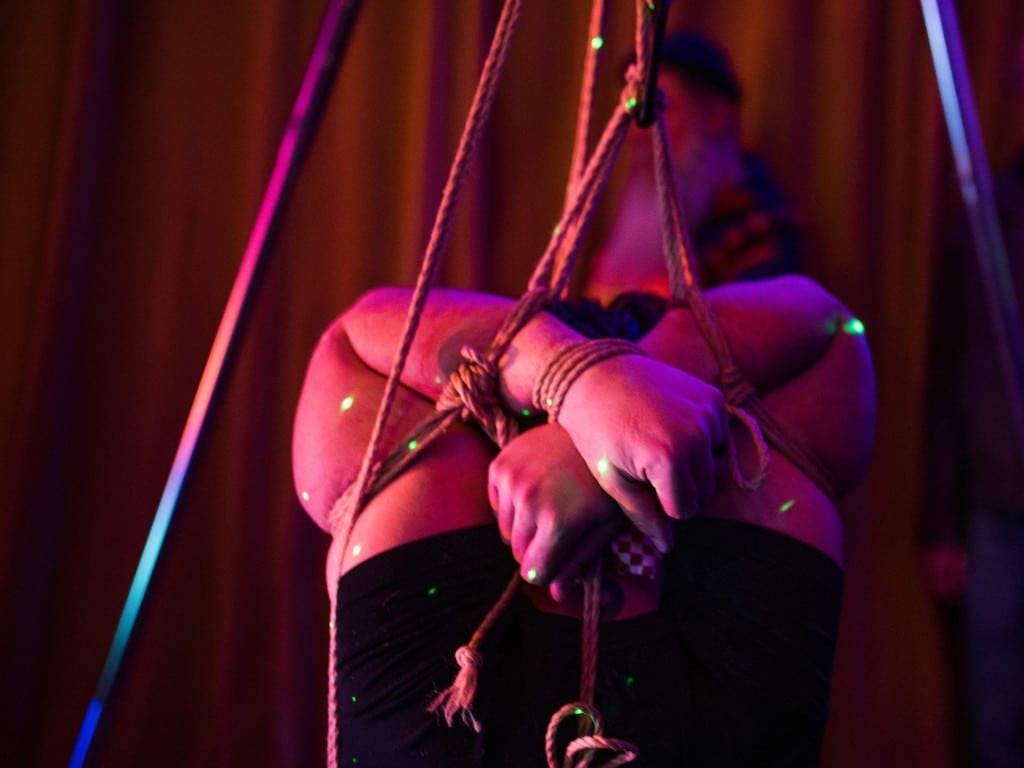
As Human Blood (Eric Hennig at a tangle of patchchords plugged into old electronics) opened by churning out what sounded like a creepy electronic soundtrack to a slasher film, Meat and Steel from Kentucky did shibari — the Japanese art of bondage.
It wasn’t sexualized, not presented as a kink for voyeurs. They were dressed modestly, in all-black. Steel tied Meat, immobilized, in rope, and hoisted them up to a ring suspended from a metal frame in front of the stage.
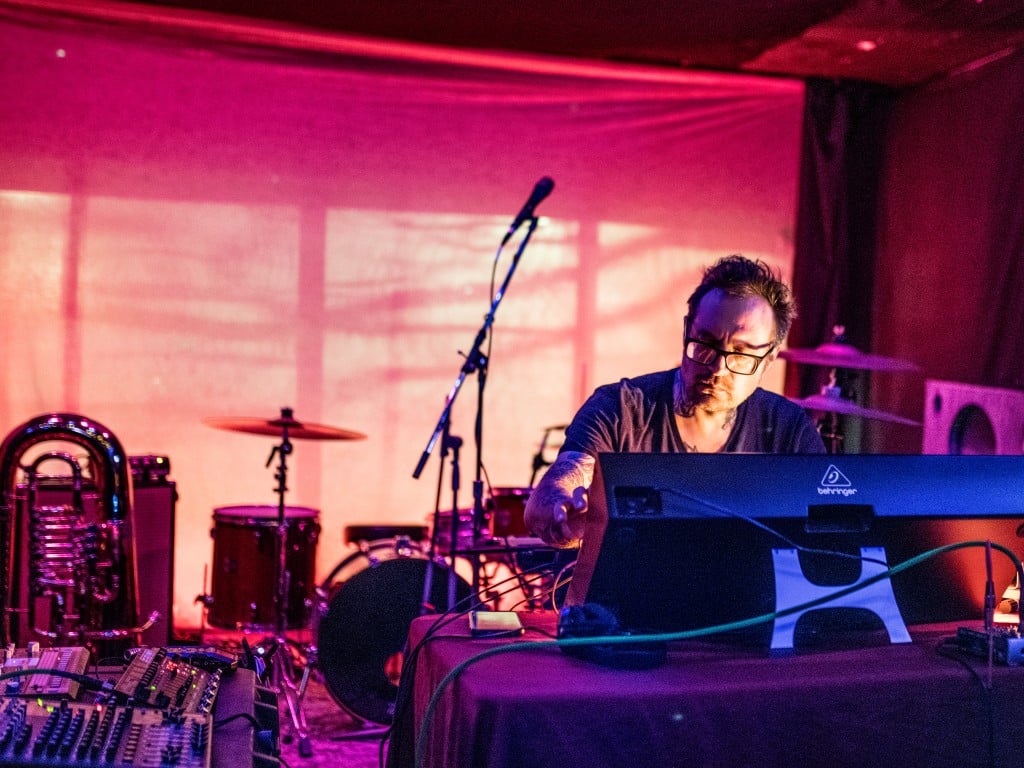
Meat hung for a while, upside down, heavy rope biting into flesh, as the sound grew even more intense. Human Blood throws in a sample of an unknown actor repeating something about “necrophilia” — Henning says later it’s from Alfred Hitchcock’s screentest of Tippi Hedren, Hitchcock’s test to see how unnerved she could be, before casting her in “The Birds.”
Outside, before the show, Turner says with a big laugh, “I’m a pretty vanilla kind of guy.” He wasn’t sure what to expect from the shibari.
All the bands on the bill were based in Kalamazoo, but Kentucky’s Meat and Steel were playing because one of their members is a good friend of the tuba player of his band, Three Grebes, Beth McDonald.
Who are they?
“That person’s name is Meat, and the other person performing is named Steel,” Turner says. “They’re incredibly professional. They have an incredible communication style with each other.”
Turner says he had asked them, “Can kids come see this?”
He says they told him, “Maybe not kids, but teenagers.”
He then asked, “So, is it… It’s not like bondage?”
“And they said, ‘It isn’t not like bondage.'”
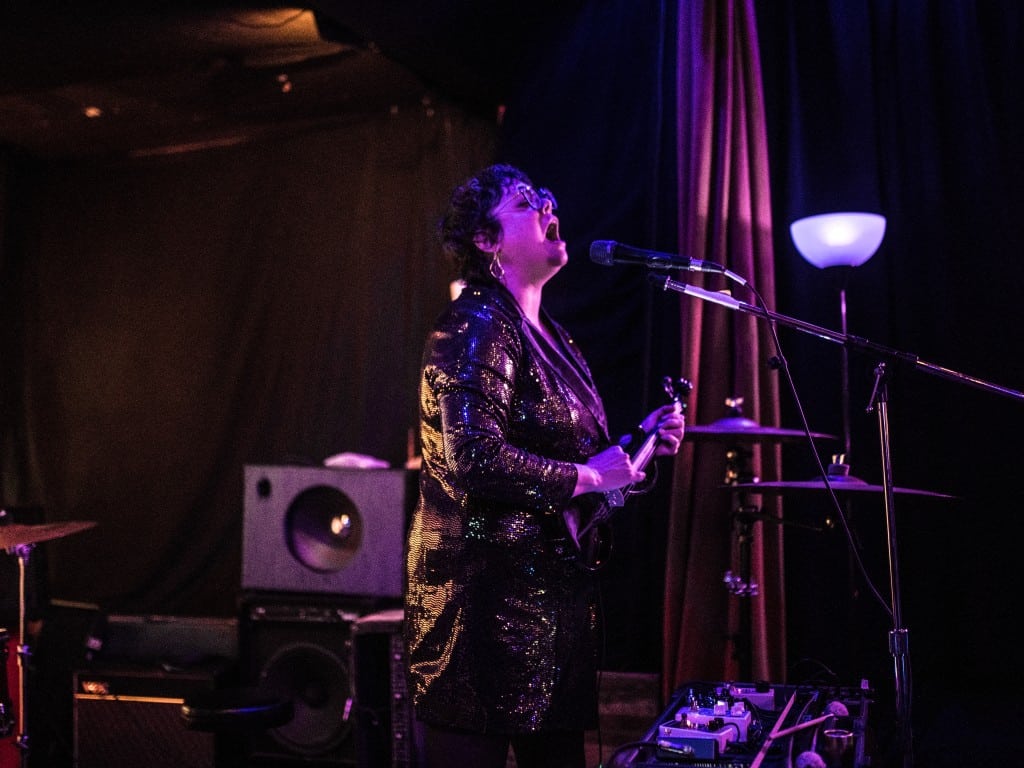
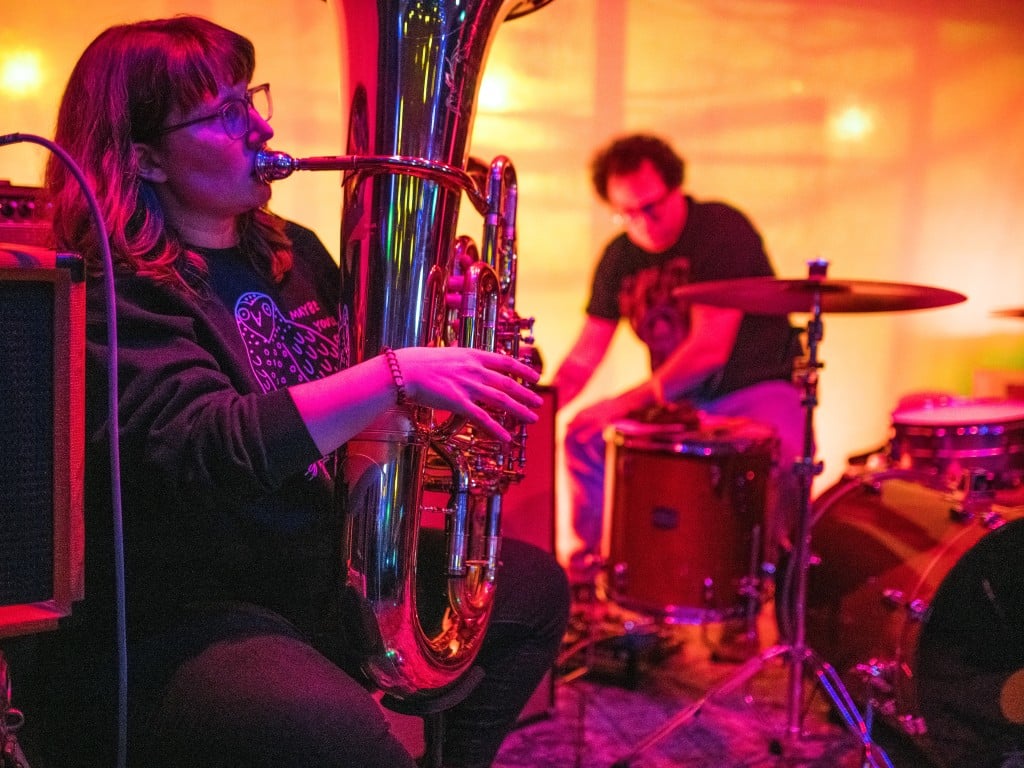
Three Grebes, with Franki Hand on vocals and violin, were second on stage. They improvised to Meat and Steel’s work. Swirling sound built until Hand’s breathy vocals were yelling, “There’s no way out!” And I’m thinking how much panic I’d feel if immobilized by a rope.
Turner was drumming intensely, staring at the shibari scaffold with apparent empathetic horror.
The intensity of the music gradually dropped as Steel gently brought down Meat. They untie, unwrap, and embrace. They hug, motionless, until the music stops.
Shows that are ‘extra‘
Kenener knew the space had potential.
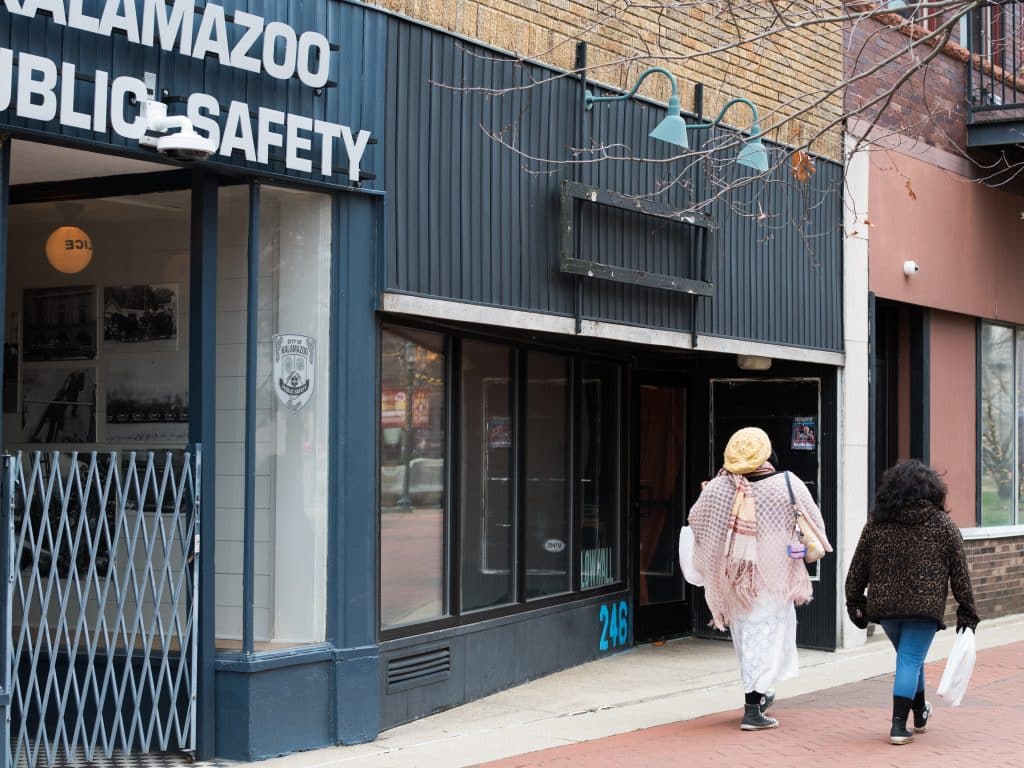
It was formerly Final Gravity brewpub, and longer ago, The Whole Art Theatre. At the north end of the Kalamazoo Mall in the Stahrs of Kalamazoo building, Glow Hall is right next door to the Kalamazoo Public Safety substation.
On one hand, it feels like the perfect location for an art/music venue, but on the other hand, he says, that block of the mall seems to be ignored. He realized this when no one turned on the holiday lights there this season — Keener has to go out at dusk to switch on the lights, or else it looks like his section of the Mall isn’t sharing in the joy of the rest of the Mall.
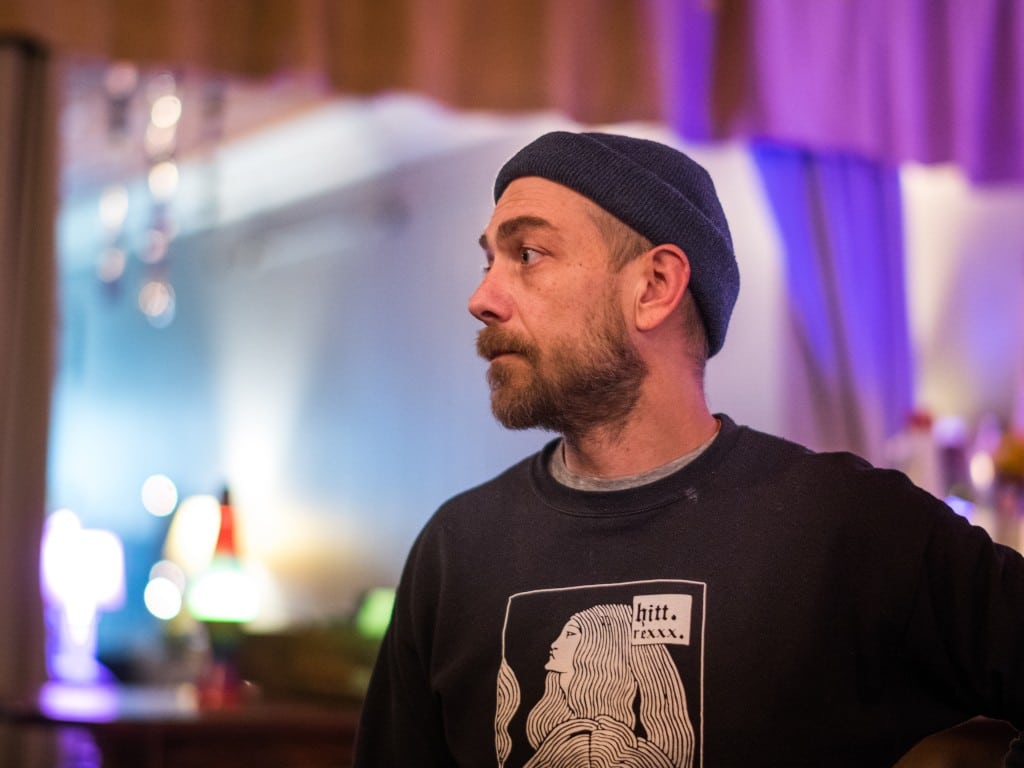
He’s fairly new to the area, having brought his family here to teach at the Kazoo School in 2020. Keener has lived all over. He was born in Wichita, Kansas, then grew up in St. Louis, then Columbia, Missouri, then Los Angeles, New Orleans, Germany (Berlin), New York City, Chicago, and probably a few other places.
Keener has been in bands and participated in many scenes. He knows that, “It’s this size room where the most magical shows happen.” Rooms that fit around 100-150 people, with a narrowness that makes for an intimacy by the stage, and a length so one can go in the back to chat or retreat if the music’s overwhelming.
“I feel like this place has that potential, but also it was just wild to me that this town didn’t really have that space yet.” But he has heard about venues of Kalamazoo’s past, The Club Soda, Kraftbrau, and The Strutt.

He adds that there is an active small-venue scene continuing. “The Dormouse is amazing. There’s a huge network and a really long history of cool house venues.”
He made Chicago his home base in 2005, but kept checking out other cities, he says. He’d return to Chicago because, “It’s one of the only cities in the country where you can be an artist and have a life.”
Keener has opinions about other cities’ scenes. There are some where everyone is hyper-critical. “Detroit has the opposite of that going on,” where instead of being a hater, people just go off and do things their own way.
Don’t hate, “Just make it better. Don’t complain about it.”
There’s a similar do-it-yourself attitude in Kalamazoo, he says, but “it’s like apples and oranges in some ways.”
We have a smaller city, rich with culture and talent, thanks to WMU and K, but with fewer people. More events seem to be happening with fewer in the audience, he feels. “And I think that there could be a lot more communication and collaboration amongst the arts and cultural establishments.”
It’s difficult to add collaboration to the list of things a small venue needs to get done. “When everybody’s just busting their butt to get by and get it done, get there, it would take extra time and effort to step back and realign,” he says.
Glow Hall is working on becoming an educational space, with arts classes eventually. Keener has also been an arts instructor at the Art Institute of Chicago. When Keener celebrates Glow Hall’s first anniversary this April, he’ll be applying for grants.
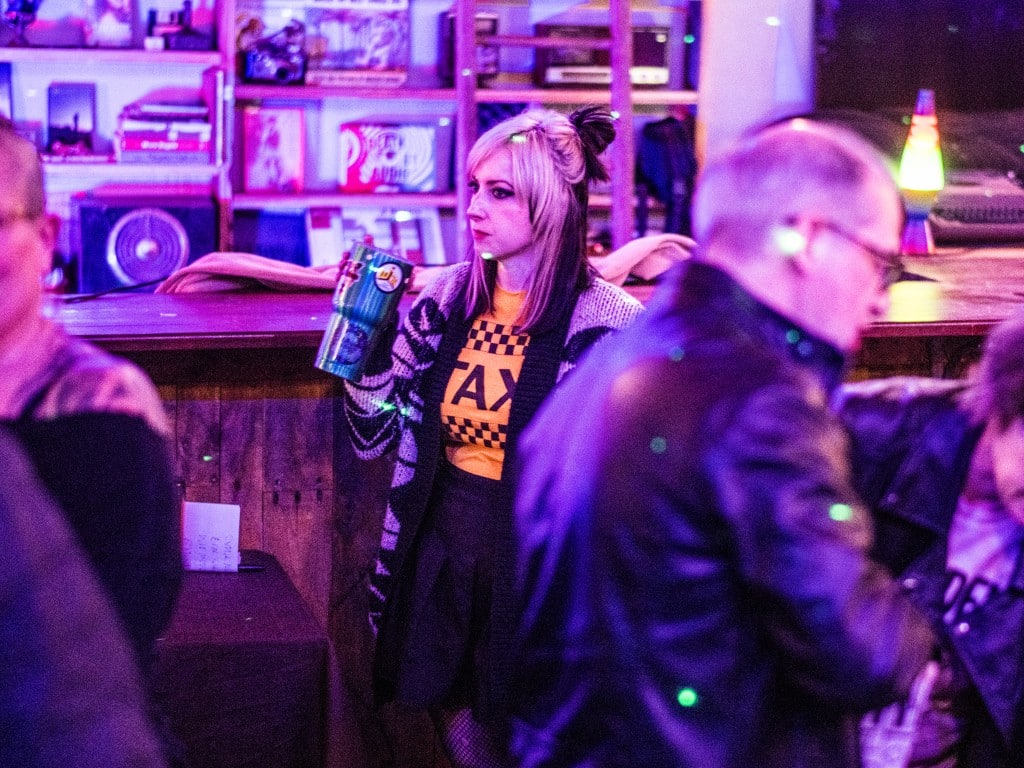
Until then, he’s hosting shows. His lowest-attended was for an audience of around ten, but most Glow Hall events bring out around 100 people.
He wants nights that are more than “just a rock show…. have it be more than you expect.”
For example, last October, he brought in KenMujo, an intense and loud guitarist from Virginia, who then added more electric guitar, sax, and four drummers pounding four full drum kits on stage.
Plus, there was a video and light show.
Plus, “there were belly dancers in the front,” Keener adds. It was “amazing.”
Shows like that “take a lot more work… I can’t do that for every show,” he says. But at least once a month or so, “I want to do a show that’s extra.”
Punk rock time
Glow Hall is all-ages, but most of the audience Saturday night was middle-aged and up.
Many of the regular Kalamazoo scenesters were there. The mood seemed to match another one of those points of inflection that we in this country seem to regularly find ourselves in. The killing of Rebecca Good by an ICE agent in Minneapolis was a topic in conversations.
“It’s punk rock time, this is what Joe Strummer (The Clash) trained us for,” Levi Strickland says, quoting Henry Rollins (Black Flag).
Strickland, who’s been in Kalamazoo bands since the ’80s, says he wanted to grow old going to shows. “I want to be 90 years old and still going to a little s#@ hole punk rock club. Because you know your town still has some soul left when there’s a s#@ hole punk rock club in your town. Because then it’s punk rock time, baby!”
Events of the day may be a little too much for punk rock to change, though.
Eric Brown, guitarist and vocalist for No Sympatico, opened their set with a “Sorry about (pause, shrug) the world,” and then rushed into their pummeling set.
He, Tommy Ufkes (drums), Jay Pemberton (bass), and Chris Frankhauser (guitar) were old enough, crusty enough, and punk enough to stick with the styles of old underground Gen-X sounds, damn whatever fashion of the later decades.
Will they dedicate a song to now-gone televangelist Pat Robertson? You know they’re going to beat that dead horse. While their “Constant Threat of Hell” raged, Meat and Steel were still hoisting and suspending.
I’ve been feeling a bit like the high school kid I was in the early ’80s, angry at all the hypocrite adults. I used to listen to raging music like this. Brown has a touch — just a touch — of Jello Biafra’s (Dead Kennedys) stage attitude, cut with a 50-something’s Midwestern attitude, as shown by No Sympatico’s ode to a hatred of mowing the yard, “Don’t Mow the Rhubarb.”
Meat and Steel put away the ropes, and Sierra Miffed closed out the show with a more-Millennial punk sound, out of the ’90s pop punk era.
Jena Tiller (vocals, guitar), Katy Knal May (drums), and Tobi Jeanne (bass) were more upbeat, less confrontational. They seem to be more about the personal than political, since Tiller dedicated two songs to those in the audience who are in therapy, and not in therapy.
Going out to a show like this feels like therapy, though. It’s sometimes enough to know people are trying to express the inexpressible. With Glow Hall, there should be more occasions for a community to hang out and emit whatever noise they need to release.
Author

Related Articles

Dimes lead to big change for underserved youth in the Battle Creek area
A Battle Creek mother and son turn bottle deposits into life-changing sports opportunities for low-income youth.

From blue light to green light: Former Kmart site set for affordable housing and childcare
Eight years after plans began, redevelopment of the former Kmart site in Battle Creek is moving forward with an 80-unit affordable and workforce housing development with an on-site childcare center, backed by tax credits, philanthropic support, and local partners.
Plunge, sweat, connect: House of Plunge brings contrast therapy to Benton Harbor
House of Plunge in Benton Harbor’s Arts District combines cold plunges, saunas, and recovery therapies as a one-stop shop for “feeling darn good.”