Green driverless vehicles to shuttle veterans at VA hospital in Battle Creek
Vehicle of the future is coming to Battle Creek's VA in the near future in the form of a self-driving shuttle.
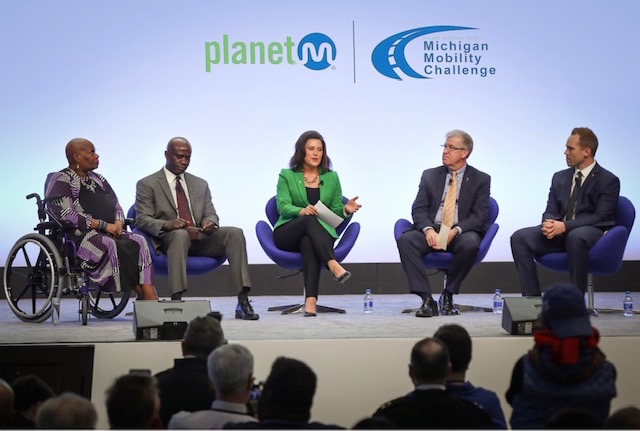
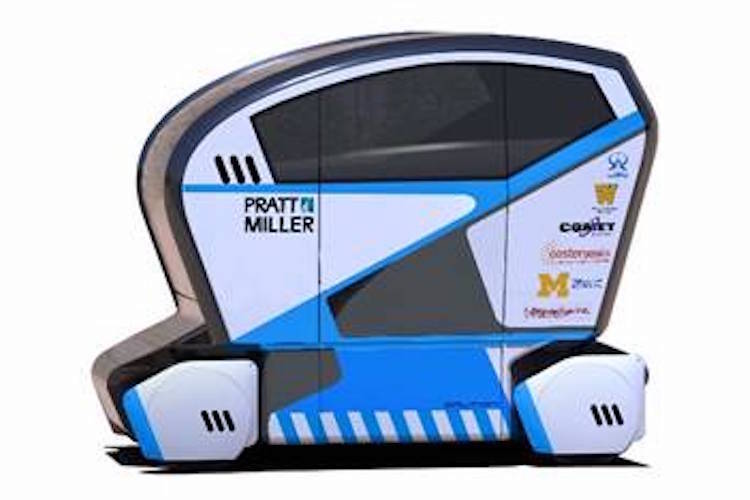
Visitors to the Battle Creek Veterans Administration Medical Center campus this fall will be able to go from one building to another in a new zero-emission accessible shuttle thanks to a $2.1 million grant announced Jan. 15 at the North American International Auto Show in Detroit. The custom-sized electric, self-driving vehicle is the future of the automotive industry, designers say.
“Technically it is called a ‘level five self-driving car,’” says Christopher Andrews, Director of Mobility and Innovation Business Development at Pratt Miller Engineering of Grand Rapids, lead of the project team that designed the new vehicle. “There are no pedals or steering wheels, but there will be a safety operator in the vehicle at all times who can take control if needed,” Andrews says.
Data show that traffic accidents can be reduced in the long run if self-driving solutions are implemented effectively, he says. Until data can prove that these solutions are safe and up to their potential, the mobility industry has agreed with local, state, and federal governments to have safety operators on board.
The vehicle coming to the VA can hold four passengers at a time, or a wheelchair rider with two other passengers. “We are working on a larger-scale vehicle, but we want to get the accessibility for the (wheelchair) riders correct before moving to the larger 12-person vehicle,” Andrews says.
The shuttle will be used for extending hours of service to veterans on the hospital campus, where there is currently a manned shuttle service that runs from 6 a.m. to 4:30 p.m. daily. The new shuttle service will address the hours after 4:30 p.m.
The pilot phase service will be offered free to riders.
The New Autonomous Mobility Vision for Michigan as it is known was one of “scores of good ideas” generated by the mobility challenge grant program, says Michigan Department of Transportation Director of Communications Jeff Cranson. It also was one of the largest projects funded in the challenge, which began with $8 million seed money.
“This innovative program is aimed at providing mobility access for all and is the result of a very effective partnership” between the Michigan Economic Development Corporation and MDOT, Cranson says.
“The vehicle system has tremendous potential,” says team member Zach Asher, assistant professor in the Mechanical and Aerospace Engineering Department of Western Michigan University.
He says that self-driving capabilities decrease the operational cost, improve safety (computers never get tired), and can even improve energy efficiency.
“The overall goal of this project is to progress self-driving technology towards commercial implementation while simultaneously engaging local Michigan companies in the latest automotive trends so that Michigan can remain the heart of the automotive industry, Asher says.
“As a researcher, I am excited about the development strategies we will cultivate and, without a doubt, this project will benefit the Western Michigan community as well the automotive industry.”
While the grants come from an MDOT budget appropriation, the success of the program largely depends on making transit agencies and vendors aware of the program, he says, so the partnership with the economic development arm was instrumental.
The Federal Transit Administration developed the Mobility On Demand Sandbox demonstration program in 2016, and Michigan was a pioneer at the state level with the Mobility Challenge.
The New Autonomous Mobility Vision for Michigan project team was made up of Pratt and Miller Engineering, Western Michigan University, the University of Michigan, Kevadiya Inc., Robotic Research, Comet Mobility, and Easterseals.
Gov. Gretchen Whitmer, in her announcement of the award, says “The Michigan Mobility Challenge can offer a blueprint for the rest of the nation on how to look to mobility technology to improve transportation options for citizens who need access to an affordable, reliable way to go to the bank, their doctor’s appointment or the grocery store.”
And Asher says, “WMU is committed to pushing the boundary of innovative and practical automotive research.”
More information about the program is available online here.
Author
Related Articles
Fewer options, fuller ERs: The behavioral health fallout of Medicaid cuts
MHA advocates for state funding that preserves behavioral health care and keeps rural hospitals open.

Kalamazoo Cookie Exchange to celebrate Women’s History Month and support Black women-owned businesses
Community members will gather March 28 at Urban Exposure Garden for the Kalamazoo Cookie Exchange, a Women’s History Month event celebrating baking, neighborhood connection and three Black women-owned local businesses.
Battle Creek turns housing into a benefit for early childhood educators
A new initiative in Battle Creek will provide rent-free housing and a pathway to homeownership for early childhood educators, aiming to boost compensation, stabilize the workforce, and address the financial challenges facing one of the lowest-paid professions.