‘Good for We’: Meknology’s Daniel Hodges has found a better way to treat wastewater
Daniel Hodges, founder of Meknology, Inc., is transforming industrial wastewater into clean water and profitable byproducts through a patented steam-based purification system, aiming to make Kalamazoo a hub for sustainable water innovation and equitable environmental progress.
Encore magazine originally published this Southwest Michigan Journalism Collaborative story here.
What if industrial wastewater could be purified and converted into profitable byproducts?
Daniel Hodges is planning to do just that in Kalamazoo.
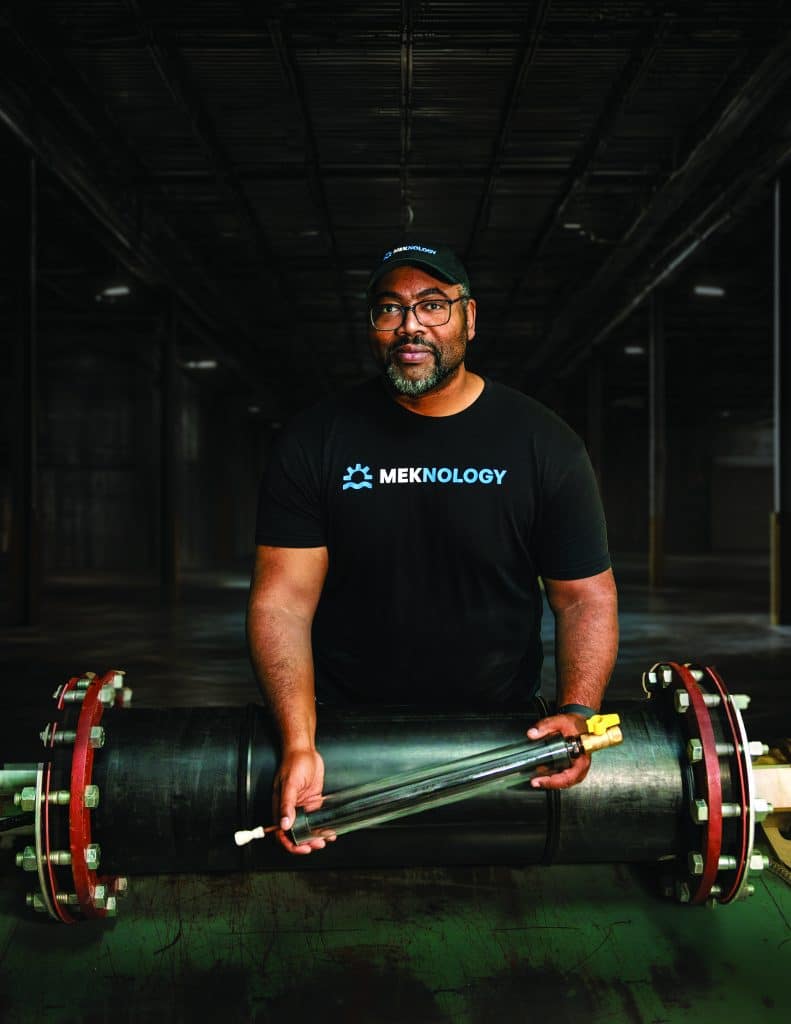
A self-described “gregarious sci-fi nerd,” Hodges is the founder and president of Meknology, Inc., a company that has developed a system that can “take wastewater and turn it into upcycled products that can be sold.”
“Our technology is unique because it cleans water by turning it into steam. We then collect the solids and partner with a third-party logistics company to sell them,” Hodges explains. For example, spent grains in brewing wastewater can be collected and sold for animal feed.
Currently, Hodges sells or leases the hardware and software of his water purification systems to brewers and distillers in Michigan. But Meknology’s system has potential to treat far more than just the wastewater from making adult beverages. The technology, which Hodges invented and patented, can be applied to any water body or water system, he says. Polluted rivers, PFAS-poisoned groundwater and lead-laden municipal drinking water are but three examples.
In fact, Hodges was inspired by that last example — specifically, the Flint water crisis — and his inherent inclination to, as he says, “create, innovate, and build things that make the world a better place.”
Hodges credits his dad with his win-win-win business mantra: “It’s got to be good for you. It’s got to be good for me. It’s got to be good for we.”
“That’s the magic formula to drive progress,” he says.
His early interests
Hodges was born in 1974 in South Haven, where his father, Booker T. Hodges, a Purple Heart veteran of the Korean Conflict, started a tailor shop and worked as a bail bondsman, and his mother, Shirley Hodges, worked various jobs, including as a bank teller. The family moved to California but returned to Michigan before Hodges’ sophomore year of high school. He graduated from Covert High School in 1992.
“Dad always had a business,” Hodges says. “I was exposed to being a businessman since Day Zero, and Mom was very big on making sure I was empathetic and that I understood how people felt and how to help people be really cared for. I like to think Dad gave me my power button and Mom gave me my volume.”
Hodges grew up admiring Thomas Jefferson’s experiments and Thomas Edison’s persistence. Hodges’ hero was “Mr. Wizard” — Donald Jeffry Herbert, the creator and host of the television series Watch Mr. Wizard (1951–1965) and Mr. Wizard’s World (1983–1989) — and his favorite toy was Dino Mech Gaiking, the giant, Transformer-type super-robot hero of the Japanese anime television and live-action film series Gaiking. “I was fascinated by Gaiking’s ability to protect people with technology,” Hodges says.
Hodges graduated from Michigan State University in 1997 with a degree in mechanical engineering. He spent the first part of his career working in product design for companies that included Ford and Whirlpool, and he went on to get a master’s degree in 2012 from Lawrence Technological University in mechatronics, robotics and automation engineering.
How Flint figured in
Hodges was working as a design engineer at BrassCraft, a plumbing products manufacturer in Novi, during the Flint water crisis. In 2014, the city of Flint had switched its water source from Lake Huron to the Flint River, and the improperly treated river water caused water distribution pipes to corrode and leach lead and other contaminants into Flint’s drinking water. After months of complaints that the water smelled and tasted bad, Flint residents were advised in October 2015 not to drink the municipal tap water, and a state of emergency was declared on Jan. 16, 2016.
Hodges saw a news article that showed a young mother in Flint bathing her child with bottled water because she couldn’t use the water from her sink. He recalls that his reaction was “How lucky I am that that’s not affecting me” but also “Is there something I could have done to have prevented that? Do I want my daughter and son to ever go through that?”
“I felt responsible. Not for the water crisis, but I felt a responsibility to use my creativity to make a change for people and the environment,” he says.
In 2019, that sentiment and the heroic altruism of childhood inspiration Gaiking compelled Hodges to enter a global competition to address water scarcity. Hodges was then working as an expert-in-residence at the Centrepolis Accelerator at Lawrence Technological University, in Southfield.
Hodges assembled a team of engineers from Lawrence Tech and asked them, “What do we, as engineers, want to do with our super powerful degrees?”
“Any one of us could have gone to the autonomous automotive industry and made self-driving cars, which is perfectly honorable and a good profession,” says Hodges. “With the call to do something to make a lasting change in the world, to make things better than they are now, I couldn’t do that. I had to do something else.”
The competition required innovators to create devices that could be commercialized. Hodges and his team focused on desalinating seawater using wind and solar power, and the resulting invention, he says, “desalinated 10 liters of water at a time, could be deployed quickly in a distressed coastal community, and cost about 60 bucks to make.”
The competition rules stated that teams would score extra points by testing their inventions within their target market. Because the Covid-19 pandemic limited where Hodges’ Michigan-based team could test its invention, the team didn’t win the competition. “We were quarantined outside our target market,” Hodges says.
However, this situation motivated Hodges to expand the idea to a broader audience. He turned his attention back to Flint and to scaling up the team’s unit to remove unhealthy particulates from municipal water systems. But in attempting to prove the concept, he hit another obstacle: “Municipalities don’t want to trust start-up companies with their city’s water supply,” he says.
“After much customer discovery research, we pivoted to wastewater and birthed Meknology in 2020.”
A better way to treat wastewater
The name Meknology is a hybrid. Mek means “to make” and comes from Gullah, the language and culture of enslaved Africans in the coastal regions of South Carolina and Georgia, which “happens to be a part of my ancestry,” Hodges says.
“Meknology,” he says, means “make technology,” which he says he does “in the spirit of empowerment.”
Meknology turned its focus to treating wastewater created by the adult beverage industry because Hodges saw potential there that went beyond purifying water. Water is the key ingredient in brewing and distilling, and disposal of the wastewater created by those processes is a major environmental hurdle for brewers and distillers and an expensive one, according to the Brewers Association. This wastewater contains a variety of organic compounds, including spent grains and stillage, chemicals, minerals, vitamins and other particulates, and current methods of disposing of this wastewater or treating it require extra labor.
Where others saw obstacles, Hodges saw opportunity: Waste could be turned “into valuable, marketable resources that save money and create new income streams” for the brewer, he says. Through the Meknology system, particulates are extracted and can be sold as a soil booster for agricultural operations, as fuel for the biodiesel industry, or as food for cattle, hogs and chickens.
“This secondary source of revenue enables brewers and distillers to convert waste into wealth. It creates a unique business model that directly impacts their bottom line by creating a new top line,” says Hodges.
In addition, when the steam generated by the system is recondensed to liquid, it is as pure distilled water that can be used to rinse tanks and vats. The water can be repurified through the Meknology system, stored and used as rinsewater multiple times, saving both water and money.
Meknology’s purification devices come in several sizes, depending on the volume of wastewater to be treated. Its largest is a 10-foot cube that processes tons of material. Smaller units are the size of a household clothes dryer. Meknology even offers a product line of satellite units that can be shared by multiple low-volume microbreweries.
With a $50,000 grant from Michigan’s Department of Environment, Great Lakes and Energy (EGLE), Meknology built its first water distillation unit, which was to be deployed earlier this year at Mammoth Distilling in the village of Central Lake (between Traverse City and Petoskey). Unfortunately, the unit was damaged in transit, but that setback created an opportunity for Hodges to develop a redesigned model that will be installed at Mammoth by year’s end. He is also preparing smaller units for Roar Brewing Co. in Detroit and HOMES Brewpub in Ann Arbor.
Landing in Kalamazoo
In July, Hodges began searching for a new headquarters and manufacturing facility for Meknology and landed on Kalamazoo because of its proximity to a host of breweries and distilleries, the interstate highway system to Michigan’s agricultural areas, and potential customers in Detroit and Chicago. The company, which has been searching for the right property to lease in Kalamazoo since the summer, is still narrowing down options, according to Hodges.
Moving Meknology to Kalamazoo will also benefit Hodges’ family, including his wife, Tiffany, a licensed professional counselor who has returned to the city of her birth. It brings them closer to their daughter, Chanteal, who moved to Kalamazoo in 2016, their 3-year-old granddaughter, Ivory, and their son, Jacob, who is studying musical theater and psychology at Northwestern University in Evanston, Illinois.
The move will also allow Mekonology to develop a valuable partnership with Western Michigan University, says Hodges.
“Our water purification technology isn’t mature yet,” Hodges explains. “We have prototypes, but we need to figure out how to reduce power requirements and then apply the technology on a massive scale. The university is key to obtaining researchers, intellectual horsepower, and — cross our fingers — maybe a grant from the National Science Foundation.
“By partnering with WMU, we hope to disruptively change the way wastewater is treated globally, and we want Kalamazoo to be the center of that disruption.”
‘A better future for everybody’
Hodges’ dreams for the future are expansive — even larger than Gaiking’s superhuman powers — and his determination is honed and focused. “I can be pretty stubborn when it comes to making things work,” he says.
There are about 12,000 brewers and distillers in the United States, he says, and “if we could take Meknology to 4,000 of them, we would be very mighty.”
He plans to hire five new employees within the company’s first year in Kalamazoo, employ 20 by the second year, and jump to 60 employees by the third year. His business plan calls for an initial public offering in 2030, when, Hodges says, “we want to be big enough to have truly impacted the world.”
Farther down the road, he sees Meknology branching out into other avenues of water treatment: Kalamazoo River Superfund sites, PFAS-laden groundwater, nuclear wastewater, lithium extraction from seawater, and, yes, purification of municipal drinking water. “It’s not just natural; it’s an eventuality,” he says.
Recalling Flint again, Hodges notes that “people have stepped in to provide bottled water for citizens, and industry has stepped in to fix the infrastructure, but a lot of that has not been equally distributed. My dream is to create a solution that helps everyone there. I want to create water-purification pods that help neighborhoods get their clean water directly on site, like a community well, which makes more sense than having only a full municipal infrastructure.”
Cutbacks in federal grant money for innovation “have already affected us adversely,” Hodges says, so he is working with investors who share his intention to “build wealth where it doesn’t exist.”
Those investors include Kalamazoo Forward Ventures and Techstars, a global start-up accelerator and venture capital firm headquartered in New York City.
“If we are brave, we can see a better future for everybody,” Hodges says. “If I can do that, then I will measure my life as successful.”
“That’s the magic formula to drive progress,” he says.
Learn more about Meknology Inc. at Meknology.com.
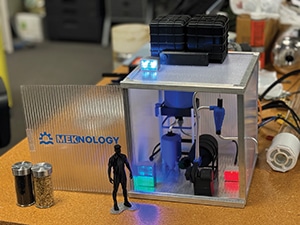
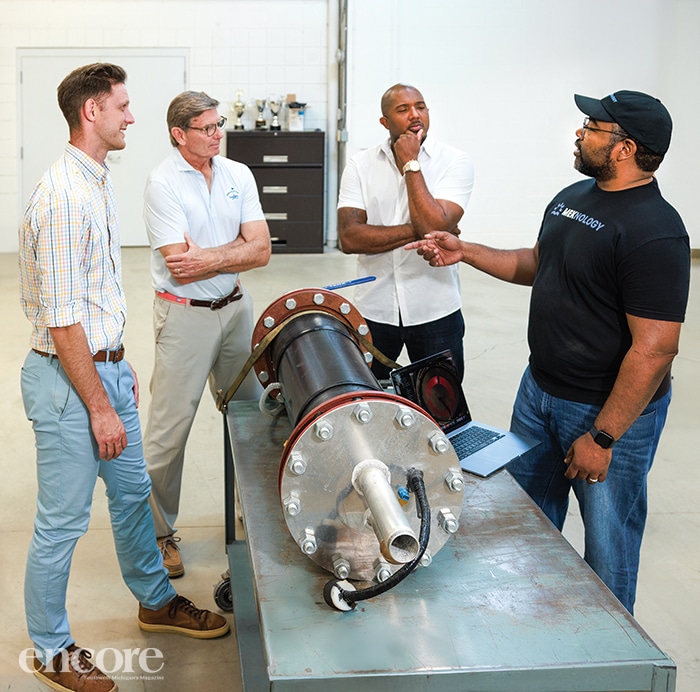
How The Meknology System Works
In the scale model shown here of Meknology’s largest water purification system, wastewater enters through the black cubes on top, and the purifying process happens within the components inside the glass container.
Distilled water comes out of the silver pipe on the right side, from which it can be pumped to holding tanks. Hodges says that many breweries and distilleries have their own water towers that can serve as holding tanks.
The two barrels on the left contain ingredients extracted from the wastewater: dried distiller’s grains and biochar, a concentrated fertilizer that releases slowly and thus reduces pollution from water runoff.
The purified distilled water can be used to clean mixing tanks and vats, then repurified and stored to clean those tanks and vats repeatedly. The dried distiller’s grains can be sold to farmers to feed cattle, hogs and chickens, while the phosphorous-enhanced biochar can be sold as a concentrated fertilizer.
Hodges says that brewers and distillers who use Meknology containers can realize a return on investment within 12 to 24 months.
The technology can also be adapted to purify water from other environmental, municipal and industrial sources.This story is part of the Southwest Michigan Journalism Collaborative’s coverage of equitable community development. SWMJC is a group of 12 regional organizations dedicated to strengthening local journalism. To learn more, visit swmichjournalism.com.
Related Articles

“I sing because I feel free”: Las Cafeteras led Kalamazoo on a musical journey of solidarity and joy
Las Cafeteras transformed a Sunday afternoon into a high-energy celebration, blending centuries of musical tradition with a joyful call for unity and shared humanity.

Readers and bakers eat their words at Kalamazoo’s 19th Annual Edible Book Festival
See who took the cake at this year’s Kalamazoo Book Arts’ Edible Book Festival.

Western Michigan University students say they have outgrown April Fools’ Day. Really.
Western Michigan University students rally to make April Fools’ Day a mandatory campus-wide celebration, arguing that required pranks could boost morale and connection. No joke?