From blue light to green light: Former Kmart site set for affordable housing and childcare
Eight years after plans began, redevelopment of the former Kmart site in Battle Creek is moving forward with an 80-unit affordable and workforce housing development with an on-site childcare center, backed by tax credits, philanthropic support, and local partners.
Editor’s note: This story is part of Southwest Michigan Second Wave’s On the Ground Battle Creek series.
BATTLE CREEK, MI — The blue light is turning green for a project that began in 2018 to redevelop the site of a former Kmart store at 200 Capital Avenue in Battle Creek.
While eight years may seem like a long time, in the development world it’s not, says Jason Muniz, Senior Developer/Partner with Edison Community Partners (ECP) and Vice President of Hollander Development, both headquartered in Kalamazoo. They are separate entities with a shared focus on affordable housing and green development.
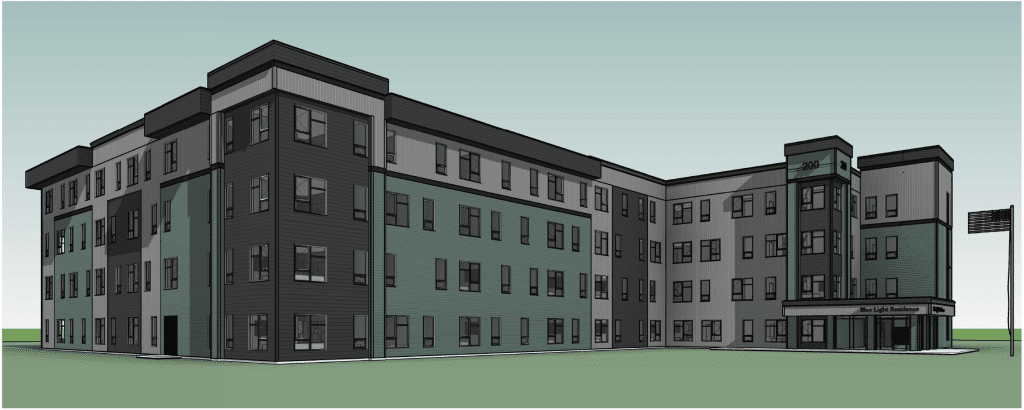
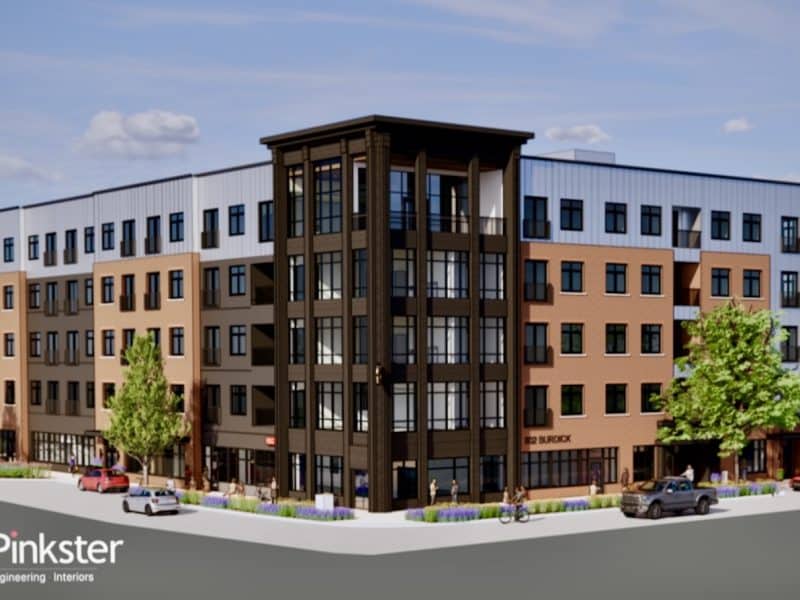
Informally, what ECP is developing in Battle Creek is being called the Blue Light project, a nod to Kmart, the former occupant. When the four-story, 80-unit affordable housing development that includes an on-site childcare center is completed in late 2027, it will be called Riverbend at Capital because of its proximity to the Kalamazoo River, which runs through the city’s downtown.
“The average development project is five years. Our longest took 11 years, and the Creamery Project in Kalamazoo took nine years. We came in two years into it,” says Muniz.
Similar to Riverbend at Capital, the Creamery offers affordable housing units, 48 in all, and has an on-site childcare facility operated by the YWCA of Kalamazoo. But state tax credits necessary to get the dirt turning in Kalamazoo weren’t as much of a challenge to secure compared to what ECP faced in Battle Creek.
The iconic Blue Light Special did not extend to Low Income Housing Tax Credits (LIHTC), crucial to the $30.2 million Riverbend project, which will occupy about half of the 10-acre parcel owned by Battle Creek Unlimited (BCU).
Through a $1.6 million grant from the W.K. Kellogg Foundation (WKKF), BCU was able to purchase the building that formerly housed Kmart in 2020 and have it demolished in 2021. WKKF also made a $3 million grant to the project earmarked for additional resources, says Jamie Schriner, WKKF Program Officer.
BCU had always targeted the site for housing, says Joe Sobieralski, President and CEO of BCU.

“I would say before we acquired the site, there was outside interest in putting storage units on it,” he says.
At the time that WKKF made its grant to BCU, “the property had been a blight on the community, and we saw this as an opportunity to take that property and reserve it for good, positive development,” Schriner says. “The property had to have a future charitable use, and affordable housing was that use.”
Sobieralski says ECP came to the table on day one.
“When we started to make a push for housing, ECP was one of the first to come to the table with regards to a LIHTC deal in Battle Creek,” he says. “That was probably seven to eight years ago. They stuck with it, even with all of the hurdles faced along the way. They were intentional with community outreach and feedback. That signaled they were the right fit.”
LIHTC spells success for affordable housing
In her previous economic development roles, including serving as Executive Director of the Community Economic Development Association of Michigan, Schriner became well-versed in the intricacies and importance of LIHTC in development projects like Riverbend.
The LIHTC Program is an investment vehicle created by the federal Tax Reform Act of 1986, which is intended to increase and preserve affordable rental housing by replacing earlier tax incentives with a credit directly applicable against taxable income. The program, administered in Michigan by the Michigan State Housing Development Authority (MSHDA), permits investors in affordable rental housing who are awarded the credit- corporations, banking institutions, and individuals — to claim a credit against their tax liability annually for a period of 10 years.
Depending on the size of the development, these tax credits are set at 4 % or 9 %. Riverbed qualified for the latter percentage and was denied several times during the process, Muniz says.

Photo: Courtesy
“It’s extremely difficult to make it work,” he says. “Historically, the 9 % low-income tax credit was enough to get a project done, but now you still need additional contributions from philanthropic sources to make it work. It’s extremely complex and high-risk when you work on a project for eight years if it doesn’t go through.”
Sobieralski says it’s not difficult to find developers willing to work on affordable housing projects.
“There are many, but I would say many don’t have the appetite to wait eight years. They’ll move on to other markets. Time is money,” he says.
In 2024, persistence paid off when MSHDA approved the LIHTC for Riverbend. These were the first LIHTC funds Battle Creek has received in “several decades,” Schriner says.
With a land mass of 44 square miles, Battle Creek is the third-largest city area-wise in Michigan. While this may seem like an advantage, it’s not. MSHDA, which considers the proximity of services to residents when making funding decisions. LIHTC applicants provide this information in a QAP (Qualified Allocation Plan).
In cities with smaller land masses, services are closer together. For example, a church might be located near a grocery store, a bank, a library, and a coffee shop. Cities are scored by MSHDA on a points basis.
“MSHDA looks for walkability and easy access to public transportation and access to resources that are within walking distance, no one mile of where residents are,” she says. “Developers are scrambling for every point they can get with QAP. It is a battle to get these points, and unfortunately, Battle Creek doesn’t score high because we have a large land mass.”
Building on collaboration
Recognizing Riverbend’s importance and the significant time already invested in bringing the project to fruition, the partners came together to make a strong case for funding to MSHDA.
“MSHDA actually has resources set aside, and they can say that while a project may not qualify under the points system, they recognize the importance and award the tax credits anyway,” Schriner says.
In addition to the LIHTC funds, the Michigan Economic Development Corp. (MEDC) announced in mid-February that it will be giving $5 million through its Revitalization and Placemaking (RAP) to Riverbend. The funds will support the cost of construction and redevelopment.
The City of Battle Creek has also committed to a PILOT (Payment In Lieu Of Taxes), which will defer taxes on the Riverbend development for 50 years, saving about $4 million, says Darcy Schmitt, Planning Supervisor with the city’s Planning Department.
“It means that the property will be exempt from taxes for 50 years but will pay an annual fee for city services based on a percentage of income generated from rent,” she says.
Muniz says the PILOT is contingent upon preservation of the affordability of the units.
The City has several other large projects that are also using the PILOT, an important tool for attracting industry.
“My understanding is that one of the first questions companies looking to locate here ask is ‘What is the housing situation in Battle Creek?’ I would say it’s not good right now. We have a deficit of housing for people who already live here, but also for potential employers,” Schmitt says.
Sobieralski agrees with Schmitt’s assessment of the city’s urgent housing situation. He says the BlueOval battery plant in Marshall and the estimated 1,700 jobs it will create add to an existing problem.
“I think the urgency was there before BlueOval, at least from BCU’s perspective,” he says. “BlueOval just magnified it. We’ve lacked housing for years.”
Ensuring that there is housing for people at various wage-earning levels is important for the city’s economy, Schmitt says.
“Battle Creek is in a unique position with very high-end incomes, very low-end incomes and very little in between,” she says.
Of the 80 one and two-bedroom apartments at Riverbend, 48 will be restricted for affordable housing units, and 32 will be workforce units for individuals earning up to 120 percent of the AMI (Average Median Income), Muniz says.
Between 2020 and 2024, the median household income in Battle Creek was $55,693, according to the U.S. Census Bureau QuickFacts.
Muniz says that affordable housing is considered to be available to individuals earning 60 percent of the AMI with total living expenses not exceeding 30 percent of the AMI.
“We focus on low-income tax credit development,” he says.
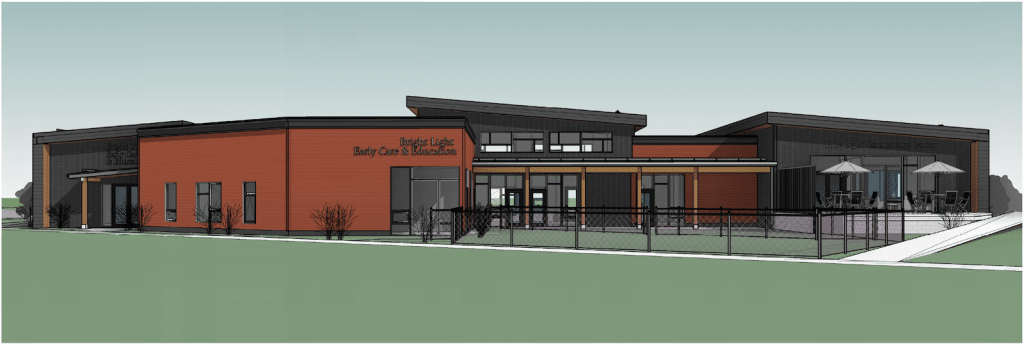
The building housing these future tenants will be 69,000 square feet. An adjacent 10,000 square foot building will house the 8,000 square foot childcare center and an amenity space for Riverbend tenants that will occupy 2,000 square feet.
Sobieralski says the addition of the childcare center was based on community need and the feedback ECP received when soliciting feedback from surrounding neighborhoods/community members.
Pairing affordable housing with affordable childcare is a challenge. Muniz says when it’s being built as new construction, it’s “extremely rare.
ECP approached WKKF about the addition of a childcare center into the development.
“This is something the community absolutely needs to make sure children are in a safe and beneficial place while their parents are at work,” Schriner says.
Bright Light Early Care and Education will operate at the Riverbend Development, says Lindsey Potter, Owner/Director of Bright Light, adding that details are a work in progress.
Getting out of their own way
Muniz says he’s being genuine when talking about the ease of working with staff at the City of Battle Creek.
“They’ve been extremely easy to work with relative to other municipalities across the state. They understand the process and how to streamline it. A lot of communities tend to get in their own way.”
During the last few years, the City has been making changes to its zoning codes, making it easier to build housing. They have also been relaxing the Special Use Permits required for in-home or center-based childcare. Schmitt says her department is also working with the community to gauge their comfort with more flexible single-family neighborhoods.
She calls these “no-brainer changes.”
When asked what could be done to shorten the timeframe on projects like Riverbend, Sobieralski says, “We have adequate local tools and resources to get projects over the hump. It’s Battle Creek’s reality — it’s pure economics, and there’s no way around it.”
BCU will own 5 % of the project, with 95 % owned by an entity controlled by ECP. Muniz says there is potential for development of the remaining five acres of the 10-acre parcel.
The removal of structures formerly used for industrial manufacturing near the site, revitalization efforts in the downtown corridor, and naturalization work on portions of the Kalamazoo River are reasons for optimism about the future of Riverbend, Muniz says.
“It’s going to add 80 new families, instantly taking a vacant piece of property and putting it back into productive use,” Schriner says. It’s going to put more children in our school system and give families a beautiful and safe place to live in Battle Creek. These families will be there to support businesses downtown, which they can walk to. They’ll have many opportunities to be engaged with the community in different ways.”
Author

Related Articles

Readers and bakers eat their words at Kalamazoo’s 19th Annual Edible Book Festival
See who took the cake at this year’s Kalamazoo Book Arts’ Edible Book Festival.

Leveling the baseball field for underserved youth in Battle Creek
Evan Gray founded Gray’s on Deck to give underserved Battle Creek youth access to baseball and life lessons through affordable, community-supported programs.
Housing pros answer the question: Are these places really affordable?
How do you define “affordable housing”? It turns out there is a precise definition.