Edison residents take opportunity to Imagine Kalamazoo 2035
Edison residents kicked off Imagine Kalamazoo 2035 by turning potholes, sidewalks, and other everyday neighborhood concerns into hands-on input about the city’s long-term future.
Editor’s Note: All photos were taken by Mark Wedel.
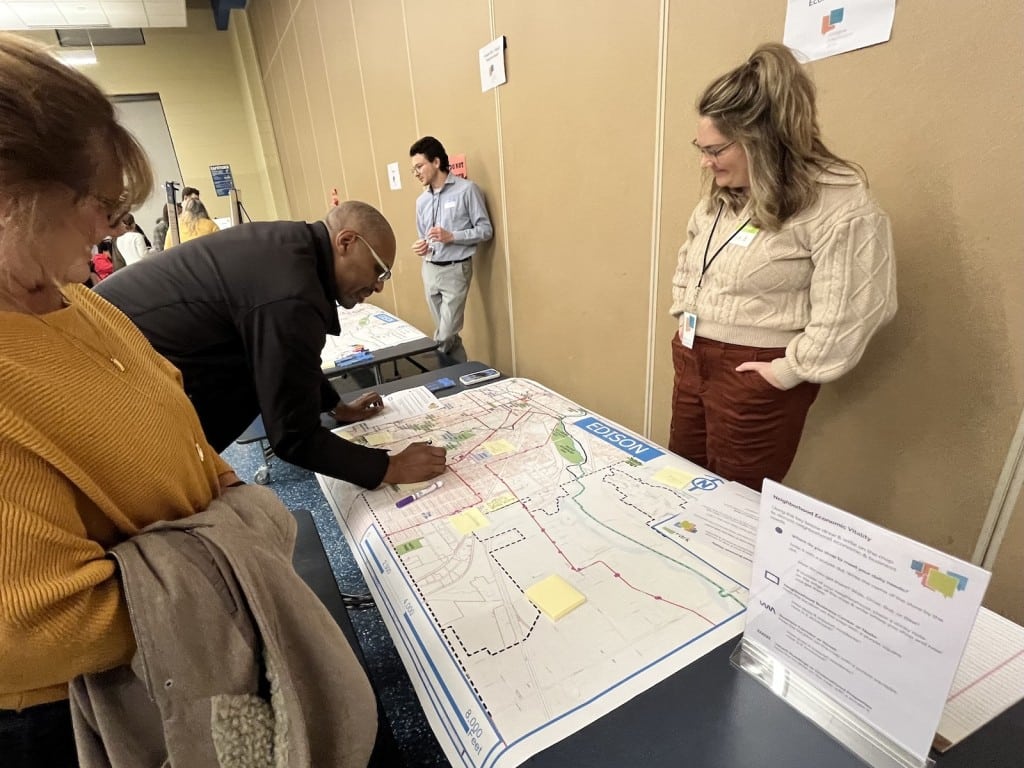
KALAMAZOO, MI — “‘Street routes needing repair,'” an Edison resident reads from the display at a table during the first Design It! meeting of Imagine Kalamazoo 2035.
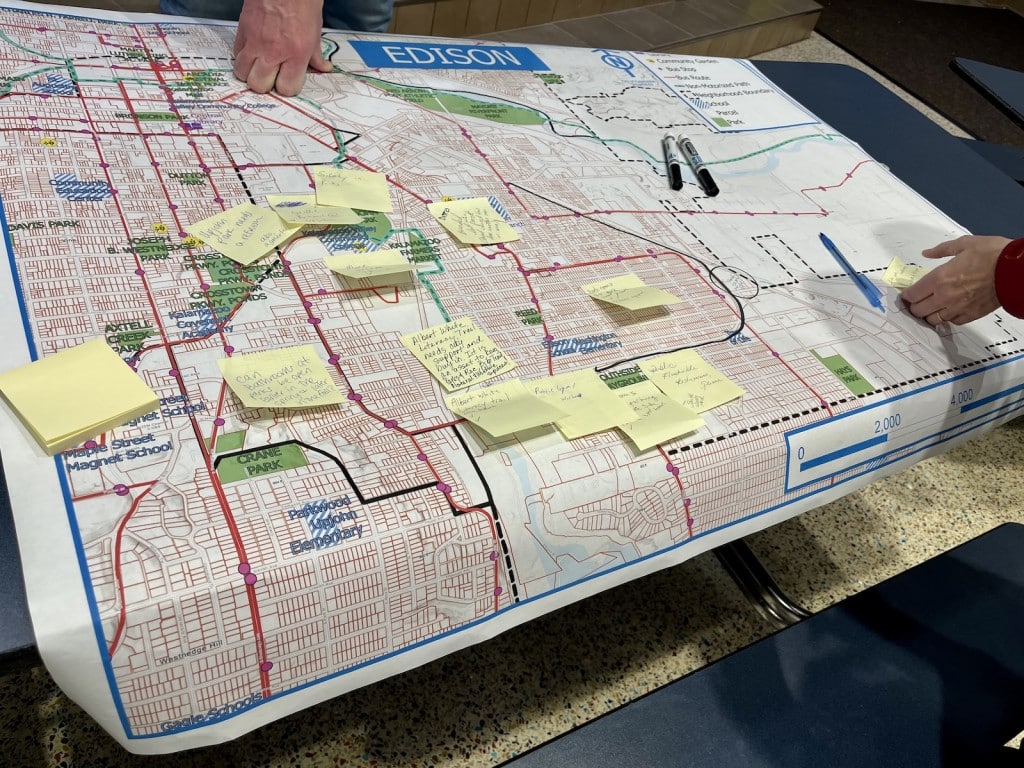
There’s a map on the table. “Can I cover this whole area here?” she asks, and then takes a marker to many of the residential streets bordered by Portage Street, Washington Avenue, and Fulford Street. She has to take alternate routes, she says, because some of the streets are “like a moonscape!”
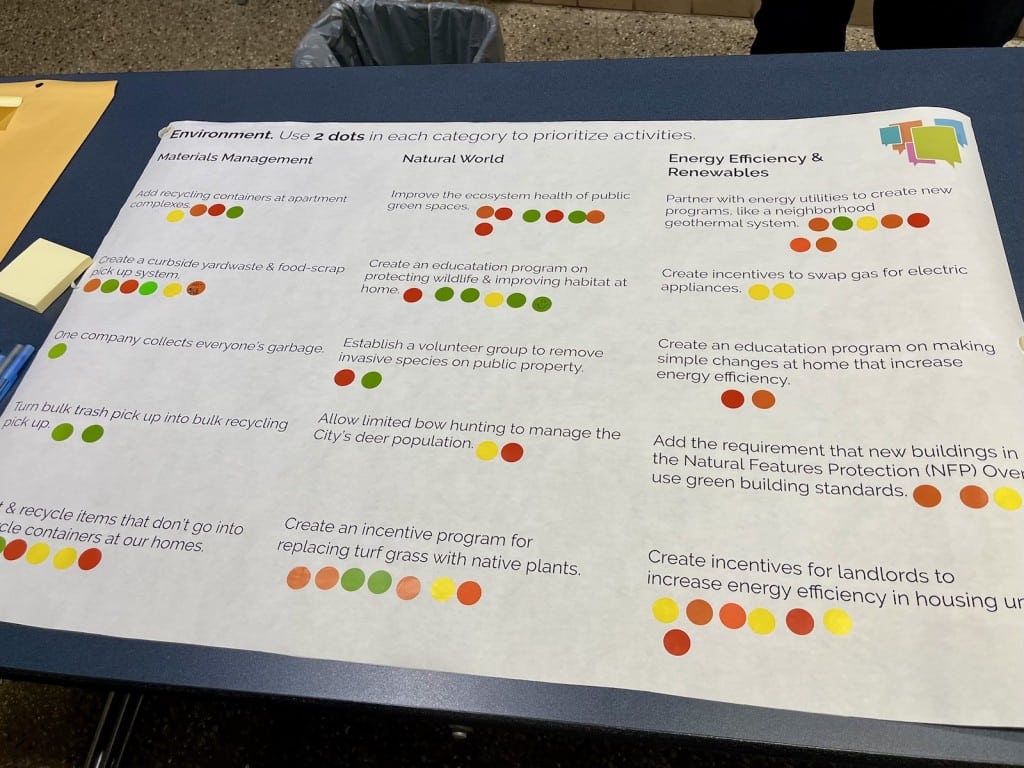
Residents were marking up maps, writing on whiteboards, and sticking sticky notes to everything, letting the City of Kalamazoo know where the problems are, at Washington Writers Academy, Jan. 16.
Edison had the first Design It. More neighborhoods will get their chances now through March.
If one doesn’t have a chance at this go-round, you’ll be able to participate online or attend many pop-up events in the coming year.
Like IK2025, IK2035 looks to get resident input in planning what the streets, green space, housing, business environment, etc., of the City of Kalamazoo should be like in the future.
What will happen in the next ten years? What crisis, what change, will the city face? Will we be able to evolve with a changing world?
Yeah, important questions, but what about those potholes in our neighborhood? Residents tend to have concerns about the problems right in front of our eyes, now. (Full disclosure: The writer lives in Edison with the woman complaining about moonscape roads above.)
Residents have opinions, demands, ideas. For example: This snowy winter has shown that our sidewalks never seem to be clear. What if the city could have a crew to plow sidewalks?
Christina Anderson, Kalamazoo City Planner and Deputy Director of Community Planning and Economic Development, sincerely says that it’s a “lovely idea,” and then explains in detail the considerations that would need to be made about increasing staff, equipment, etc.
But, she points out, we’re now in year two of a pilot program to clear 14 miles of sidewalks in high-pedestrian areas. The city hopes to expand it, after studies show how it went, she says.
Anderson often hears the ideas, complaints, and all the running commentary on the city from residents.
“I appreciate that folks care enough to come up with ideas that they think would work and that they want to share them,” Anderson says. “It shows that the community is interested and involved, and ultimately that we’re all on the same page, which is that we just want a community that best serves those that live or work here or visit.”
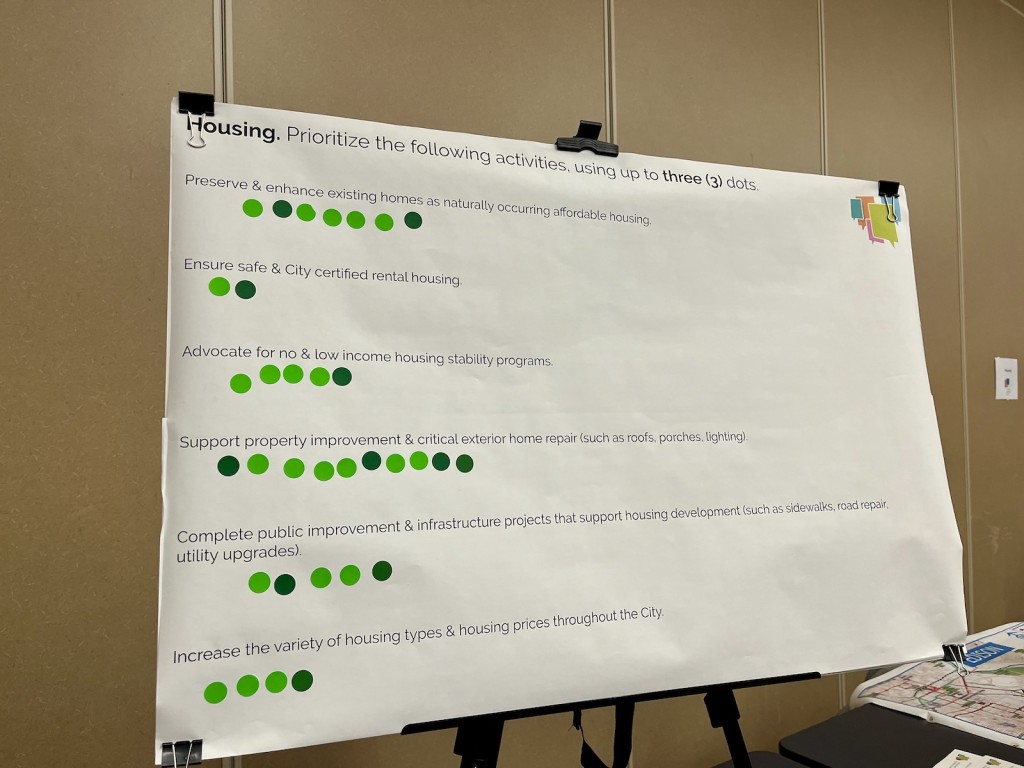
The Edison event was like a who’s who of Kalamazoo City government. Sharilyn Parsons, Manager of Community Development, was studying the housing table. Its whiteboard with green stickers — a means for participants to highlight what they feel is more important – showed that property improvement, repair, and preservation of existing homes were high priorities for residents.
We spoke with Cee Maul, the new Neighborhood Activator for the City. They say they’ve been hearing a lot at the meeting about needing more green space in Edison.
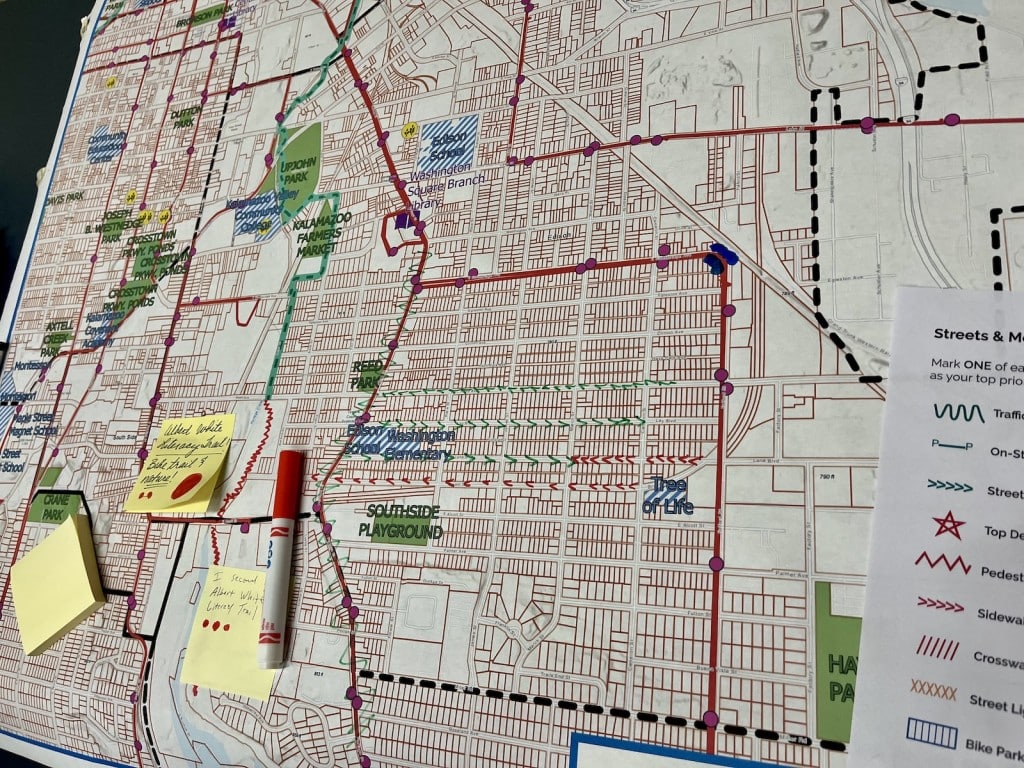
Residents have also been pointing out neighborhood trouble spots. “One of the good things about these meetings is the maps,” Maul says. “People can mark on there certain areas that might be blind spots for the City.”
Spots in Edison have seen illegal dumping and people doing burnouts on the streets, such as on the mural on the play street cul-de-sac at Bryant, Maul says. “The way to mitigate that or take care of that is to shine lights on those dark spots. The way that we do that is through resident engagement.”
City Commissioner Jae Slaby and Vice Mayor Drew Duncan were on hand.
Slayby says, “What I would like to see is metrics, measurable outcomes. Because I think we owe it to the residents who spend all their time in these meetings telling us what they want to see.”
The city needs to “be able to say, hey, we did get this done with some tangible deliverables, right? And I think that that’s important to hold us accountable, instead of just open-ended vision statements.”
Duncan says he agrees with Slaby, “but I would like to see exactly what we’re doing (at Design It), get more community input. As I ran for office, it was overwhelmingly clear that the community felt that they did not have enough conversation around something that would be what would become the city’s decade-long master plan, right?”
Community cohesiveness
Anderson points out that the City has made an effort to get residents out to these events.
In 2017, for IK2025, their Edison meeting was held in the small conference room at the Edison Neighborhood Association building.
This time, they had a larger space, more parking, kids’ activities, plus a taco bar for the dinner-time event. Upcoming Design It!s will be at KPS facilities, churches, and neighborhood association buildings.
Anderson says they make sure to encourage City staff and officials to attend. “We want staff to hear the comments directly.”
They’re about planning for the future, but also the meetings are a way of increasing community cohesiveness.
Neighborhood Activator Maul, Anderson says, is working on “how do we make sure that we have an active point of contact in every neighborhood? How do we start to think about a network of communication?
“These things are important not only in good times where we’re trying to spread the word about an opportunity or maybe a traffic detour that’s going to happen,” Anderson says, “but also if there’s ever a time of crisis or a need to share emergency information, having that deep network is really helpful.”
IK2030 is not about “predicting the future, right? It’s about setting priorities. If we had full control, where would we go? What does it look like? What is our vision? What are our needs? Are those needs being met now?”
Visions sometimes run into things like global pandemics, she points out. The past ten years show that anything could happen.
“There’s a level of resiliency that exists when residents come together to discuss topics, when there’s communication, when there’s trust between neighbors, between neighborhoods in the city, that all make us more resilient when there is a crisis,” Anderson says.
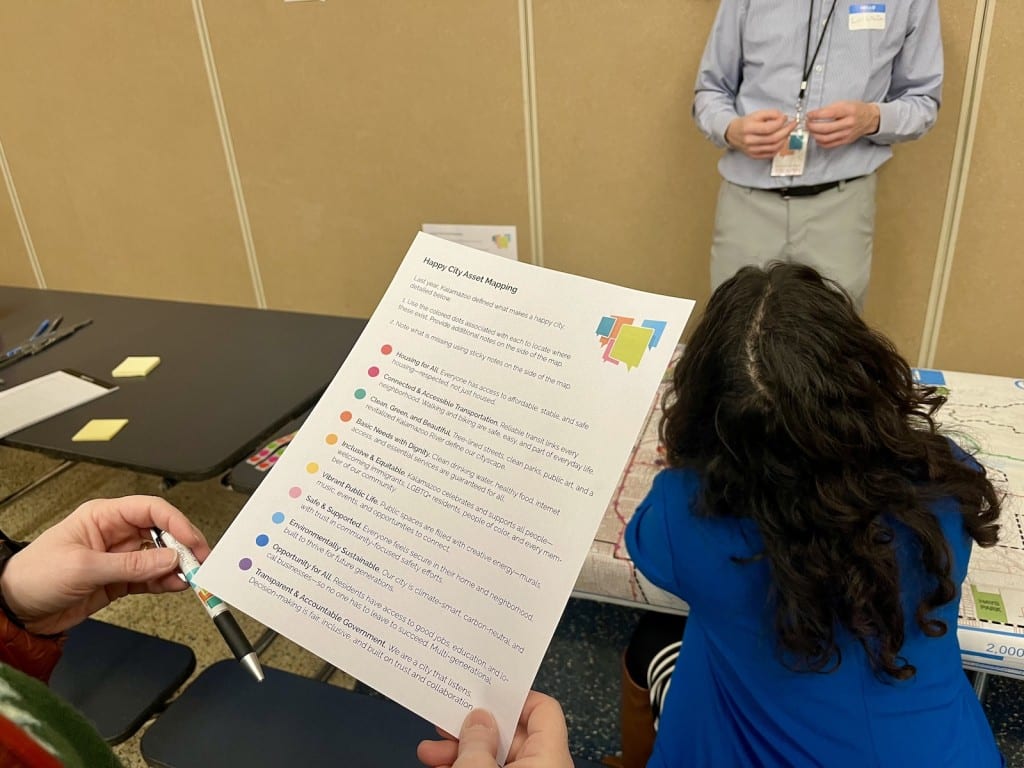
She brings up Imagine Kalamazoo’s 2025 community read, “Happy Cities.“
One area the book examined was the importance of building basic trust and communication between neighbors. “That level of trust that you have with those that live on your block, you and your neighborhood association, your neighborhood with the city…. Those types of interactions support a community that’s more resilient in good times and in rough times,” Anderson says.
“Just bringing people into the room is the most important piece of this,” she says. “Because once everybody’s in the room, then they can have conversations with their neighbors.”
Anderson says that the meetings with residents in 2017 went into the changes we’ve seen, and are seeing, now in the City, “the things we heard that showed up in the strategic vision that showed up in the master plan, that showed up in neighborhood plans that resulted in action…. Different types of projects, policy changes, street changes, addition of sidewalks, business support came from those meetings.”
There’s no illusion that everyone agrees with all of IK2025 or will agree with what comes from IK2035.
“We will not necessarily agree on everything we discuss, but at least we know that we’re there, right?” Anderson says.
“Our goal is to give anyone who wants to the opportunity to engage with us. We can’t make anybody, but we want to make sure that one has an opportunity that feels safe, that is easy, in order to come to the table with us,” she says.
The second Design It! meeting was to be at Burke Acres, but had to be rescheduled due to the weather.
The next is for Westnedge Hill/South Westnedge/Southside at Girl Scouts Heart of Michigan, 601 W. Maple St., Jan. 28.
For the full list and updates, visit the Imagine Kalamazoo page.
Author

Related Articles
Kalamazoo’s Holiday Lights Ride blends seasonal joy with winter street challenges
The Holiday Lights Ride brought bikes, music, and seasonal joy to downtown Kalamazoo, even as icy streets underscored the challenges of winter riding.
Remembering the Block: How Black history and culture inform Kalamazoo’s present
As downtown Kalamazoo transforms, residents are turning to the deep history of Black art, culture, and community on North Burdick Street to ground the present by understanding and respecting the city’s roots.
Know Your Rights: Protesting without fear of retribution in Battle Creek
A recent “Know Your Rights” panel in Battle Creek brought together community leaders, legal experts, and organizers to educate residents on how to protest safely and effectively — emphasizing nonviolence and the power of collective civic action.