A Way Home — Housing Solutions: This story is part of Southwest Michigan Second Wave’s series on solutions to homelessness and ways to increase affordable housing. It is made possible by a coalition of funders, including the City of Kalamazoo, Kalamazoo County, the ENNA Foundation, and Kalamazoo County Land Bank.
KALAMAZOO, MI — The first part of a 70-unit, state-of-the-art apartment complex for senior citizens should be ready for occupancy in Kalamazoo’s Northside Neighborhood by fall of next year.
The opening of The Legacy Senior Living project will be the culmination of months of planning by building partners Mt. Zion Baptist Church and Edison Community Partners LLC.
Applications for prospective tenants will not be accepted until early 2026.
“The North Building should be ready,” says Cathy Worthams, operations director for Mt. Zion. “We should be able to start moving people in, they’re saying, no later than October. So they’re looking at that third quarter, going into the fourth quarter of 2026.”
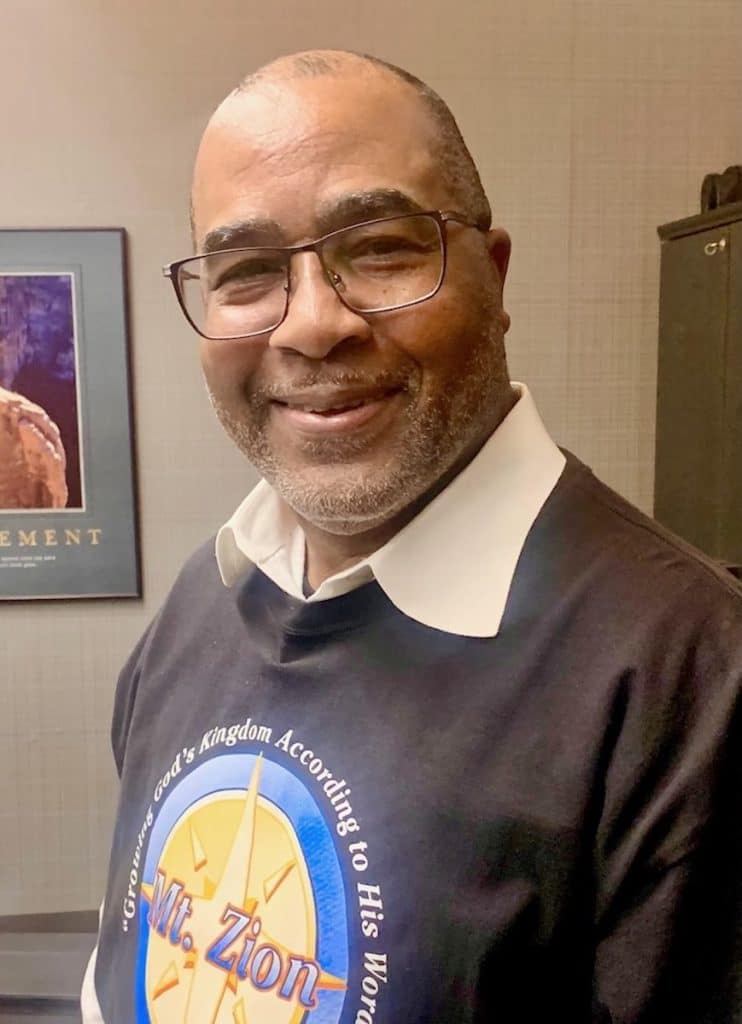
Rev. Addis Moore, pastor of Mt. Zion Baptist Church, expects the Legacy Senior Living project to provide a modern, safe, and community-supported environment for people age 55 and older.
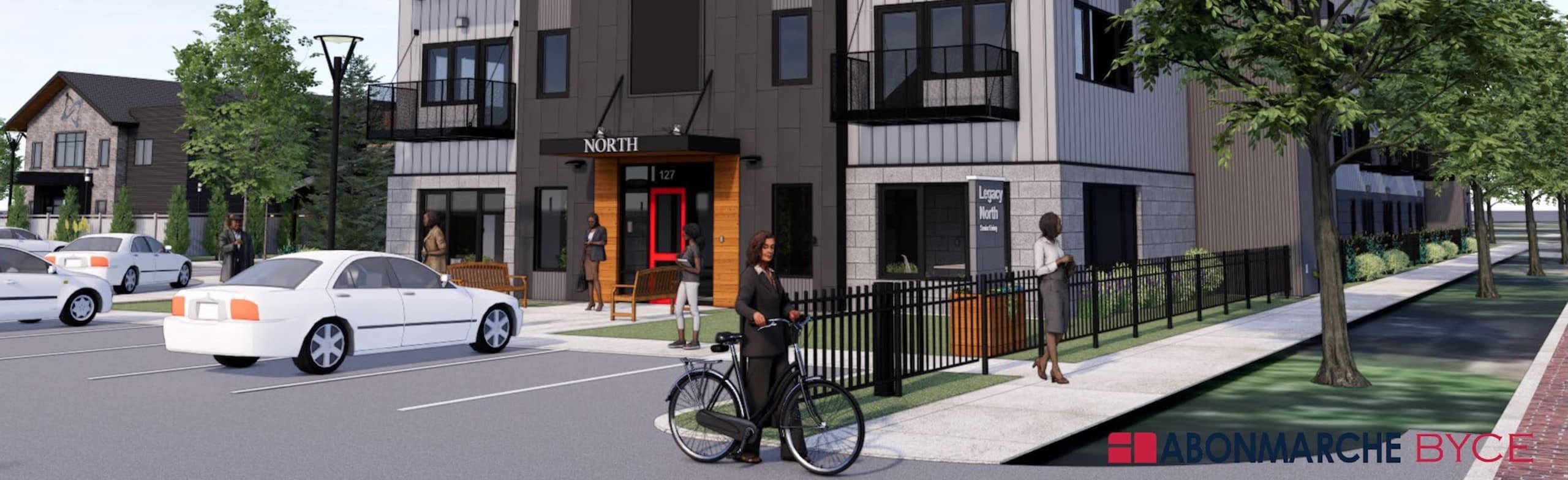
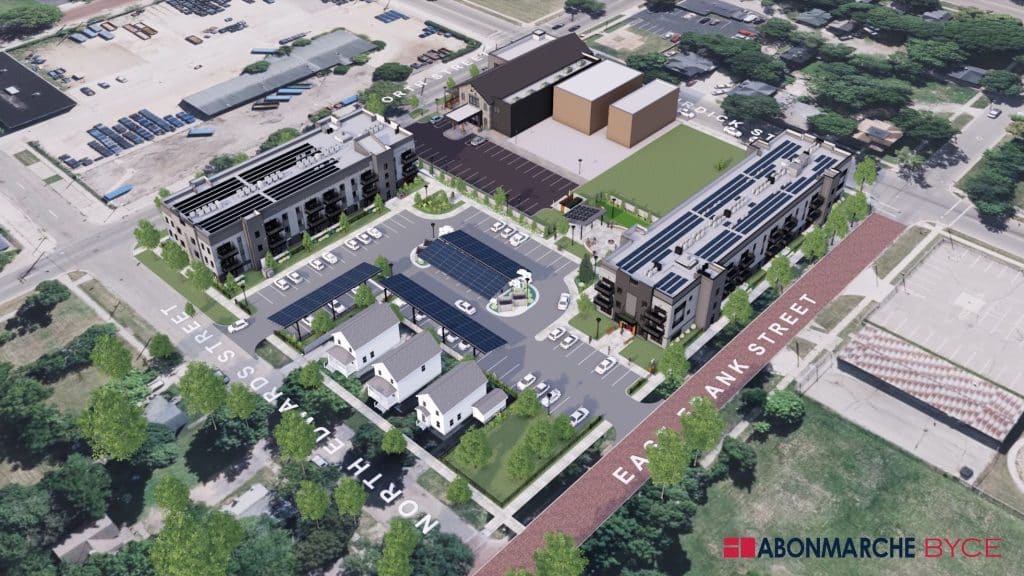
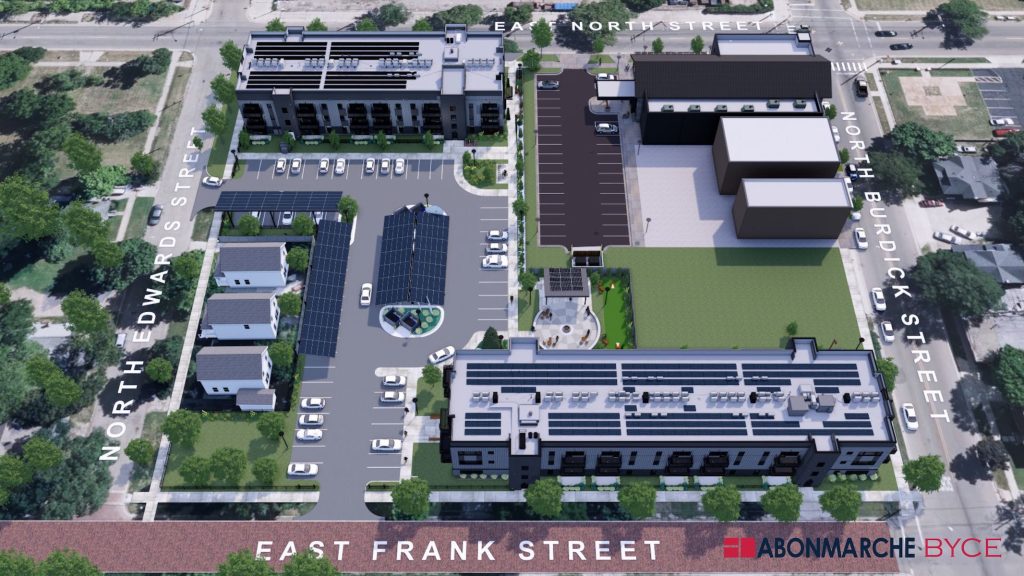
The $23 million, affordable-housing development includes two buildings. The one at 128 E. Frank St., called the North Building, will have 34 one-bedroom units and two two-bedroom apartments. It will have a community room, residential amenity spaces, a fitness center, a beauty salon/barber area, and possibly an ice cream parlor for residents. It will be built to Passive House sustainability standards, which are expected to result in lower energy costs. The project is being financed in part with 9 percent Low Income Housing Tax Credits.
A structure at 127 E. North St., called the South Building, will have 32 one-bedroom units and two two-bedroom apartments. It will feature a library, a puzzle room, and a shared roof deck. It is being financed with 4 percent Low Income Housing Tax Credits.
“The South Building will also have a three-season porch/patio area,” says architect Hayward Babineaux, project manager for Abonmarche Byce. “It will be closed in, and people can look out. It will be heated during other seasons.”
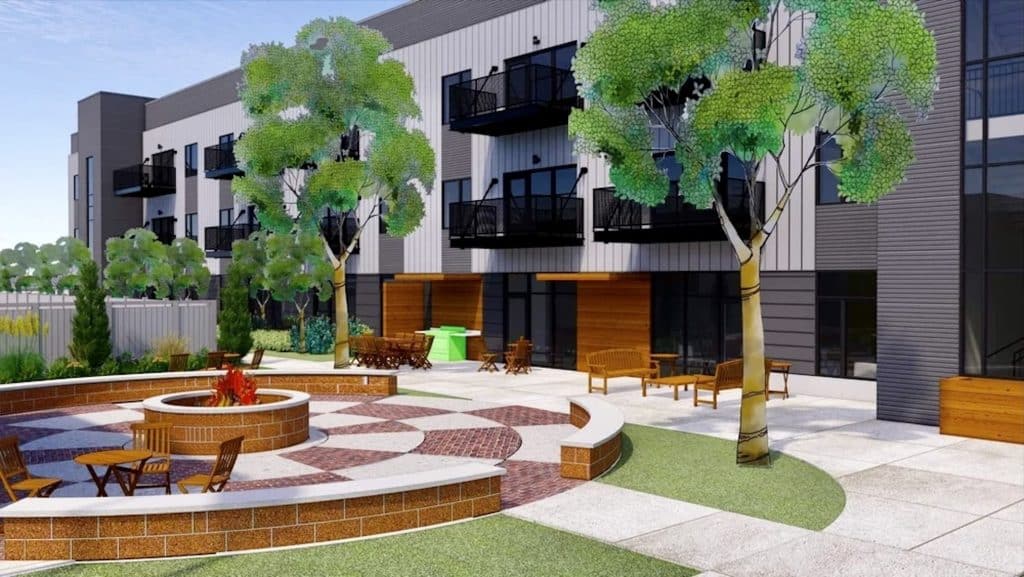
On the property outside the two buildings will be a commons space for residents that Babineaux says may include a barbecue area or a fire pit area where residents can spend time together.
Mt. Zion Baptist Church at 120 Roberson St. is about two blocks north of the senior housing development.
So what is happening now?
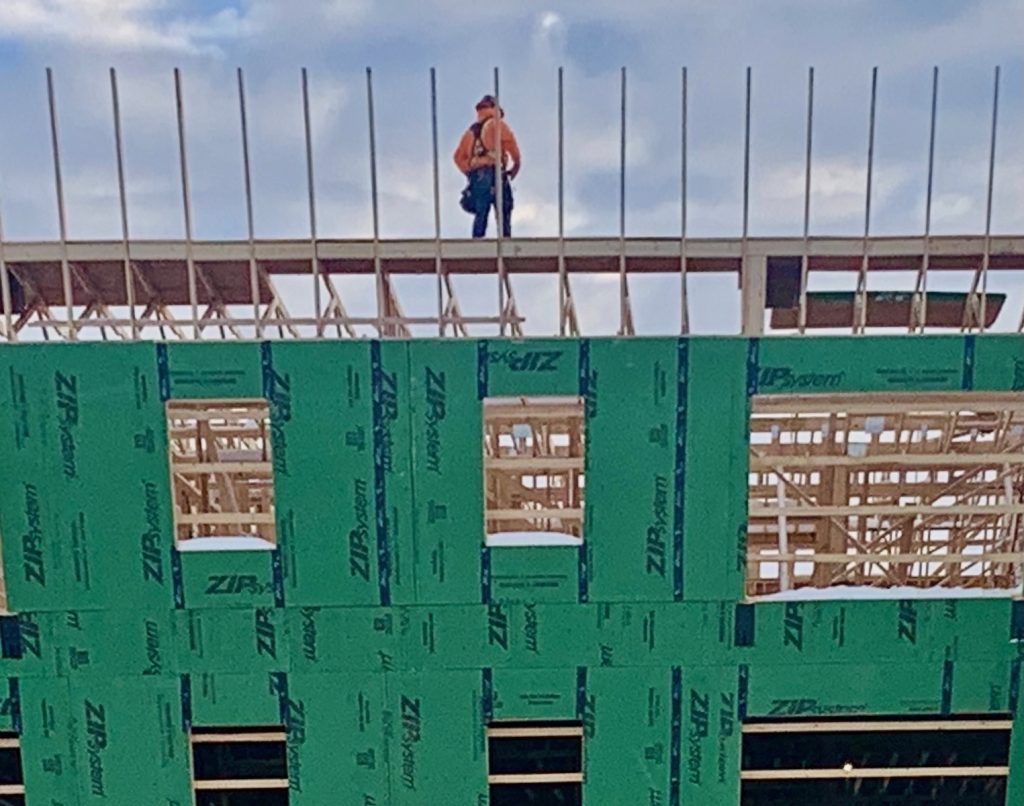
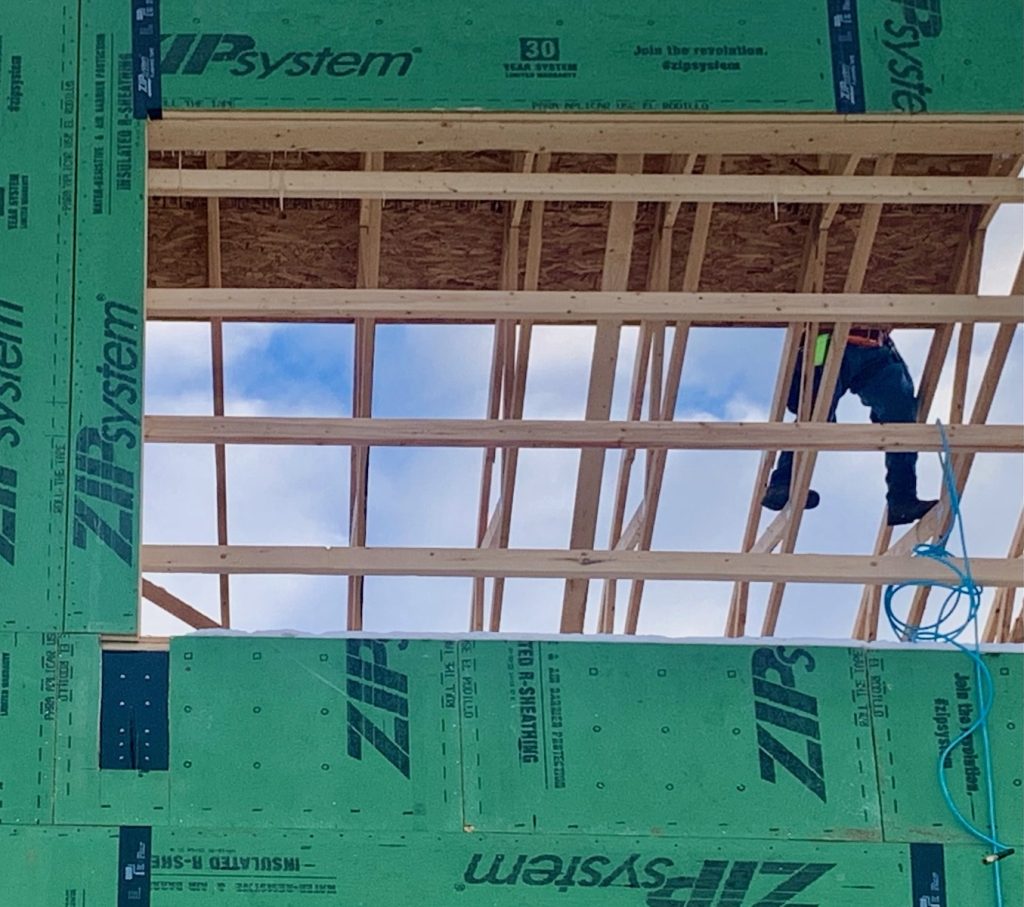
Rev. Addis Moore, pastor of Mt. Zion, says three floors are up on each building, and roofing has begun. “And they were beginning to start roofing on the North Building and then, of course, moving to the South Building. So they’re in the roofing phase right now,” says Moore.
Babineaux says, “I would say that by the end of this month, the project will be what we consider close to closed-in — where all of the walls will be up, and it should be getting windows, and the roof will be up. Probably by the end of this month or early next month, both buildings will be closed in, and they will be doing most of the work on the inside after that.”
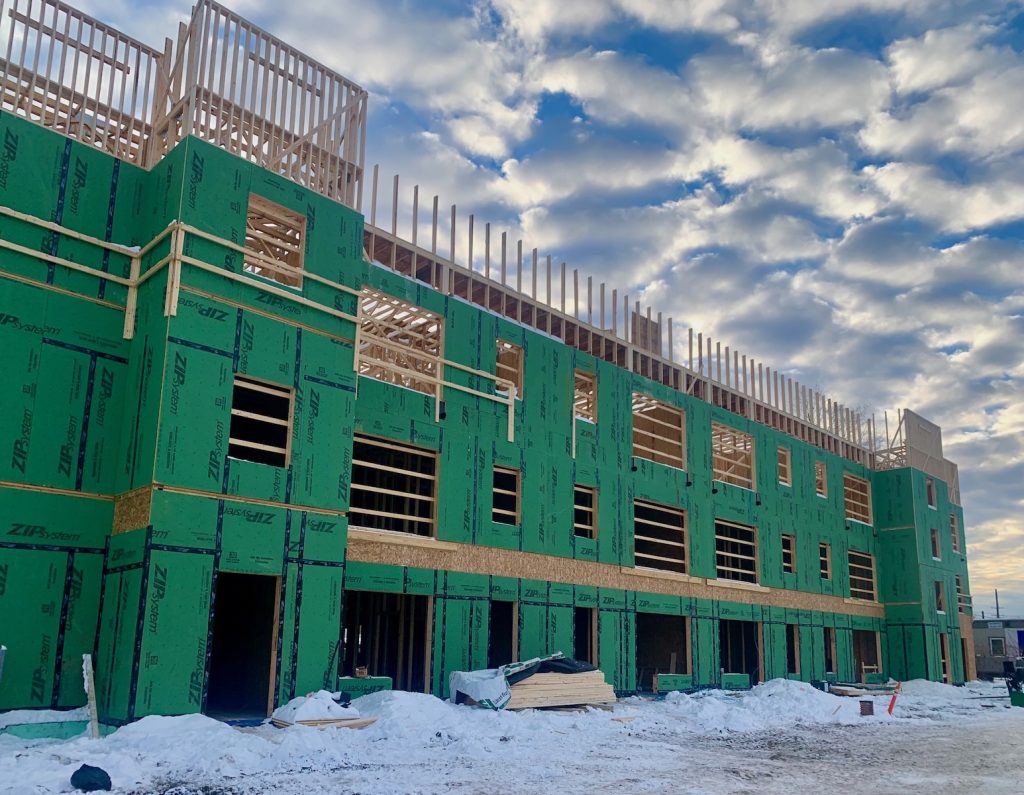
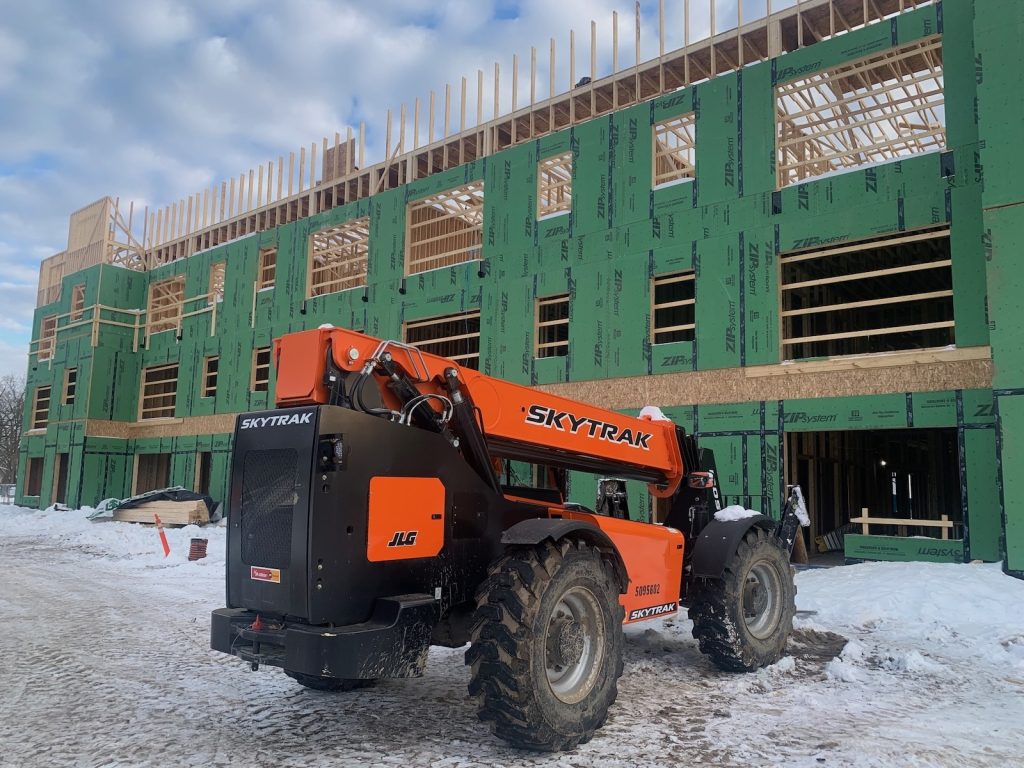
The total cost of the project, which was reported to be as high as $27 million, is expected to be about $23 million, with $18 million of that used for construction and the balance for equipment, furnishings, amenities, and other things, according to Worthams. “In terms of its budget for the project,” she says, “We are still on track. We’re doing very well with AVB and the budget.”
A ground-breaking ceremony for the project took place in March with about 200 people in attendance. Kalamazoo-based AVB is the builder. Abonmarche Byce is the architect.
Funding and financial assistance for the project have been pulled together from multiple sources, including the Kalamazoo Community Foundation, the City of Kalamazoo, and the Kalamazoo County Homes for All millage. The financing package includes more than $1 million in tax credits from the State of Michigan, two Payment In Lieu of Taxes (PILOT) agreements from the City of Kalamazoo, and a $1 million interest-free loan from the city. The PILOT agreements are expected to save the project developers millions of dollars in property taxes.
Moore says there are still opportunities to provide financial assistance for community organizations, foundations, or other philanthropic organizations to partner with the church to help with the cost of furnishings and other amenities.
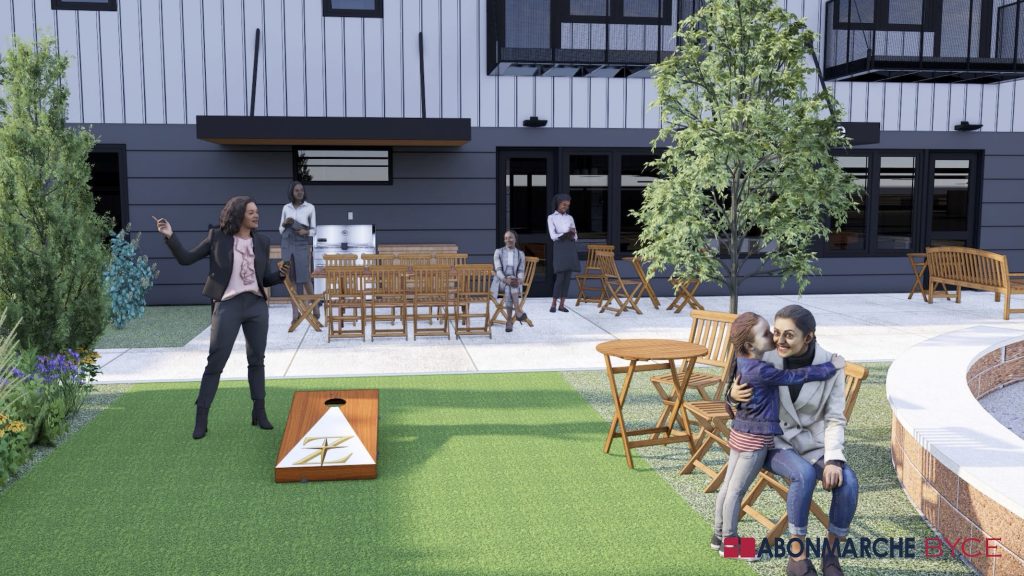
Courtesy Abonmarche Byce
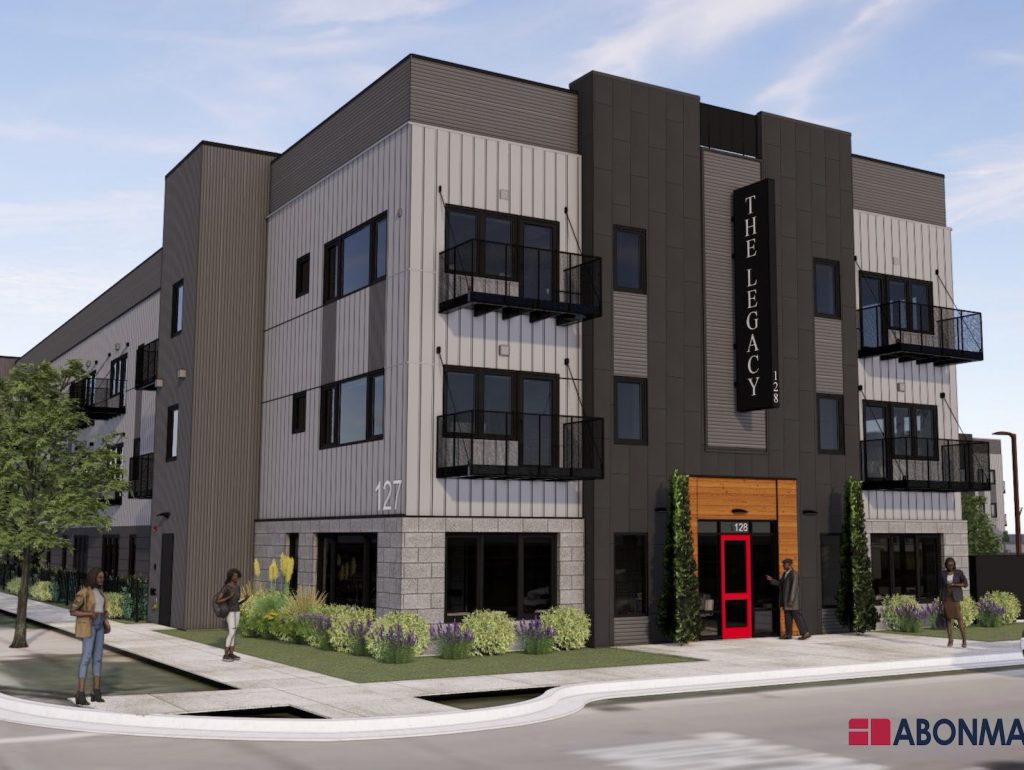
The project is intended to be an affordable-housing development for people ages 55 and older. Rents will be based on applicants’ income levels as they compare to the Area Median Income for Kalamazoo County. According to preliminary estimates, a single person who earns 30 percent of the Area Median Income, some $20,130 per year, could expect to pay about $539 in monthly rent for a one-bedroom apartment. A person making 50 percent of AMI, some $33,550 per year, could expect to pay about $898 in monthly rent. And a person making 80 percent of AMI, some $53,680 per year, could expect to pay about $1,438.
A person who makes 20 percent or less of AMI, about $13,420 per year, could expect to pay about $359 in monthly rent.
Lansing-based KMG has been hired to be a third-party ongoing manager of the property, Worhams says. Applicants will be screened by KMG on a first-come, first-served basis. “And so what we’ll do here at the church, probably at the beginning of the year, is we’ll take initial applications. We’ll forward it to them (KMG). They will be put into the system to make sure that the individuals are qualified based on all the formularies that people need to meet to be able to get in.”
Neither Mt. Zion nor any of its partners will be able to place residents in the apartments, Worthams says. “It has to go through the process because there will be some MSHDA (Michigan State Housing Development Authority) funding used.”
The process will include a general screening application, and subsequently, a more lengthy application required by MSHDA. “We will have those details hopefully within the next week or so, in terms of actual deadline and the process from Mt. Zion to MSHDA,” Worthams says. Moore says, “We will announce that when that process begins because we’re still working out details with our property manager at this time.”
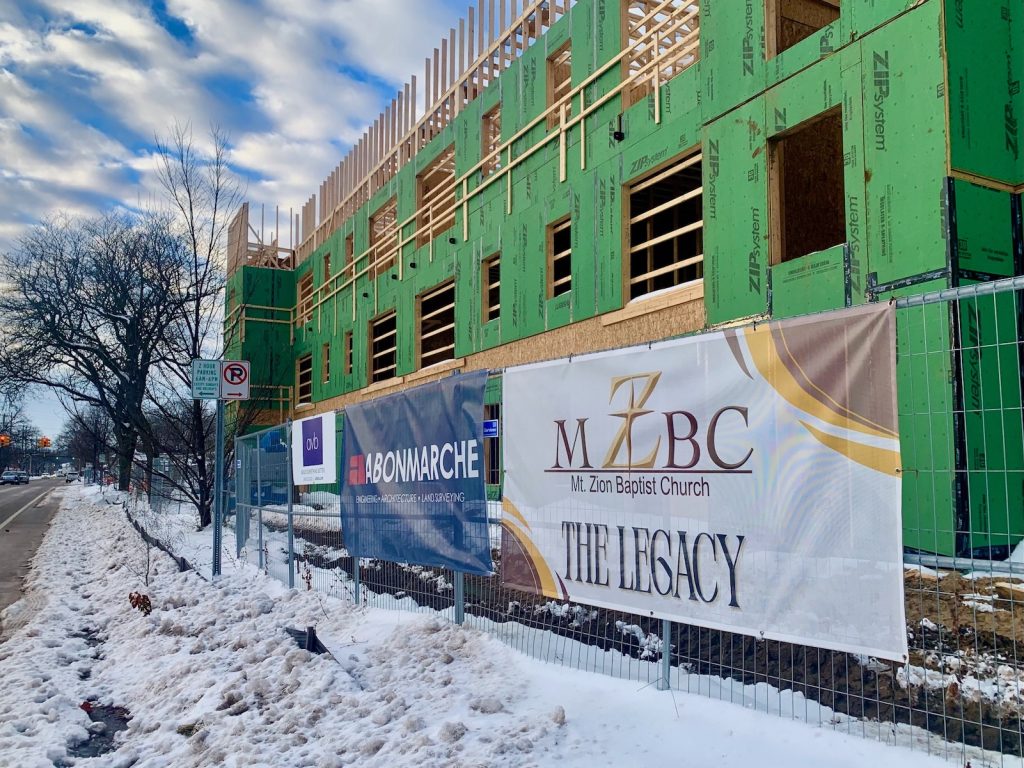
According to information provided by Mt. Zion and Edison Community Partners, the project aims to provide high-quality, energy-efficient housing while fostering community engagement and revitalization.
Babineaux says people can be excited “about the fact that we are providing a project that will have some affordable units. But not only that, the project has sustainable design elements to it that will help cut down on electric bills and things of that nature, because we’ll have solar panels on the roof that will help out with energy consumption. There’s going to be no gas on site. Everything will be electric. The project is not just affordable housing; a lot of the sustainable design aspects of the project will also help reduce utility bills.”
Some utility costs may be included in the monthly rent.
Moore says he expects the project to attract seniors who are living with family members but who want to live independently, those living in places that need a lot of repair or upkeep, and those living in places that are not safe.
“I think it’s attractive to an elderly population that wants to feel safe, that wants to feel a sense of community, and particularly to those individuals that are living alone,” Moore says. “It’s definitely attractive to them.”
Some rooms will be ADA-compliant and handicapped accessible.
Elevating the community
Legacy Senior Living will put back into use several parcels of vacant land between the 100 block of East Frank Street and the 100 block of East North Street that Mt. Zion had purchased over many years.
Moore says the project’s progress is generating excitement from church members and community residents, “particularly now because everybody sees the buildings going up and it’s not just a thought now. It’s not a dream. It’s a reality. Folks see it coming to fruition, and so it’s really becoming quite real to individuals now.”
Mt. Zion Baptist Church has a total congregation of about 1,700 people, seeing about 800 active members on any given Sunday. Moore, who has been senior pastor of the church for about 31 years, is an advocate of church members and the community doing more to elevate everyone, saying, “We’ve just got to do more ourselves and invest in ourselves and do everything we can to lift up our people so we can become who we should become.”
The church has more property that it has not yet redeveloped. A possible use of that property would be the future development of a stand-alone site for the church’s preschool program. The preschool program now accommodates about 40 youngsters ages 3 and 4 on the lower level of the church. The program opened in 2014.
“Ninety percent of the 3- and 4-year-olds in our community were not privy to a preschool to get them ready for kindergarten and school,” Moore says. “So the church established its own.” Now, he says, “We’d really like a stand-alone facility for that.”
No solid plans for the preschool have yet been made, however.
Speaking of the Northside, which has the city’s highest concentration of African-American residents, Moore says he would like to see the neighborhood become one that people show off when visitors come to town. And he thinks the Legacy Senior Living project will help the transformation.
“There have been some projects like the Family Health Center (which has received millions in new investment over the years),” he says. “But when you look at the magnitude of this project as far as housing is concerned, and look at where it is located as soon as you enter the Northside, and the way it is going to look, it’s going to hasten the transformation of the Northside. And I believe it’s going to spur others to do more on this type of level to make sure our community is what it should be.”
Author

Related Articles
Housing pros answer the question: Are these places really affordable?
How do you define “affordable housing”? It turns out there is a precise definition.
Collaborative collisions: Entrepreneurs ‘Reach Forward’ to find new opportunities and connections in Kalamazoo
The Reach Forward Conversations Event brought local entrepreneurs, product sellers, and buyers together to spark connections that could lead to contracts, growth opportunities, and stronger small-business networks in the Kalamazoo area.
Day-to-day interactions with happy customers keeps Pastrami Joe’s owner going
In 2022, Andrew Scibbe’ purchased Pastrami Joe’s Deli in Marshall. Two years later, he reopened a second location in downtown Battle Creek.