Early childhood millages strengthen childcare system
Kalamazoo childcare millage would be a test case for the state.
Across Michigan, families face a difficult reality. Childcare is often too expensive to afford, while providers struggle to cover costs and pay workers sustainable wages.
“The average cost of childcare is very high, but at the same time the workforce is just not paid for the essential work that they’re doing,” says Anne Kuhnen, policy analyst with the Michigan League for Public Policy.
When Kalamazoo County voters head to the polls Aug. 4, they will decide whether to create a dedicated local funding source for childcare, one of the community’s most pressing challenges. Only three other Michigan counties currently have a dedicated childcare millage: Kent, Leelanau, and Benzie.
Supporters of the proposed early childhood millage say the initiative would help address a system that is becoming increasingly difficult for families to afford, providers to sustain, and educators to remain in. If approved, the millage would generate funding to support childcare access, affordability, workforce retention, and other early childhood needs identified by the community.
Under the proposal, a 0.5-mill property tax would generate an estimated $6.3 million annually for 10 years to support services and programs for young children and their caregivers. For a home with a taxable value of $100,000, the millage would cost approximately $50 per year.
The proposal emerged through collaboration among the Southwest Michigan Child Care Coalition, the Kalamazoo Child Care Coalition, local organizations, providers, employers, families, and community leaders. Advocates say the effort reflects a growing recognition that childcare is not simply a family issue, but an economic and community issue that affects everyone.
A system under strain
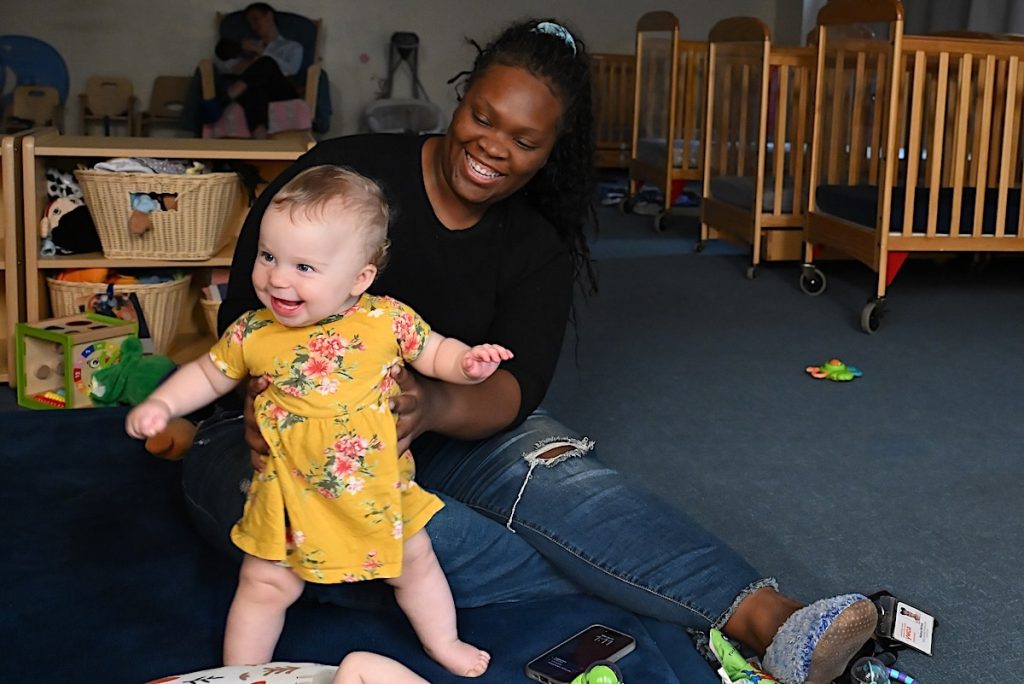
According to the Kalamazoo Child Care Coalition, childcare providers are among the lowest-paid workers in the region. In 2023, 71% earned less than $15 per hour, despite the critical role they play in supporting children’s development and family stability. Kuhnen notes that the median wage for a childcare worker in Michigan is approximately $15 per hour, well below the statewide median for workers overall. Many workers also lack access to benefits such as paid leave, health insurance, and retirement plans.
For families, the challenge often begins with finding an available slot.
“It’s really difficult to be able to get your child in care, period, and then to be able to sustain their care financially,” says Susan Rosas, CEO of YWCA Kalamazoo.
Coalition leaders say the challenge is particularly severe for families with infants and toddlers. Waiting lists for infant and toddler care often stretch to 12 months, requiring parents to begin searching for care long before a child is born. Even families who qualify for assistance frequently face administrative barriers and uncertainty navigating eligibility requirements and support programs. At the same time, providers are navigating rising costs, workforce turnover, and increasing demand.
“Families can’t afford to pay and teachers can’t afford to stay,” Rosas says.
Beth Berglin, director of policy and strategy at Michigan Transformation Collective, says those challenges are especially acute for providers serving low-income families. Michigan’s childcare reimbursement rates have remained largely stagnant while operating costs and wages have continued to rise, forcing some providers to limit or stop accepting subsidized children altogether.
Building a local solution
Supporters say the proposed millage was designed to address multiple parts of the childcare ecosystem simultaneously.
“We have to make sure that care is more affordable for families. We must,” Rosas says. “And we have to make sure that providers can sustain these classrooms and keep people employed. You can’t have one without the other.”
Unlike funding approaches focused on a single program or population, coalition leaders intentionally designed the proposal to remain flexible over time.
“This millage is designed for flexibility with changing need in the community,” Rosas says.
The coalition’s priorities include lowering childcare costs for families, increasing wages for educators, supporting providers serving low-income children, and improving families’ ability to navigate and access available care options. Both Rosas and Berglin say the proposed millage is also the result of extensive community collaboration.
“I think it’s really been a beautiful demonstration of how when there is this big collective issue, we can all inform what a collective solution might look like,” Rosas says.
Berglin says the coalition drew on partnerships spanning workforce development, housing, transportation, public health, and economic development sectors.
“We were able to have a broader conversation than we were ever able to have in the past,” she says.
Childcare is an economic issue
While childcare is often discussed as a family support service, Berglin says its effects ripple throughout the economy. Advocates say inadequate childcare comes with significant economic consequences. According to coalition materials, Michigan’s infant and toddler childcare crisis results in an estimated $3 billion annually in lost earnings, productivity, and revenue.
“Our providers need support from the community,” says April Goodwin, executive director of Southwest Child Care Resource and Referral. “If your employees don’t have childcare, many of them can’t come to work.”
Goodwin says inadequate childcare contributes to workforce participation challenges, particularly for women, who are often forced to reduce work hours or leave the workforce entirely when care is unavailable. Mothering Justice sees the Kalamazoo proposal as part of a broader movement to recognize childcare as critical infrastructure.
“This millage will help reduce that cost for our families while also trying to find new funding streams that will improve the quality of care for the early childhood workforce,” says Terrell Couch, policy and engagement manager for Mothering Justice.
Couch says communities across Michigan are increasingly pursuing local funding solutions because families and employers alike understand the economic consequences of an underfunded childcare system.
“Communities want this to be an issue that we’re focusing on,” Couch says. “We’re seeing communities and people that look like us really stepping up and saying this is the priority.”
A recent Michigan State University study found that families living farther from licensed childcare providers are significantly less likely to participate in the workforce, with women experiencing the largest declines in labor force participation. Couch notes that childcare is connected to multiple policy areas, including workforce development, maternal health, economic growth, and family stability.
“Childcare is also a maternal health issue. It is ensuring that our mamas have that one extra hand of support in their village when they need to go to work,” Couch says.
Local action with statewide implications
While advocates applaud local initiatives, many caution that county-level millages cannot fully solve a statewide challenge. Kuhnen points out that Michigan lacks a dedicated early childhood funding source similar to the School Aid Fund that supports K-12 education.
“I think the potential is really in addressing the inaction of state and federal lawmakers,” Kuhnen says.
She points to Kent County’s Ready by Five millage as an example of how local funding can support prenatal services, developmental screenings, home visiting programs, and early literacy initiatives. However, she also warns that relying solely on local funding can create inequities because some communities have stronger tax bases than others. Couch agrees.
“Families shouldn’t just have to live in certain cities to ensure that they have affordable, high-quality childcare,” he says. “The state again has a role to play in this.”
Berglin says Kalamazoo’s coalition hopes the county can serve as a model for what targeted local investment can accomplish.
“We can also be a test case for the state,” Berglin says. “Look at what this community has done. Look at this economic evidence. Look at what has happened for families. Look at what has happened for teachers.”
Advocates from all three organizations say the growing number of communities exploring local early childhood funding should signal to lawmakers that more sustained state investment is needed.
“This is certainly a signal that early childhood funding is important for communities,” Kuhnen says. “It’s important for families, employers and the local economy.”
Supporters argue that the gap is particularly noticeable for children younger than age 3. While Michigan has expanded access to preschool through programs such as the Great Start Readiness Program, coalition leaders say comparatively few public resources are invested in services for infants and toddlers.

What success could look like
If the millage passes, supporters say success would be measured in both immediate and long-term outcomes. In the short term, Goodwin hopes to see fewer provider closures, stronger workforce retention, and shorter waitlists for families seeking care. Long term, coalition leaders envision a system where families can find the care they need, educators can build sustainable careers, and communities can better support children during their earliest years.
“We want to be able to show what wrapping our arms around families of young kids and the early childhood system looks like for a community,” Berglin says. “And to prove to the state that this is economically one of the best investments that we can make with our tax dollars.”
Coalition leaders say the millage would provide a long-term, dedicated local funding stream focused specifically on lowering childcare costs, increasing provider wages, and helping families find available care. For Rosas, the first measure of success will come at the ballot box.
“The shortest-term success,” she says, “is that Kalamazoo voters show up and make sure this thing passes on August 4.”
Photos by John Grap.
Early Education Matters shares how Michigan parents, childcare providers, and early childhood educators are working together to create more early education opportunities for all little Michiganders. It is made possible with funding from the W.K. Kellogg Foundation.
Author

Related Articles

Is PreK for All meeting its goals?
Roadmap co-author encouraged by how the state is expanding its Great Start Readiness Program into universal pre-K.
Michigan’s free universal pre-K program could serve 70,000 4-year-olds this school year
Launched in 2023, PreK for All now has no income qualifications.

The Farm Bill, SNAP, and the childcare connection
SNAP helps families meet all basic needs, including childcare.