
KALAMAZOO, MI – Among residents of established neighborhoods, the conversation goes something like this:
“It sure would be nice if someone did something with that abandoned house.”
“Which one?”
“The one at the end of the block. And the two that were damaged by fire last year. And the overgrown land where that elderly couple used to live.”
Enter the Kalamazoo County Land Bank, a 16-year-old, quasi-governmental agency that tackles property and housing vacancies after tax foreclosures in order to stabilize neighborhoods.
“Historically, it’s been our work to take tax-foreclosed properties that don’t sell at tax auction,” says Executive Director Zac Bauer. “And our community has said we want to see a reduction in tax foreclosures. So now what we are doing — while we still receive a couple of properties for tax foreclosure every once in a while — the majority of our work now is to do strategic acquisitions with funding from local philanthropy, from the State Land Bank, or from Kalamazoo County or City government.”
At present, the Land Bank has a portfolio of 322 land parcels in Kalamazoo County. Of those, 279 are in the City of Kalamazoo.
Fully explained, Bauer says, the organization’s mission “is to create vibrant communities by eliminating blight, expanding affordable housing, and stabilizing property values.”
The Land Bank is focused on properties that are no longer serving their intended purpose or that have become blighted. “And so our work is to take something and through stewardship, prevent speculation, to really prioritize community involvement in the redevelopment, and redeployment of that property,” Bauer says.
Often working with other organizations, the Land Bank serves as a behind-the-scenes property developer, a housing renovator, and residential landlord. It also strives to provide housing opportunities that allow renters to evolve into homeowners, and connect struggling homeowners with services that can keep them in their homes.
While it continues to work with neighborhood organizations to reclaim and redevelop unused properties with one-, two- and five-parcel projects, a large part of its energy this year is being spent on its Homeward Promise Project, a rather large-scale project – repurposing 57 properties. The Kalamazoo County Land Bank Authority acquired the properties on Jan. 31, 2023 to prevent them from losing value and to ensure they “remain affordable and available for potential owner-occupancy.”

All of the residential properties are in the Edison Neighborhood. Twenty-eight of them have been used as rental properties sold by a retiring landlord. The rest were unoccupied houses. All were purchased with the help of a $4.5 million grant (being paid over three years) from the Stryker-Johnston Foundation.
The goal of the project is to rehabilitate the properties to provide more opportunities for low- and moderate-income people to become homeowners. That expands the behind-the-scenes work it has traditionally done – collaborating with developers, nonprofit organizations, small businesses, and area residents.
“We took them on because the market itself wasn’t improving the situation,” says Bauer, who ended his first year with the Land Bank on Oct. 4, 2025. He says the houses were in need of love “and we saw ourselves playing that role while preventing anyone from being displaced from their homes.”
The Land Bank is working with Seven Generations Architecture + Engineering, as well as Kalamazoo Contractors and Developers Connect, and other contractors to rehab the houses and make them available for home-ownership or rental, Bauer says. Among those that have already had some internal or external work in order to allow tenants to stay or return quickly is a house that is being rented on March Street, and another to be rented at 915 Clarence St.d another at 1420 March St.
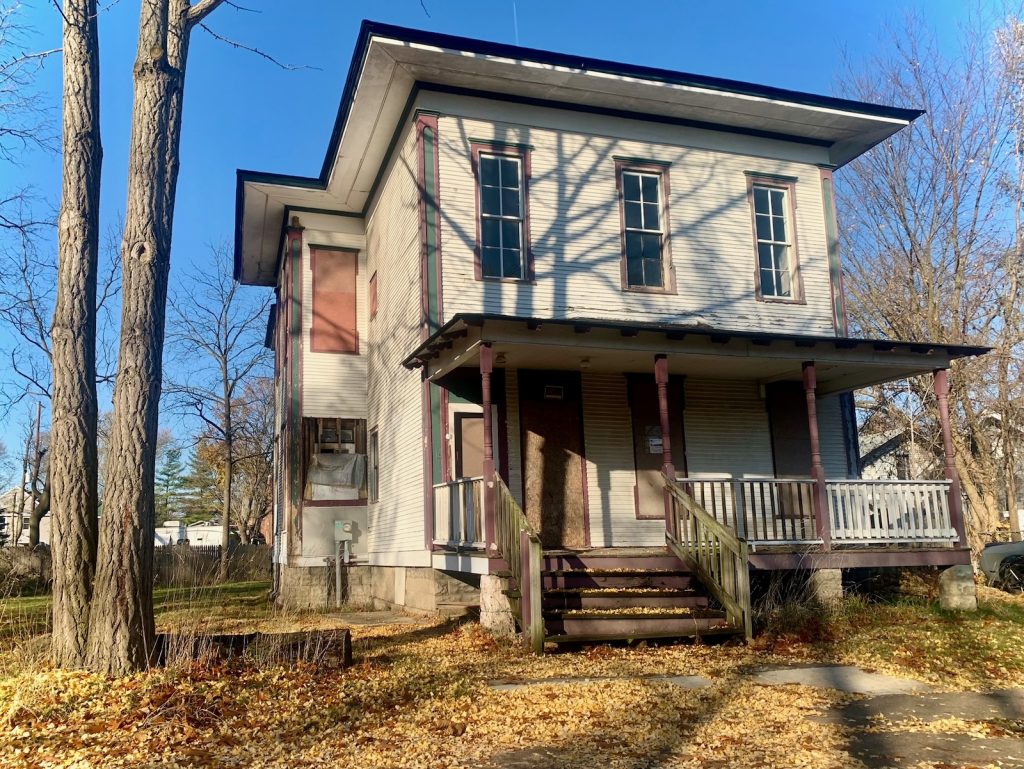
Derek Mann, deputy director of the Land Bank, says a third, unoccupied house at 1212 Brownell St., may be renovated for use as a stacked duplex (one unit on the ground floor and the other on the second floor). It is a single-family, Italianate-style home that needs extensive renovation. It is expected to have a two-bedroom rental space on each floor.
“It’s the most historic, most beautiful home I think in our portfolio, truthfully,” Mann says. “And so we thought that although it is a little bit rough, it would be a shame to see it squandered.”
He says the house will be renovated in a step-by-step process, with the exterior requiring new windows, a new roof, new soffits, new fascia, and new siding.
I’yanna Wilson, operations coordinator for the Land Bank, says, “This was owned by one of the first families of Kalamazoo. It was their daughter’s home.”
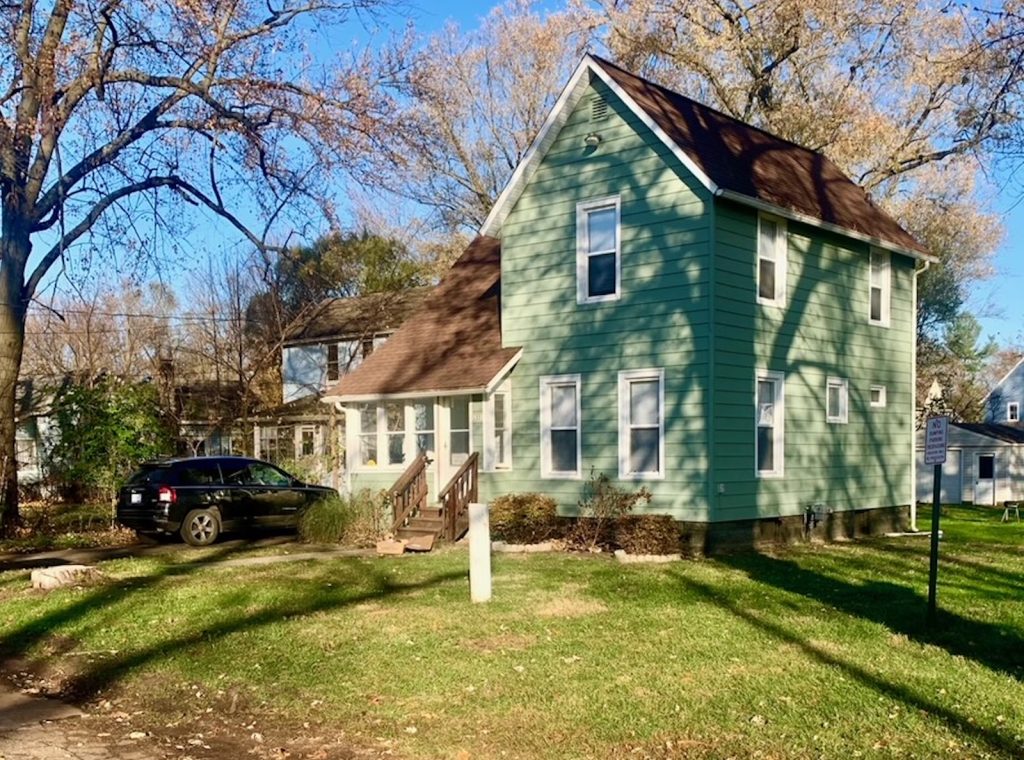
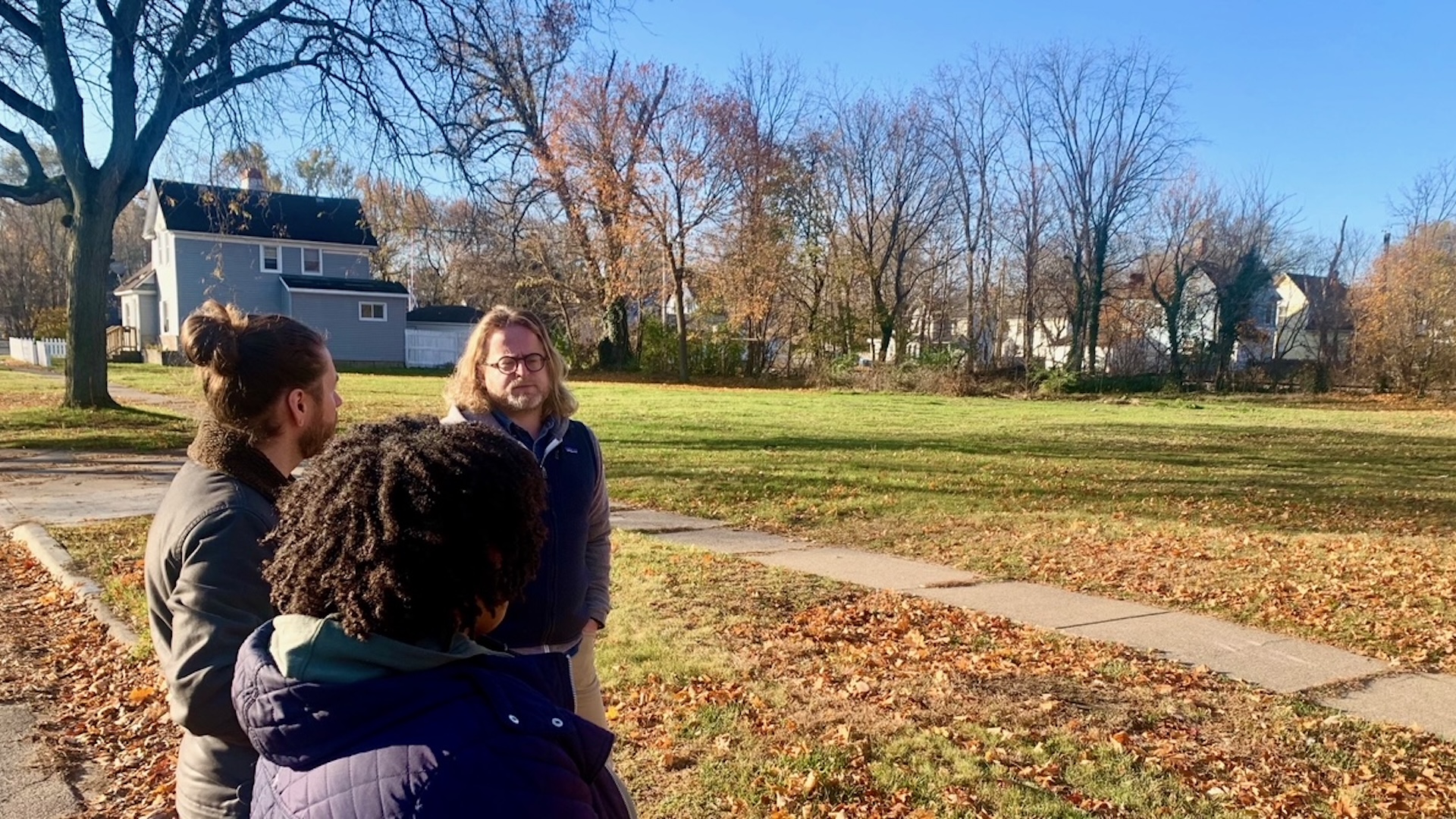
The staff of the Kalamazoo County Land Bank works in the background on lots of collaborative home-building and renovation projects. Photo: Al Jones
For several generations, the Brownells owned a farm that encompassed the land around the 1200 block of Brownell Street. As a wedding gift for their daughter, her parents built the house at 1212 Brownell. It’s across the street from the parents’ house, and that house is still standing and occupied today.
Wilson describes the unoccupied house at 1212 Brownell as really cool. But she says, “We really have to get into this home and assess the condition. … We think it was more of a holding spot for extra (construction and repair) materials that the seller (a former landlord) needed later.
“It’s a really spacious home,” she says, “and so we’re (asking ourselves) ‘How can we re-imagine this and put it to good use?’ And create a little bit of density as well.”
Many communities are encouraging the creation of higher-density housing, such as duplexes and townhomes, so the limited amounts of space in urban areas can be put to better use. Communities are also adjusting to changing lifestyles where couples have fewer children and less need for standalone, single-family homes.
The Land Bank also hopes to use pre-approved housing plans from the City of Kalamazoo to build housing on three adjoined parcels of land at the corner of Clarence and Garden streets in the Edison Neighborhood. The site held three dilapidated and unused houses.
“Trying to rehab 57 homes is a pretty big project,” Bauer says. “This year, we plan on releasing several RFPs (Requests for Proposals from service providers) for rehab of these homes.” He says he hopes to get at least seven of them occupied and back on the city’s tax rolls by next year.
At the same time, he hopes to increase area residents’ access to affordable, high-quality housing. He says the Land Bank is seeing more longtime landlords sell off their closely held rental portfolios and exiting that business. “And so this is a way for us to ensure that speculation is not driving the market,” Bauer says.
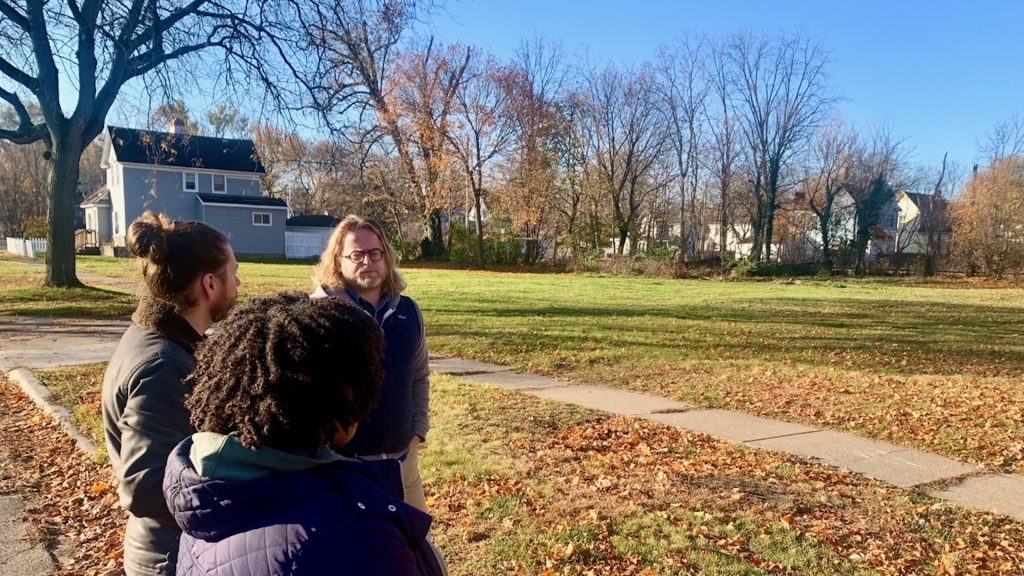
The Kalamazoo County Land Bank Authority was created in 2009 to address tax-foreclose situations where the risk of investing (the potential for loss) was too great to attract independent developers, or where city or county governments lacked mechanisms to address certain situations. It has tools to acquire, develop or sell properties in a way to meet county or city needs, Bauer says.
The Land Bank functions with a four-person staff. They operate with a just-approved annual budget of about $6 million. Along with Bauer, the staff includes: Deputy Director Mann, who has a specialty in building trades; Operations Coordinator Wilson, who helps facilitate community engagement work; and Property Manager Tracy Whaley, who interacts with tenants and oversees leasing and rental issues.
The Land Bank has an independent board of directors. Its members are appointed by the Kalamazoo County Board of Commissioners. Kalamazoo County Treasurer Thomas Whitener currently chairs the seven-member board. The organization is funded by:
- A 5/50 tax — For five years, it is allowed to capture 50 percent of the property taxes of certain properties it sells;
- Income from its portfolio of rental properties. It presently has 25 active rental properties, all in the City of Kalamazoo;
- Revenue from the City of Kalamazoo and Kalamazoo County;
- Support from local philanthropic organizations.
Eastside condos for sale
The Land Bank is also working to sell five condominiums in a six-unit site-condo project it developed with the Kalamazoo Eastside Neighborhood Association at 1601 E. Main St. One of the six units in Eastside Square has been sold. The development has one- and two-bedroom income-restricted units that average about 1,200 square feet. The property, which also has 1800 square feet of commercial space to be filled, has been on the market for about a year. Although he did not name them, Bauer says his organization is in negotiations with a prospective commercial tenant.
Two of the six units are intended to house a family with an annual income that is 60 percent or less of Kalamazoo County’s Area Median Income. Two others are intended for a family earning 80 percent of AMI. And two are expected to accommodate a household earning 120 percent of AMI. Eighty percent of the Area Median Income is about $55,000 for a household with one individual and $79,000 for a family of four. The units are expected to sell in the $140,000 to $145,000 range.
“These are reasonably priced, brand new construction,” Bauer says. “This is really in the vibrant Eastside Neighborhood, which has always been a great place for families to raise kids, but is now getting even more vibrant as some corridor improvement has been completed.”
Eastside Square is part of the ongoing effort to develop more affordable, mixed-income housing, as well as new space for attractive businesses. The condo project converts land parcels that had two houses into space that will now house six families or individuals.
“From a density standpoint, that takes some of our most valuable resources, which is land, and uses it to the max,” Bauer says. “So we can house more people in high-quality, safe, affordable housing. We can support the local economy by having affordable commercial space available, and it also supports the city by ensuring that we’re taking a place with two single-family homes and essentially turning it into six.”
What is the housing density strategy?
Speaking of the creation of higher-density housing, Bauer says, “I think it’s a question of how our demographics are changing and also, as a result, how our needs for housing are changing. In the past, we had families with a large number of children. The way the nuclear family looks now is you are more likely to be a non-married couple or a cohabiting couple with no children or one child.”
He says the housing that would support multi-child families is less needed now. In the meantime, the Land Bank is focused on redevelopment done in collaboration with community organizations.
“It always begins with the neighborhood association,” he says. “We start there. The Land Bank doesn’t control zoning or any of the rules around developing. That’s really the city. So we start with the local organizations. We bring in the city. We bring in the county. And that’s when we start developing an approach to ensure we can responsibly get input from the neighborhood.”
The organization’s goals?
Bauer says he expects to have RFPs (requests for proposals) for at least seven of the 57 Homeward Promise properties out by the end of this year, and to have those properties redeveloped and on the market by early 2026. He also looks forward to:
- “Working more closely with organizations like Kalamazoo Climate Crisis Coalition “to ensure that we are introducing energy-efficiency and green technology into our construction and ensure that Kalamazoo County is leading the way with energy efficiency and green-build.”
- Working more closely with organizations like Kalamazoo Neighborhood Housing Services, “to make sure their pipeline of housing-ready residents have a place to step into when they want to make their first home purchase.” It also plans to work more closely with Community Homeworks, “to ensure that we can serve as a conduit for state funding for their home repair program. They are vital for folks. The average house in Kalamazoo is 50 years old.”
And Bauer says the Land Bank will continue to largely be a background player in local redevelopment and land-acquisition projects.
“We don’t say a lot,” Bauer says. “We’re not in the public a lot, but we’re always working behind the scenes to ensure that the land in our community that’s being underused has a vibrant future in housing and economic development.”
He says, “We’re the quiet partner in the equation. We hear when things go wrong. And very rarely do people pick up the phone and tell us when things go right.”
Author

Related Articles
With a new apartment building in the Vine Neighborhood, Open Doors now serves about 100 households
Vine is a perfect neighborhood for Open Doors, with local shopping, culture, and services nearby.
New Eastside Square Condominium project is a creative housing effort inside and out
Three of the six condominium units in the new Eastside Square Condominium development are occupied. Two more expected to be purchased soon.
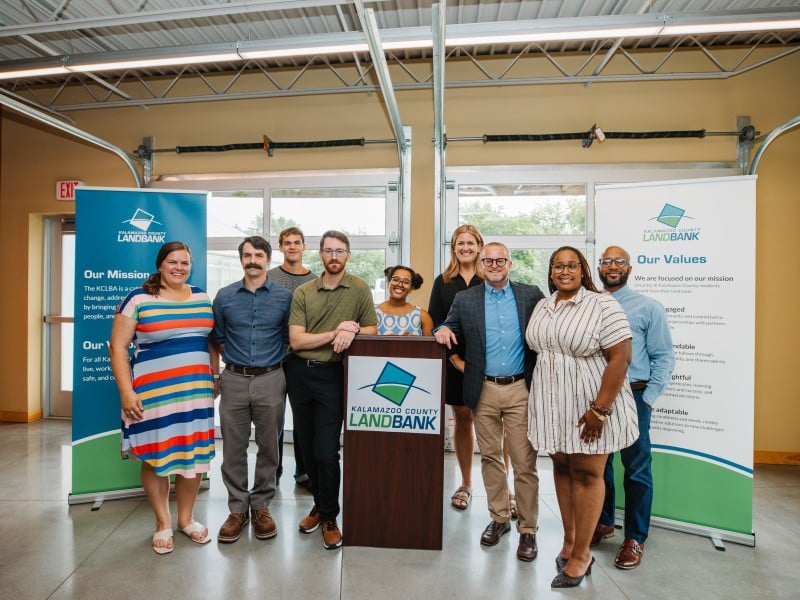
New 5-year plan means the Kalamazoo County Land Bank is thinking more than one house at a time
The Land Bank plans to expand its focus by working to find solutions that lay the groundwork for stronger communities.